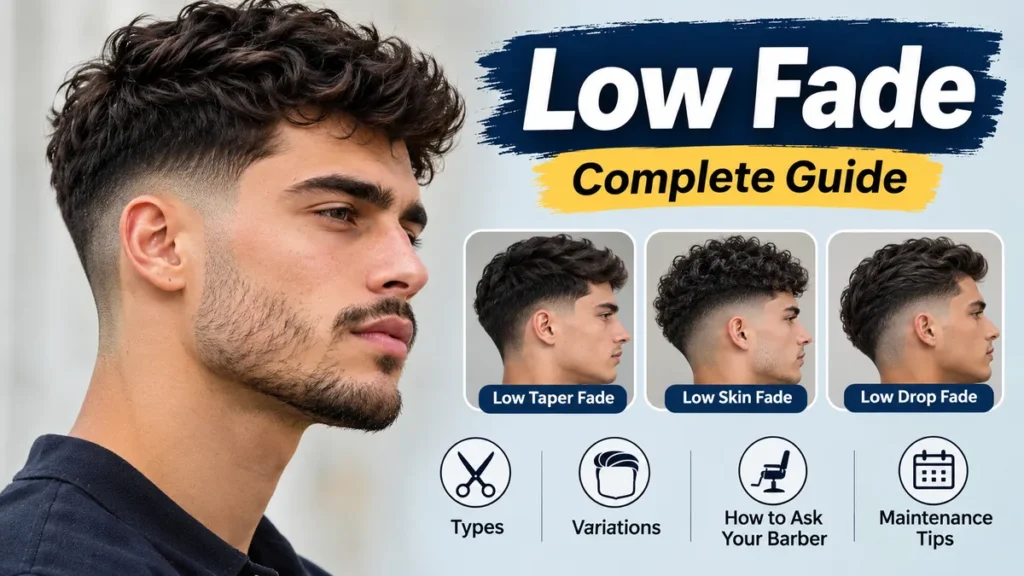
A low fade is one of the most versatile men’s haircuts because it creates a clean, modern appearance without removing too much hair from the sides. It works with short crops, textured tops, curly hair, and longer hairstyles, making it a practical choice for different hair types and personal styles.
Unlike a high fade that creates a dramatic contrast, a low fade keeps the transition close to the ears and neckline. The result is a subtle, balanced haircut that can look professional, casual, or edgy depending on how the top is styled.
A low fade is a haircut in which the hair gradually transitions from very short near the ears and neckline to longer hair higher up the sides and back. The fade begins low on the head, preserving more hair around the temples and upper sides. It suits straight, wavy, curly, and coily hair.
What Is a low fade Haircut?
A low fade is a barbering technique that gradually blends hair from a shorter length near the bottom of the head into longer hair above.
The defining feature is the position of the fade. Instead of starting high above the temples, the transition remains close to the natural hairline around the ears and lower back of the head.
A typical low fade includes three main elements:
- Short lower section: Hair around the sideburns, ears, and neckline is trimmed closely.
- Gradual transition: Clippers and blending techniques create a smooth change between lengths.
- Longer upper section: Hair around the upper sides and crown retains more length, creating a natural shape.
The exact result depends on the clipper guards, blending technique, head shape, and hairstyle on top.
Why Is the Low Fade So Popular?
The appeal of this haircut comes from its flexibility.
It creates a neat outline without requiring the extreme contrast associated with some modern barbering styles. A low fade can also complement both traditional and contemporary haircuts.
Its main advantages include a subtle appearance, compatibility with different hair textures, and the ability to pair with a wide range of top hairstyles.
However, the short sections grow out relatively quickly. Anyone who prefers a consistently sharp fade will need regular barber visits.
Different Types of Low Fade Haircuts
Not every low fade looks the same. Barbers can adjust the starting length, transition height, and blending technique to create several distinct variations.
1. Low Taper Fade
A low taper fade concentrates the shortest transition around the sideburns and neckline while leaving more hair along the sides.
It is especially suitable for people who want a subtle, tidy haircut without exposing much scalp.
A taper and a fade are not technically identical. A taper generally focuses on specific edges, while a fade can extend more broadly around the sides and back.
2. Low Skin Fade
A low skin fade, sometimes called a low bald fade, blends the hair down to bare skin near the bottom.
The transition gradually becomes longer as it moves upward.
This produces a more noticeable contrast than a low fade that finishes at a short clipper length.
The style is particularly effective when paired with a textured crop, short quiff, or defined curls.
3. Low Drop Fade
A low drop fade follows a curved line that descends behind the ears toward the back of the head.
Rather than maintaining the same horizontal height, the fade drops lower around the occipital area.
This shape can complement the natural contours of the skull and preserve more hair toward the back.
4. Low Burst Fade
A low burst fade creates a curved, semicircular transition around the ear.
Unlike a conventional fade that continues around the entire head, a burst fade often leaves more length toward the back.
It is commonly paired with mohawks, mullets, and other hairstyles that emphasize the center or rear section.
5. Low Fade With Textured Top
This variation combines closely blended sides with deliberately textured hair above.
The top may be styled using matte clay, texture powder, or a lightweight styling cream.
It works particularly well with straight or wavy hair because texture creates movement and visual separation.
6. Low Fade With Curly Hair
Curly hair provides natural volume above the faded sections.
A low fade can reduce bulk around the ears while preserving the shape and definition of the curls on top.
The barber should consider curl shrinkage and avoid cutting the upper section too short while the hair is stretched or wet.
7. Low Fade With a Side Part
A side-part hairstyle adds structure and a classic appearance to the low fade.
The top is usually left long enough to comb to one side, while the lower sides remain neatly blended.
A natural part gives a softer finish, whereas a shaved hard part creates a stronger visual line.
Low Fade vs. Mid Fade vs. High Fade
The primary difference between these three haircuts is where the shortest section begins and how high the transition extends.
| Feature | Low Fade | Mid Fade | High Fade |
|---|---|---|---|
| Fade position | Near ears and neckline | Around middle of sides | High on sides, toward temples |
| Contrast | Subtle to moderate | Moderate | More dramatic |
| Hair retained on sides | More | Medium amount | Less |
| Overall appearance | Conservative and versatile | Balanced and modern | Bold and defined |
| Common pairings | Side part, curls, crop | Quiff, pompadour, crop | Buzz cut, textured crop, high-top styles |
A low fade is generally a good starting point for someone trying a fade for the first time.
A mid fade provides a more visible transition without removing as much side hair as a high fade.
A high fade emphasizes the top hairstyle and creates a stronger separation between the sides and upper section.
Is a Low Fade Better Than a Taper?
Neither haircut is universally better.
A traditional taper usually reduces length around the sideburns and neckline while keeping much of the side hair intact.
A low fade generally blends a larger portion of the lower sides, although the two techniques can overlap.
For someone who wants minimal change, a taper may be preferable. For a cleaner transition around the ears, a low fade may provide the desired result.
Best Low Fade Hairstyles for Different Hair Types
Hair texture influences how a fade looks, how the top should be cut, and which styling products work best.
Low Fade for Straight Hair
Straight hair makes the transitions between different clipper lengths easier to see.
A skilled barber must blend carefully to avoid noticeable lines or uneven patches.
Suitable top styles include a French crop, crew cut, side part, short quiff, and textured fringe.
Fine, straight hair may benefit from lightweight styling products that add volume without flattening the strands.
Low Fade for Wavy Hair
Wavy hair adds natural movement and texture.
Keeping moderate length on top allows the waves to remain visible while the faded sides provide structure.
A sea salt spray or lightweight styling cream can enhance the texture, although salt-based products may feel drying on some hair types.
Low Fade for Curly Hair
Curly hair can create an attractive contrast between a voluminous top and shorter sides.
The haircut works with loose curls, tight curls, and medium-length curly fringes.
Curl cream or leave-in conditioner may help control frizz and preserve definition.
The barber should account for the natural curl pattern rather than relying only on the appearance of wet hair.
Low Fade for Coily Hair
Coily and tightly curled hair can be paired with a low fade, short afro, twists, sponge curls, or a shaped natural top.
The gradual transition helps create a defined silhouette without removing the hair’s natural texture.
A barber experienced with tightly coiled hair can better manage the blending, hairline, and overall shape.
Choosing a Low Fade for Your Face Shape
Face shape can help guide haircut proportions, but it is not a strict rule. Hair density, growth patterns, head shape, and personal preference are equally relevant.
| Face Shape | Suggested Approach | Styling Consideration |
|---|---|---|
| Round | Low fade with volume on top | Height can create a more elongated appearance |
| Oval | Classic low fade with various top styles | Most proportions are adaptable |
| Square | Low fade with textured crop or side part | Can complement a defined jawline |
| Long or oblong | Subtle low fade with moderate top height | Avoid excessive vertical volume |
| Heart-shaped | Low fade with textured fringe | Can balance a wider forehead |
| Diamond | Soft low fade with a fuller upper section | Avoid unnecessarily narrow sides |
A barber can also adjust the fade to accommodate a prominent occipital bone, uneven hair growth, or a naturally high hairline.
The objective is not to force every face into a particular category. It is to create proportions that suit the individual.
How to Ask Your Barber for a Low Fade
One of the most common haircut mistakes is assuming that the phrase “low fade” gives a barber all the information needed.
It describes the position of the fade but does not specify the shortest length, hairstyle on top, or desired neckline.
A clearer request should cover four details.
1. Specify the Fade Height
Tell the barber that you want the transition kept close to the ears and neckline.
If you want to retain fullness along the upper sides, mention that explicitly.
2. Choose the Shortest Clipper Length
A low fade can finish at bare skin or retain some visible hair.
Common clipper settings include:
| Clipper Setting | Approximate Hair Length |
|---|---|
| No. 0.5 guard | 1.5 mm |
| No. 1 guard | 3 mm |
| No. 1.5 guard | 4.5 mm |
| No. 2 guard | 6 mm |
| No. 3 guard | 10 mm |
| No. 4 guard | 13 mm |
These measurements are approximate. Actual cutting lengths can vary with the clipper system, blade adjustment, and cutting technique.
A zero setting is not necessarily the same as shaving down to bare skin. Haircutopia+1
3. Explain the Top Hairstyle
The length and shape of the top affect how the entire haircut looks.
Tell the barber whether you want a textured crop, fringe, quiff, side part, buzz cut, or natural curls.
If possible, describe the length in inches or centimetres rather than simply asking for a little off the top.
4. Show a Reference Photo
A reference image helps communicate details that haircut terminology may not capture.
Choose a photograph showing a similar hair texture and the desired fade from the side.
A useful request would be:
“I’d like a low fade starting just above my ears, blended down to a number one at the bottom. Keep the fade low around the back, leave enough length on top for a textured style, and give me a natural neckline.”
This approach reduces misunderstandings because it identifies the fade height, shortest length, top style, and finishing details. Barber Script DIDA NYC+1
How Barbers Create a Low Fade
Creating a smooth fade requires control over clipper lengths, cutting angles, and the natural growth pattern of the hair.
Although techniques vary, the general process follows several stages.
Step 1: Consultation and Hair Assessment
The barber examines the hair density, texture, growth direction, scalp shape, and existing haircut.
Cowlicks, uneven growth, and the shape of the occipital bone may influence where the transition is placed.
Step 2: Establishing the Fade Area
The barber identifies the lower section that will become the shortest part of the haircut.
For a conventional low fade, this area stays close to the ears and neckline.
The initial guideline helps establish a consistent shape around the head.
Step 3: Creating the Shortest Section
Clippers are used to trim the lower area to the agreed length.
For a skin fade, the barber may use a trimmer, foil shaver, or another suitable tool to achieve a closer finish.
Step 4: Blending Between Lengths
The barber progressively changes cutting lengths using clipper guards, adjustable blades, and controlled movements.
The objective is to remove visible weight lines and create a smooth gradient.
This is often the most technically demanding part of the haircut.
Step 5: Connecting the Sides to the Top
Depending on the hairstyle, the barber may use clipper-over-comb or scissor-over-comb techniques to connect the longer hair with the faded sides.
This step helps prevent an unintended shelf or abrupt separation.
Step 6: Finishing the Hairline
The barber refines the sideburns, neckline, and edges.
A natural hairline creates a softer appearance, while a sharper line-up produces a more defined finish.
The haircut is then checked from multiple angles for balance.
How to Maintain a Low Fade Haircut
A low fade is relatively easy to style, but maintaining its freshly cut appearance requires regular attention.
How Often Should You Get a Low Fade?
Most people who want a consistently defined low fade schedule touch-ups approximately every two to four weeks.
The ideal interval depends on the shortest length and how much visible growth is acceptable.
| Low Fade Style | Typical Touch-Up Interval |
|---|---|
| Low skin fade | 1–2 weeks for a very sharp finish |
| Classic low fade | 2–3 weeks |
| Low taper fade | 3–4 weeks |
| Low fade with longer top | 2–4 weeks, depending on the desired shape |
These are general grooming guidelines, not fixed requirements. A softer taper can remain presentable for longer than a close skin fade. Crew+1
Daily Styling Tips
The best styling routine depends on hair texture and length.
For straight hair, a small amount of matte clay or styling paste can add separation and structure.
For wavy hair, lightweight cream or mousse may help maintain movement.
For curly and coily hair, moisturizing products and gentle handling can help preserve definition and reduce breakage.
Avoid using excessive styling product, which can create buildup and make hair appear heavy.
Keeping the Scalp Comfortable
Very short haircuts expose more of the scalp, particularly when the fade reaches bare skin.
Use a gentle shampoo suited to your scalp and avoid aggressive scratching or unnecessary close shaving.
If your scalp is exposed to strong sunlight, consider a hat or suitable sunscreen on uncovered areas.
People prone to razor bumps or irritation may prefer a fade that retains a small amount of hair instead of finishing at skin level.
Common Low Fade Haircut Mistakes
Even a technically simple-looking fade can go wrong when the style is poorly planned or executed.
Taking the Fade Too High
One of the most common problems is gradually moving the blend upward while trying to remove visible lines.
This can turn a low fade into something closer to a mid fade.
The barber should establish the intended height before cutting and maintain that shape throughout the process.
Creating Visible Lines
A well-executed fade should show a gradual change in hair length.
Harsh horizontal lines can appear when adjacent clipper lengths are not blended correctly.
Hair density and texture influence how visible these lines become.
Removing Too Much Weight From the Sides
Some hairstyles need fullness around the upper sides to maintain their proportions.
Taking too much hair away can make the top appear disconnected or unusually narrow.
This is especially relevant for longer side-part hairstyles and certain head shapes.
Ignoring Hair Growth Patterns
Hair does not always grow uniformly.
Cowlicks, crown swirls, and changes in growth direction can affect how short sections appear.
An experienced barber adjusts cutting direction and blending techniques accordingly.
Choosing a Style Based Only on Photos
A haircut may look different on another person because of variations in hair texture, density, head shape, and styling habits.
Reference images are useful, but the final design should be adapted to the individual’s hair.
Can You Do a Low Fade at Home?
A low fade can be attempted at home with appropriate tools, although producing a symmetrical and seamless blend on yourself is challenging.
The back of the head is particularly difficult to see and control.
Basic equipment typically includes adjustable clippers, multiple guards, a handheld mirror, a fixed mirror, a comb, and a trimmer.
Beginners should start with longer guard settings rather than immediately cutting close to the scalp.
It is also sensible to keep the fade area lower than initially planned. Hair can be shortened further, but removing too much cannot be reversed.
For a first attempt, a simple low taper is often easier to manage than a skin fade requiring precise blending.
Is a Low Fade Suitable for Professional Settings?
A low fade can work well in many professional environments because it preserves more hair on the sides and generally creates a restrained silhouette.
Pairing it with a side part, crew cut, short textured crop, or neatly styled curls can produce a polished appearance.
However, suitability depends on workplace grooming expectations rather than the haircut name alone.
A low skin fade with a dramatic top may look more noticeable than a soft low fade with a classic hairstyle.
For a conservative finish, retain visible hair at the bottom and avoid overly sharp contrasts or elaborate shaved designs.
How to Choose the Right Low Fade Style
The most useful approach is to consider three practical factors: how much contrast you prefer, how you normally style your hair, and how frequently you are willing to maintain the cut.
If you prefer subtle changes, start with a low taper or a low fade that finishes at a number one guard.
If you want a sharper appearance, consider a low skin fade.
For curly or coily hair, preserving enough length on top allows the natural texture to remain a central feature of the hairstyle.
If you prefer a classic look, a low fade with a side part or crew cut offers a balanced option.
The most successful haircut is not necessarily the shortest or most fashionable variation. It is the one that works naturally with your hair and everyday routine.
Final Thoughts on the low fade
A low fade combines clean barbering with the flexibility to suit many hairstyles, hair textures, and personal preferences. Its defining characteristic is the gradual transition positioned close to the ears and neckline, which preserves more fullness than a mid or high fade.
From a subtle low taper to a sharper low skin fade, the style can be adapted through changes in clipper length, blending shape, and top styling.
For the best result, choose a variation that complements your hair texture and maintenance preferences, then explain the desired fade height, shortest length, and top hairstyle clearly to your barber.