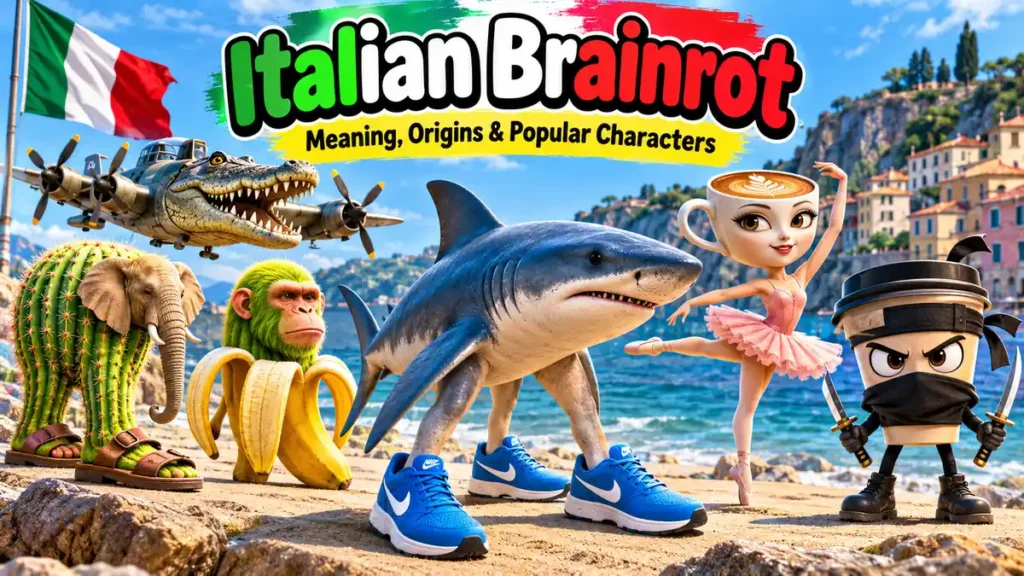
A shark wearing sneakers, a crocodile fused with a bomber plane, and a ballerina with a cappuccino cup for a head might sound like characters from a strange dream. Yet these bizarre creations became some of the internet’s most recognizable memes.
They’re part of a viral phenomenon called italian brainrot, which combines artificial intelligence, surreal humor, rhythmic names, and exaggerated Italian-sounding narration.
The trend spread rapidly through TikTok, YouTube Shorts, Instagram Reels, and online gaming communities, attracting particular attention among Gen Alpha audiences.
Italian brainrot is an internet meme trend featuring absurd, often AI-generated characters that combine animals, food, objects, and human features. The characters usually have rhythmic Italian-inspired names and synthetic voiceovers. Emerging on TikTok in early 2025, the trend became popular through surreal visuals, repetitive sounds, and endlessly remixable humor. Know Your Meme+1
What Is italian brainrot?
Italian brainrot is a style of internet humor built around deliberately nonsensical images, videos, and audio.
Its characters often combine things that would never naturally belong together. A shark might have three legs and wear athletic shoes. An elephant might have a cactus body. A coffee cup might become the head of a dancing figure.
These unusual designs are usually accompanied by computerized voices delivering dramatic, rhythmic phrases.
The result is content that is memorable precisely because it makes so little conventional sense.
What does brainrot mean?
The broader internet slang term brainrot, also written as brain rot, describes low-value, repetitive, or absurd online content and sometimes the feeling of becoming mentally absorbed in it.
People also use the term jokingly to describe an obsession with memes, catchphrases, or online trends.
In this context, brainrot is not a medical diagnosis. It is a humorous cultural label.
Italian brainrot refers to a specific branch of this humor, recognizable through its AI-generated creatures and Italian-inspired sounds.
Why is it called Italian brainrot?
The name comes primarily from the language and presentation of the memes.
Common features include:
- Italian-sounding character names with repeated syllables and rhymes.
- Synthetic Italian narration or exaggerated pronunciation.
- Strange combinations of animals and everyday objects.
- Surreal scenes that resemble AI-generated artwork.
- Short videos designed for rapid sharing and remixing.
Not every character’s name is genuine Italian, and many narrations mix actual Italian with nonsense, slang, or invented expressions.
The trend should therefore not be confused with traditional Italian folklore or a formal genre of Italian entertainment.
Where Did italian brainrot Come From?
The modern trend emerged on TikTok in early 2025.
Although the exact first creator is difficult to establish, the character Tralalero Tralala is widely regarded as its defining early example.
According to Know Your Meme, an early video associated with TikTok user @eZburger401 appeared in January 2025. Later uploads helped establish the recognizable image of a shark wearing blue sneakers. Know Your Meme+1
The rise of Tralalero Tralala
Tralalero Tralala | Italian Brainrot Meme Character | brainrot.cyou
Tralalero Tralala became one of the most recognizable symbols of the trend.
The character is typically depicted as a shark with three legs wearing blue athletic shoes, often standing on a beach.
Its name is catchy, repetitive, and easy to imitate.
Early versions paired the unusual image with an Italian text-to-speech recording containing profanity and religiously offensive language. Later adaptations frequently focused on the shark itself rather than the original narration.
The combination of an impossible animal, an unforgettable name, and dramatic audio made the character especially suitable for short-form videos.
How the trend spread
The growth of Italian brainrot followed a relatively simple pattern.
- A creator posted an AI-generated character with a memorable name.
- Other users reused the audio or created variations of the character.
- New creators invented additional creatures using the same visual formula.
- Fans began making character comparisons, fictional battles, and interconnected stories.
- The characters spread into games, animations, compilations, and merchandise.
By spring 2025, Italian brainrot had developed into a loose collection of recognizable characters rather than a single viral joke. Know Your Meme+1
Most Popular Italian Brainrot Characters
One of the most appealing aspects of Italian brainrot is its expanding cast of unusual characters.
There is no universally accepted official roster. Different creators regularly introduce new designs, names, and fictional relationships.
The following are among the best-known examples.
Italian brainrot – Download Stickers from Sigstick
1. Bombardiro Crocodilo
A crocodile combined with a military bomber aircraft. Its dramatic appearance and rhythmic name made it one of the trend’s major early characters. Some original narration associated with this meme includes disturbing references to violence.
Italian Brainrot characters and game commentary | Create & Merge Memes!
2. Ballerina Cappuccina
A graceful ballerina with a cappuccino cup for a head. The character combines dance imagery with an everyday Italian coffee reference and is especially recognizable in fan animations.
Lirili Larila(Lirilì Larilà) – Italian Brainrot Wiki
3. Lirili Larila
An elephant-like creature with a cactus body, often shown wearing sandals in a desert landscape. Its surreal appearance fits the dreamlike style of the trend.
Brr Brr Patapim – Italian Brainrot Wiki
4. Brr Brr Patapim
A strange forest creature combining monkey-like features, vegetation, and oversized feet. It became particularly recognizable through short videos and repeated voiceovers.
チンパンジーニ・バナニーニ – イタリアンブレインロット キャラクター解説
5. Chimpanzini Bananini
A chimpanzee and banana hybrid. The character illustrates how the trend transforms a simple animal-and-food combination into a memorable visual joke.
Stream Cappuccino Assassino music | Listen to songs, albums, playlists for free on SoundCloud
6. Cappuccino Assassino
A coffee-themed assassin character often depicted with a cup-like head and ninja-inspired clothing. Fan-made stories sometimes connect the character with Ballerina Cappuccina.
These characters are documented across meme archives and popular explainers, although their appearances and fictional backstories can vary between creators. Know Your Meme+2
Italian brainrot characters and their meanings
| Character | Appearance | Main idea |
|---|---|---|
| Tralalero Tralala | Shark wearing sneakers | Absurd animal humor |
| Bombardiro Crocodilo | Crocodile-bomber hybrid | Surreal mechanical creature |
| Ballerina Cappuccina | Coffee-cup ballerina | Dance and coffee parody |
| Lirili Larila | Cactus-elephant hybrid | Dreamlike absurdity |
| Brr Brr Patapim | Forest-monkey hybrid | Strange fantasy creature |
| Chimpanzini Bananini | Banana-chimpanzee hybrid | Animal-food combination |
| Cappuccino Assassino | Coffee-themed assassin | Action-character parody |
Most of these characters do not have a fixed symbolic meaning.
Their identities come from their unusual appearances, memorable sounds, and the fictional stories that internet users invent around them.
Why Did italian brainrot Become So Popular?
Italian brainrot spread because it combines several features that work especially well in short-form internet entertainment.
1. The characters are instantly recognizable
A shark wearing sneakers is visually unusual.
Even someone unfamiliar with the trend can recognize that something strange is happening.
This immediate visual surprise helps the content stand out while viewers scroll through social media feeds.
2. Repetitive names are easy to remember
Names such as Tralalero Tralala and Brr Brr Patapim use rhythm, repetition, and playful sounds.
They function almost like short musical hooks.
People can repeat the names without understanding Italian or knowing the characters’ backstories.
3. Artificial intelligence makes new characters easy to create
Generative AI tools allow creators to produce unusual images without drawing every detail manually.
For example, a creator can describe a fictional creature combining a penguin, a refrigerator, and a pair of running shoes.
An image generator can turn that description into a visual concept.
Text-to-speech software can then add an exaggerated narration, making the result resemble existing brainrot videos.
This accessible creative process encourages constant experimentation.
4. The format encourages remixes
Unlike a story with a fixed beginning and ending, Italian brainrot can expand indefinitely.
Fans can create fictional rivalries, character rankings, family trees, or entirely new creatures.
There is no single official storyline that everyone must follow.
5. Nonsense humor crosses language barriers
A viewer does not need to understand every word to appreciate an absurd animal-object combination.
The visual joke works independently of the narration.
This helps explain why the trend spread beyond Italian-speaking audiences.
Research examining Italian brainrot as an AI-generated meme phenomenon also highlights its combination of synthetic voices, strange imagery, and highly remixable characters. Sage Journals+1
Is Italian Brainrot Actually Italian?
Italian brainrot uses Italian language, cultural references, and pronunciation patterns, but the phenomenon is international.
Some character names contain recognizable Italian words.
For example:
- Ballerina refers to a female ballet dancer.
- Cappuccino is a familiar Italian coffee drink.
- Coccodrillo is the Italian word for crocodile, although meme names frequently use altered spellings.
- Assassino means assassin or murderer.
- Tralala is a playful musical expression rather than a meaningful character description.
Other names are primarily invented for their sound.
The narration may contain genuine Italian, incorrect grammar, meaningless rhymes, or intentionally provocative language.
Consequently, translating every character name literally will not necessarily reveal a hidden joke.
Are the characters connected to Italian culture?
Some characters borrow recognizable cultural elements, particularly coffee, music, and Italian-sounding names.
However, the trend does not accurately represent Italian history, language, or everyday culture.
It is better understood as an international internet meme that uses an exaggerated Italian-inspired aesthetic.
Italian Brainrot vs. Indonesian Brainrot
As the format expanded, similar memes appeared using different languages and cultural references.
One particularly recognizable example is Indonesian brainrot.
Mediensucht-Experte über „Italian Brainrot“-Memes: „Schulkinder kriegen körperliche Wutausbrüche“
Tung Tung Tung Sahur
ボネカ・アンバラブ (Boneca Ambalabu)|音声・ボイスあり – イタリアンブレインロット図鑑 | イタリアンブレインロット
Boneca Ambalabu
Tung Tung Tung Sahur
Tung Tung Tung Sahur is commonly depicted as a wooden, humanoid figure carrying a bat.
Its name refers to sahur, the pre-dawn meal eaten by Muslims during Ramadan.
Although it frequently appears alongside Italian brainrot characters, its cultural reference is Indonesian rather than Italian.
Boneca Ambalabu
Boneca Ambalabu is another surreal character associated with the broader Indonesian brainrot trend.
It is commonly depicted as a frog-like creature combined with a tire and human legs.
Its unusual appearance and repetitive audio follow a format similar to Italian brainrot.
Key differences
| Feature | Italian brainrot | Indonesian brainrot |
|---|---|---|
| Language style | Italian-inspired | Indonesian-inspired |
| Common imagery | Animal-object hybrids | Strange creatures and objects |
| Audio | Italian-style synthetic narration | Indonesian-language or rhythmic narration |
| Famous example | Tralalero Tralala | Tung Tung Tung Sahur |
| Humor | Absurd and surreal | Absurd and surreal |
The distinction is not always strict. Fans frequently combine characters from both trends into the same fictional universe. Know Your Meme+1
How Italian Brainrot Became Part of Gaming Culture
Italian brainrot eventually moved beyond short videos and meme compilations.
Its characters began appearing in fan-made animations, interactive experiences, and games.
One of the most recognizable examples is Steal a Brainrot on Roblox.
What is Steal a Brainrot?
Steal a Brainrot is a multiplayer Roblox game built around collecting brainrot-inspired characters and attempting to steal characters from other players.
The game translates recognizable meme creatures into collectible in-game assets.
Its appeal combines character recognition with competition and progression.
Players who already know the memes can immediately recognize many of the designs.
The game’s popularity also introduces the characters to people who may never have watched the original TikTok videos. AP News+1
Why does the meme work in games?
Italian brainrot characters are well suited to games because they have distinctive silhouettes, memorable names, and flexible fictional identities.
A game developer does not need to explain a complicated story before introducing a character.
Players can understand the basic concept simply by looking at its design.
The same flexibility supports fan-made competitions, fictional battles, and character-collection challenges.
How Are Italian Brainrot Memes Made?
Most recognizable Italian brainrot content combines three creative elements: an unusual visual concept, a memorable name, and a distinctive voiceover.
Generative artificial intelligence often plays a major role, although creators may also use traditional illustration, animation, and video-editing techniques.
Step 1: Invent an impossible character
The starting point is usually a combination of unrelated things.
For example, imagine a penguin whose body resembles a watermelon and whose feet are shaped like roller skates.
The more unexpected the combination, the more closely it resembles the visual language of brainrot memes.
Step 2: Create the image
Creators can use AI image generators to turn a written description into artwork.
A typical description specifies the character’s appearance, environment, lighting, and overall style.
Some creators prefer exaggerated realism, while others use cartoon illustrations or deliberately imperfect AI imagery.
Step 3: Give the character a rhythmic name
Names are often designed around repeated syllables, alliteration, or rhyme.
The goal is memorability rather than linguistic accuracy.
A successful name should be easy to recognize when heard repeatedly.
Step 4: Add synthetic narration
Text-to-speech software can turn a written script into a spoken voiceover.
Italian brainrot videos often use dramatic delivery, rhythmic repetition, and unusual pacing.
However, the original recordings are not always harmless. Some contain profanity, religious insults, or references to violence.
Step 5: Edit the video
Creators combine the character image with narration, music, captions, and simple animation.
Zoom effects, sudden transitions, and repeated sound clips can emphasize the absurdity.
The finished content is often short enough to be watched several times.
This process helps explain why the format expanded so quickly: each new character can reuse a familiar structure while introducing a different visual joke.
Is Italian Brainrot Safe for Kids?
Italian brainrot is popular among children and younger teenagers, but its suitability depends on the specific content.
The bizarre character designs themselves are generally harmless entertainment.
However, some videos include material that parents may not expect from their cartoon-like appearance.
Potential concerns
Inappropriate language: Some early narrations contain profanity, blasphemy, and offensive expressions.
Violent themes: Certain characters, particularly Bombardiro Crocodilo, have been associated with disturbing references to real-world violence.
Repetitive viewing: Short-form videos can encourage extended scrolling, especially when recommendations continuously present similar content.
Misunderstood language: Children may repeat phrases without knowing what the words mean.
The Associated Press has reported on both the popularity of the trend among children and the concerns surrounding some of its content. AP News+1
Does watching brainrot damage your brain?
There is no established scientific basis for claiming that watching Italian brainrot memes literally causes brain damage.
The term brainrot is internet slang, not a clinical condition.
Concerns about excessive screen time, sleep disruption, and compulsive scrolling are broader issues related to digital media habits.
They should not be confused with a proven medical effect of one particular meme trend.
Children can enjoy silly online humor while still benefiting from reasonable screen-time boundaries, age-appropriate content, and a balance of offline activities.
What should parents know?
Parents unfamiliar with the trend can start by asking children which characters they recognize and where they encounter them.
Watching a few examples together may reveal whether the content is simply absurd humor or includes inappropriate narration.
It is also useful to explain that AI-generated images are fictional and that repeated phrases in unfamiliar languages may have meanings worth checking.
Why Italian Brainrot Matters in Internet Culture
Italian brainrot illustrates a shift in how internet memes can be created and shared.
Earlier viral memes often centered on a recognizable photograph, a short video clip, or a catchphrase.
Italian brainrot works differently.
It provides a repeatable creative format that thousands of users can adapt.
AI-generated content has become part of meme culture
Generative AI allows internet users to produce increasingly elaborate fictional images without requiring professional illustration skills.
This changes the speed at which new visual jokes can appear.
It also creates questions about originality, authorship, and the growing volume of automatically generated online content.
Researchers have examined Italian brainrot as an example of how AI-generated imagery and deliberately absurd internet aesthetics can merge into a recognizable cultural phenomenon. Sage Journals
Gen Alpha has developed its own meme vocabulary
Italian brainrot is frequently associated with Generation Alpha, although people of many ages encounter and share it.
Names such as Tralalero Tralala can function as shared references among friends.
Someone familiar with the characters may understand a joke immediately, while an outsider sees only a strange image.
This kind of shared vocabulary is common in internet communities.
The characters behave like a shared fictional universe
Unlike a traditional franchise, Italian brainrot has no universally recognized creator controlling every character.
Different users invent relationships, rivalries, and fictional histories.
One video might portray two characters as enemies, while another presents them as friends.
These contradictions are part of the participatory nature of the meme.
There is no need for every version to follow the same storyline.
Is Italian Brainrot Still Popular in 2026?
Italian brainrot has continued beyond its original viral period in 2025.
By 2026, the phenomenon was represented not only by the early TikTok characters but also by fan communities, gaming adaptations, character guides, and ongoing remixes.
Its visibility has expanded into multiple formats, including:
- Short-form videos and meme compilations.
- Fan-made character animations.
- Roblox games and character-collection experiences.
- Fictional battles and character rankings.
- Physical toys and other merchandise.
- International variations using different languages.
The continued appearance of new character guides and adaptations demonstrates that the format has developed beyond a single short-lived viral clip. Characters.biz+2
However, popularity changes quickly on social media. The continued existence of a meme community does not necessarily mean its original characters are still dominating every platform.
What Makes Italian Brainrot Different From Other Memes?
Italian brainrot shares features with other absurd internet trends, including Skibidi Toilet and surreal AI-generated meme formats.
However, several characteristics distinguish it.
| Feature | Italian brainrot | Traditional image memes |
|---|---|---|
| Main content | AI-generated hybrid creatures | Existing photos or illustrations |
| Names | Rhythmic, invented phrases | Usually recognizable labels |
| Audio | Often synthetic narration | Optional |
| Characters | Continuously expanding roster | Often one recurring subject |
| Storytelling | Fan-created and inconsistent | Varies by meme |
| Visual style | Surreal and exaggerated | Highly variable |
The main difference is that Italian brainrot operates as a flexible character-creation format.
Its popularity does not depend entirely on one image or one joke.
Anyone familiar with the formula can understand how a new character fits into the trend.
The Lasting Appeal of italian brainrot
Italian brainrot began as a strange collection of AI-generated images and rhythmic audio clips, but it developed into a recognizable form of internet entertainment.
Characters such as Tralalero Tralala, Bombardiro Crocodilo, Ballerina Cappuccina, and Brr Brr Patapim demonstrate how unusual visuals and memorable sounds can turn seemingly meaningless ideas into widely shared cultural references.
The phenomenon also reflects larger changes in digital creativity, particularly the accessibility of generative AI and the influence of short-form video platforms.
For anyone encountering these characters for the first time, the simplest explanation is also the most accurate: italian brainrot is intentionally absurd internet humor, and much of its appeal comes from the fact that it does not need to make sense.