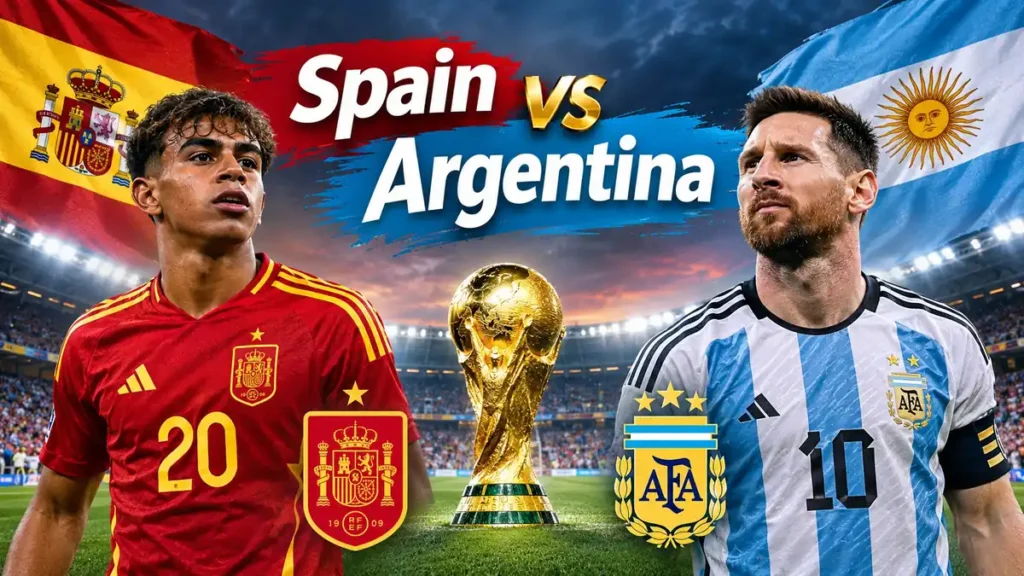
Few international football matchups bring together as much technical quality, history, and championship pedigree as spain vs argentina. Both countries have produced legendary players, influential coaches, and teams capable of dominating the world’s biggest competitions.
Spain and Argentina have met 15 times in senior men’s international football, with Spain winning seven matches, Argentina winning six, and two ending in draws. Their latest encounter was the 2026 FIFA World Cup final on July 19, when Spain defeated Argentina 1–0 after extra time to claim its second world championship. FIFA+2
spain vs argentina: Head-to-Head Record
The historical record reveals an unusually balanced rivalry. Although the two national teams have competed across different footballing eras, neither has consistently dominated the other.
| Head-to-head statistic | Record |
|---|---|
| Total matches | 15 |
| Spain wins | 7 |
| Argentina wins | 6 |
| Draws | 2 |
| Latest meeting | July 19, 2026 |
| Latest result | Spain 1–0 Argentina |
| Biggest Spain victory | 6–1 (2018) |
| Biggest Argentina victory | 4–1 (2010) |
11v11+1
Spain holds a narrow advantage in overall victories. Argentina, however, has historically been a difficult opponent, particularly when playing at home.
One important distinction is that most meetings have been international friendlies. Competitive World Cup encounters have been much rarer, making their 2026 final especially significant.
spain vs argentina: 2026 World Cup Final Result
Spain
1 – 0
Argentina | Authentic Football Club
Argentina
July 19, 2026 · FIFA World Cup Final · After extra time
The most consequential meeting between these nations took place in the final of the 2026 FIFA World Cup, held at MetLife Stadium in East Rutherford, New Jersey, within the New York/New Jersey host region.
Spain emerged victorious by a single goal after extra time, securing its second men’s World Cup title following its first triumph in 2010. Argentina finished runner-up after entering the tournament as the defending champion from 2022. FIFA+1
Why the 2026 final mattered
The match carried several layers of historical significance.
First, it brought together two countries with distinct but equally respected football traditions. Spain’s reputation for controlled possession and coordinated movement faced Argentina’s established combination of technical ability, creativity, and competitive resilience.
Second, it was their first World Cup meeting since 1966. That earlier encounter had ended in Argentina’s favor.
Third, the final added another chapter to Spain’s remarkable development as an international football power. After decades of frustration in major tournaments, Spain’s victories in 2010 and 2026 established a two-title World Cup record.
The narrow scoreline also illustrates why individual match results should not be confused with overall superiority. Winning a final establishes the champion of that competition, but broader comparisons require examining multiple tournaments and generations.
Complete Spain vs Argentina Match Results
The following table presents all 15 recorded senior men’s international meetings, from their first encounter in 1952 through the 2026 World Cup final.
| Date | Match | Score | Competition |
|---|---|---|---|
| Jul 19, 2026 | Spain vs Argentina | 1–0 | World Cup final |
| Mar 27, 2018 | Spain vs Argentina | 6–1 | Friendly |
| Sep 7, 2010 | Argentina vs Spain | 4–1 | Friendly |
| Nov 14, 2009 | Spain vs Argentina | 2–1 | Friendly |
| Oct 11, 2006 | Spain vs Argentina | 2–1 | Friendly |
| Nov 17, 1999 | Spain vs Argentina | 0–2 | Friendly |
| Sep 20, 1995 | Spain vs Argentina | 2–1 | Friendly |
| Oct 12, 1988 | Spain vs Argentina | 1–1 | Friendly |
| Oct 12, 1974 | Argentina vs Spain | 1–1 | Copa Hispanidad |
| Oct 11, 1972 | Spain vs Argentina | 1–0 | Copa Hispanidad |
| Jul 13, 1966 | Argentina vs Spain | 2–1 | World Cup |
| Jun 11, 1961 | Spain vs Argentina | 2–0 | Friendly |
| Jul 24, 1960 | Argentina vs Spain | 2–0 | Friendly |
| Jul 5, 1953 | Argentina vs Spain | 1–0 | Friendly |
| Dec 7, 1952 | Spain vs Argentina | 0–1 | Friendly |
11v11+2
What the historical results reveal
Three patterns stand out.
Spain has enjoyed greater success in more recent meetings, winning the 2006, 2009, 2018, and 2026 encounters. Argentina’s most recent victory came in September 2010.
Both teams have also recorded emphatic friendly victories. Argentina’s 4–1 win in Buenos Aires in 2010 and Spain’s 6–1 victory in Madrid in 2018 demonstrate that even elite international teams can experience heavy defeats.
Finally, the limited number of competitive meetings makes it difficult to establish a definitive historical hierarchy solely through head-to-head results.
International friendlies and World Cup knockout matches involve different levels of pressure, preparation, squad rotation, and tactical risk.
Spain vs Argentina: Biggest Matches in Their Rivalry
Although these countries have met relatively infrequently, several encounters have become memorable because of their results, timing, or historical significance.
Spain 6–1 Argentina — March 27, 2018
Spain vs Argentina – live score, predicted lineups and H2H stats
Spain v Argentina – International Friendly
Argentina sufrió una humillante goleada ante España en Madrid – Infobae
8
Spain produced the largest victory in the rivalry’s history when it defeated Argentina 6–1 at the Wanda Metropolitano in Madrid.
Isco scored a hat-trick, while Diego Costa, Thiago Alcântara, and Iago Aspas also contributed goals. Nicolás Otamendi scored Argentina’s consolation goal.
Lionel Messi did not participate in the match.
The result highlighted Spain’s attacking movement, combination play, and ability to exploit defensive weaknesses.
However, the match was a friendly played shortly before the 2018 World Cup. It did not necessarily indicate how the countries would perform in competitive tournament conditions.
Argentina 4–1 Spain — September 7, 2010
Argentina recorded one of its most impressive victories over Spain at the Estadio Monumental in Buenos Aires.
The result was particularly notable because Spain had won the 2010 FIFA World Cup only weeks earlier.
Argentina’s goals came from Lionel Messi, Gonzalo Higuaín, Carlos Tevez, and Sergio Agüero. Fernando Llorente scored for Spain.
Argentina attacked effectively and punished defensive mistakes, demonstrating the danger of its forward line.
This result remains a reminder that even a reigning world champion can struggle against a talented opponent.
Argentina 2–1 Spain — 1966 World Cup
Their first competitive World Cup meeting occurred during the 1966 tournament in England.
Argentina defeated Spain 2–1 in the group stage, with Luis Artime scoring both Argentine goals. José Pirri scored for Spain.
The victory helped Argentina progress through the tournament, while Spain failed to advance beyond the group stage.
For six decades, this remained the only World Cup meeting between the two countries.
Spain 1–0 Argentina — July 19, 2026
The 2026 final became the most important encounter in the rivalry because the World Cup trophy was at stake.
Spain controlled much of the contest but faced strong resistance from Argentina goalkeeper Emiliano Martínez.
The decisive moment arrived in the 106th minute. Pedro Porro delivered a cross, Nico Williams headed the ball into a dangerous area, and substitute Ferran Torres finished the move.
Argentina had been reduced to ten players when Enzo Fernández received a second yellow card late in regulation time.
Spain maintained its advantage to win the championship under head coach Luis de la Fuente. World Cup 2026 report and highlights+1
Spain vs Argentina: World Cup and International Trophies
Both national teams have impressive records, but their success has developed differently.
Argentina built its international reputation across several generations, winning major titles in the twentieth century before returning to global dominance in the 2020s.
Spain’s greatest sustained period began in 2008, when it established one of international football’s most celebrated winning teams.
| Achievement | Spain | Argentina |
|---|---|---|
| FIFA World Cup titles | 2 | 3 |
| World Cup winning years | 2010, 2026 | 1978, 1986, 2022 |
| Continental championships | 4 EURO titles | 16 Copa América titles |
| Latest continental title | EURO 2024 | Copa América 2024 |
| Finalissima titles | 0 | 2 |
| Confederation | UEFA | CONMEBOL |
| National team nickname | La Roja | La Albiceleste |
UEFA.com+3
Spain’s greatest international achievements
Spain’s breakthrough came at UEFA EURO 2008, when it defeated Germany in the final.
That victory began an extraordinary period of international success:
- EURO 2008: Champions
- FIFA World Cup 2010: Champions
- EURO 2012: Champions
- EURO 2024: Champions
- FIFA World Cup 2026: Champions
Spain’s 2010 World Cup victory against the Netherlands was secured by Andrés Iniesta’s extra-time goal.
At EURO 2012, Spain defeated Italy 4–0 in the final, producing one of the most dominant performances in European Championship history.
Its 2024 European Championship triumph brought a record fourth continental title. Two years later, Spain added another World Cup. UEFA.com+2
Argentina’s greatest international achievements
Argentina’s three World Cup victories came in different footballing eras.
In 1978, Argentina won its first World Cup on home soil.
In 1986, Diego Maradona inspired the team to another title in Mexico, producing performances that remain central to World Cup history.
Argentina’s third championship arrived in Qatar in 2022, when Lionel Messi captained the team to victory over France following a dramatic 3–3 draw and penalty shootout.
The country also won consecutive Copa América titles in 2021 and 2024.
Its 2024 triumph against Colombia was secured by Lautaro Martínez’s extra-time goal, giving Argentina a record 16th Copa América title. Copa América+1
Which country has won more major trophies?
Argentina leads in total men’s World Cup championships, with three compared with Spain’s two.
It also has more continental titles, although direct comparisons between Copa América and the European Championship require context. The competitions have different histories, formats, numbers of participants, and scheduling patterns.
Spain holds the record for European Championship victories, while Argentina has the most Copa América titles.
Consequently, trophy counts demonstrate each country’s historical success but do not independently establish which team would win a particular match.
Spain vs Argentina: Playing Styles and Tactical Differences
The footballing identities of Spain and Argentina share several characteristics. Both value technically skilled players, intelligent movement, and the ability to control the ball in crowded areas.
Their traditional approaches nevertheless differ in meaningful ways.
Spain: Possession, positional play, and coordinated pressing
Spain is closely associated with tiki-taka, a possession-oriented style built around short passing, positional awareness, and coordinated movement.
During the successful 2008–2012 period, players such as Xavi Hernández, Andrés Iniesta, and Sergio Busquets helped Spain control matches through midfield dominance.
The modern Spanish team has retained many principles of positional play while incorporating more direct attacking movements.
Under Luis de la Fuente, Spain has combined:
- Structured possession and intelligent passing angles.
- High pressing after losing the ball.
- Quick transitions into attacking positions.
- Wide attacking threats from players such as Lamine Yamal and Nico Williams.
- Midfield creativity and control through players including Pedri and Rodri.
The addition of pace and direct dribbling makes Spain less dependent on extended passing sequences than some earlier generations.
Argentina: Technical creativity and tactical adaptability
Argentina has traditionally combined technical excellence with competitive intensity.
Its footballing identity includes close control, individual creativity, quick combinations, and the ability to adapt to different opponents.
Under Lionel Scaloni, Argentina became particularly effective at balancing defensive organization with attacking freedom.
Important tactical characteristics include:
- Compact defensive structures.
- Flexible midfield combinations.
- Fast attacking transitions.
- Creative movement between defensive lines.
- Strong competitive discipline and experience in knockout matches.
Lionel Messi’s ability to receive the ball between midfield and defense was a defining feature of Argentina’s successful 2022 World Cup campaign.
Players such as Rodrigo De Paul, Alexis Mac Allister, and Enzo Fernández also contributed to the team’s balance between creativity and defensive responsibility.
Tactical comparison
| Tactical aspect | Spain | Argentina |
|---|---|---|
| Traditional identity | Positional possession | Creative, adaptable football |
| Midfield approach | Passing and territorial control | Technical combinations and balance |
| Attacking strengths | Width, movement, combinations | Individual creativity and transitions |
| Defensive approach | Coordinated pressing | Compactness and tactical flexibility |
| Main potential weakness | Exposure when possession is lost | Reduced attacking output against sustained pressure |
| Key advantage | Collective control | Adaptability and individual quality |
These are general tendencies rather than fixed rules. Both countries can change formations and strategies depending on personnel, opponents, and match circumstances.
Which playing style is more effective?
Neither approach is automatically superior.
Spain’s positional structure can limit an opponent’s opportunities by controlling possession and territory.
Argentina’s adaptability can be particularly valuable when matches become unpredictable or require tactical adjustments.
The 2026 World Cup final illustrated the effectiveness of Spain’s territorial control, while Argentina’s defensive resistance kept the contest scoreless for more than 100 minutes.
The decisive difference ultimately came from Spain’s ability to create and finish a late opportunity.
Legendary Players: Spain vs Argentina
The rivalry also offers an opportunity to compare two countries that have produced some of football’s most influential players.
Spain 2010 – World Cup Winners – ESPN
Spain’s golden generationWorld Cup and European Championship winners
Argentina’s 2022 championsThird World Cup triumph
Spain’s most influential players
Xavi Hernández was central to Spain’s possession-based system. His passing accuracy, awareness, and control of midfield tempo helped define the team’s most successful era.
Andrés Iniesta combined technical precision with creativity and exceptional decision-making. His winning goal in the 2010 World Cup final remains one of Spanish football’s defining moments.
Iker Casillas captained Spain through its golden era and provided crucial saves in major tournaments.
Sergio Ramos contributed leadership, defensive ability, and experience across multiple championship campaigns.
David Villa was one of Spain’s most important international goalscorers, particularly during its 2010 World Cup success.
The later generation introduced influential players such as Rodri, Pedri, Lamine Yamal, Nico Williams, and Ferran Torres, who helped shape Spain’s return to the summit of international football.
Argentina’s most influential players
Diego Maradona remains one of Argentina’s greatest sporting figures. His performances at the 1986 World Cup helped establish his extraordinary international legacy.
Lionel Messi became the central figure of Argentina’s modern era, combining goalscoring, playmaking, and leadership. His achievements include the 2022 World Cup and multiple Copa América titles.
Gabriel Batistuta was renowned for his powerful finishing and exceptional international goalscoring record.
Ángel Di María played decisive roles in several important Argentina victories, including major international finals.
Javier Mascherano provided defensive intelligence and leadership through a lengthy international career.
Argentina’s recent championship teams have also benefited from Emiliano Martínez, Julián Álvarez, Lautaro Martínez, Rodrigo De Paul, and Alexis Mac Allister.
Messi vs Spain’s golden generation
Comparing Lionel Messi with Spain’s historic midfielders is especially interesting because several shared the same club environment at FC Barcelona.
Messi, Xavi, and Iniesta formed an influential combination during Barcelona’s successful period under Pep Guardiola.
Their familiarity demonstrates how closely Argentine and Spanish football have been connected at club level, even when their national teams competed separately.
Messi’s international career was defined by creative freedom and attacking influence, while Spain’s golden generation was particularly associated with collective positional control.
Both approaches helped reshape modern football.
Spain vs Argentina Finalissima: Why Was the Match Cancelled?
Before their 2026 World Cup final, Spain and Argentina were scheduled to meet in the Finalissima, a competition between the reigning European and South American champions.
Spain qualified by winning UEFA EURO 2024, while Argentina qualified by winning the 2024 Copa América.
The match was originally scheduled for March 27, 2026, in Qatar.
However, UEFA officially cancelled the fixture on March 15, 2026, following regional security concerns and unsuccessful negotiations over alternative arrangements. UEFA.com+1
Why was the Finalissima not played?
The original Qatar venue became unsuitable because of the regional political and security situation.
Organizers considered alternative venues and dates, including possibilities in Europe.
UEFA and the participating football associations were unable to reach a final agreement on the scheduling arrangements.
UEFA stated that the proposed alternatives could not be finalized. Argentina’s football association emphasized its preference for a neutral venue and indicated that disagreements over the date prevented the match from taking place.
The cancellation meant there was no 2026 Finalissima champion. UEFA.com+1
Did Spain and Argentina eventually play in 2026?
Yes. Although the Finalissima was cancelled, the two national teams later met in the FIFA World Cup final on July 19, 2026.
That encounter was a separate competition and should not be recorded as a Finalissima result.
Spain’s 1–0 World Cup victory therefore counts toward their international head-to-head record and World Cup history, not the cancelled continental champions’ fixture.
Spain vs Argentina: Which Team Is Better Historically?
Determining which country has the stronger footballing legacy depends on the criteria used.
Argentina has won more men’s World Cups and has a longer history of major international tournament success.
Spain has dominated several important periods of European football and developed a distinctive tactical identity that influenced clubs and national teams worldwide.
Their historical achievements can be assessed across three categories.
World Cup success
Argentina leads with three titles, compared with Spain’s two.
Argentina also has a rich history of World Cup finals and iconic tournament performances.
Spain’s achievements are concentrated in two championship generations, with victories in 2010 and 2026.
On total men’s World Cup titles, Argentina holds the advantage.
Continental dominance
Spain has won four European Championships, including consecutive victories in 2008 and 2012.
Argentina has won 16 Copa América titles, reflecting its long-standing success in South American international football.
Both countries have established records in their respective continental competitions.
Recent head-to-head performance
Spain has enjoyed the better recent record against Argentina.
Its 6–1 victory in 2018 and 1–0 World Cup final win in 2026 are particularly significant.
Argentina’s 4–1 victory in 2010 remains its most recent win in the fixture.
These results give Spain the advantage in recent direct encounters, although the limited number of matches means the sample is relatively small.
What Makes the Spain and Argentina Rivalry Special?
Unlike some international football rivalries, Spain and Argentina are not frequent opponents in continental tournaments.
Spain competes within UEFA, while Argentina belongs to CONMEBOL.
Their competitive opportunities are therefore primarily limited to global tournaments and occasional intercontinental competitions.
Despite this separation, the countries have strong footballing connections.
Spanish clubs have historically attracted Argentine players, while Argentine football has been influenced by European tactical developments.
FC Barcelona, Real Madrid, Atlético de Madrid, and other Spanish clubs have provided important stages for Argentine footballers.
Similarly, Spanish coaches and tactical ideas have influenced the broader international game.
The countries also share a language and numerous cultural connections, adding familiarity to encounters between their national teams.
Why do Spain and Argentina rarely play each other?
Their different confederations are the main reason.
Spain’s competitive calendar centers on European Championship qualification, UEFA Nations League fixtures, and World Cup qualification.
Argentina’s schedule includes South American World Cup qualification and Copa América competitions.
International friendly windows are limited, and organizing matches between teams on different continents can involve significant travel and scheduling challenges.
As a result, their meetings are less frequent than rivalries involving teams from the same confederation.
How many times have Spain and Argentina met in the World Cup?
They have met twice in the men’s FIFA World Cup.
Argentina won 2–1 in the group stage of the 1966 tournament.
Spain won 1–0 after extra time in the 2026 final.
Their World Cup head-to-head record is therefore perfectly balanced at one victory each. FIFA+1
What is the biggest win in Spain vs Argentina history?
Spain’s 6–1 victory on March 27, 2018, is the largest winning margin recorded between the two senior men’s national teams.
Argentina’s biggest victory was its 4–1 win on September 7, 2010.
Both results came in international friendlies rather than competitive World Cup matches.
Final Verdict: spain vs argentina
The spain vs argentina rivalry brings together two of international football’s most accomplished national teams.
Spain leads their overall head-to-head record with seven victories to Argentina’s six, while two matches have ended in draws.
Argentina has the stronger historical record in men’s World Cup titles, with three championships compared with Spain’s two. Spain, meanwhile, holds the record for UEFA European Championship victories.
Their 2026 World Cup final provided a defining moment in the rivalry, as Ferran Torres scored in extra time to secure Spain’s second world title.
Ultimately, Argentina’s historical achievements and Spain’s recent success offer different measures of footballing greatness. Their contrasting strengths, legendary players, and shared influence on the sport make this one of international football’s most compelling comparisons.