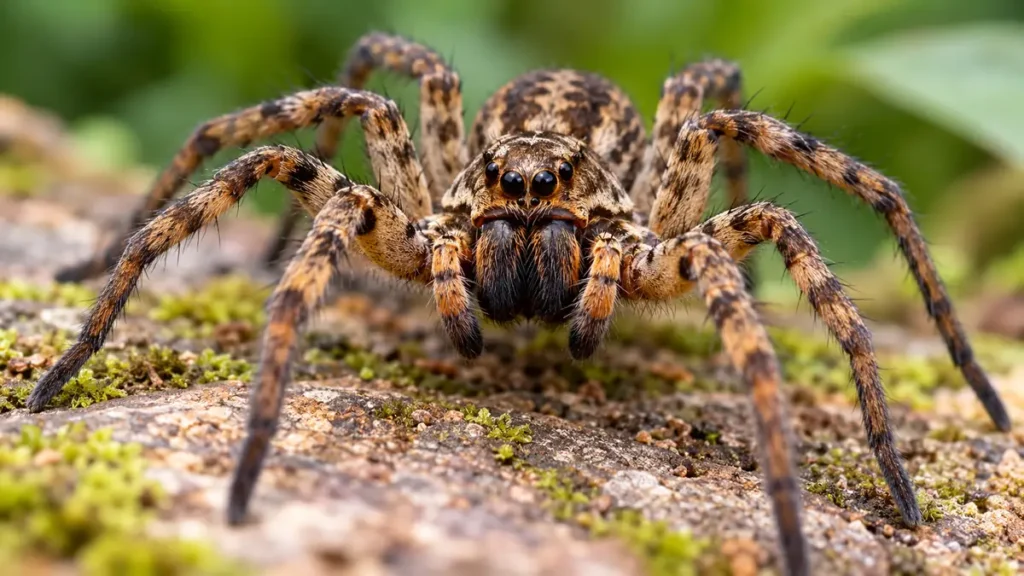
Spotting a large, hairy spider racing across your floor can be unsettling, especially when you don’t know whether it is dangerous. The good news is that a wolf spider is usually more interested in escaping than confronting you.
These remarkable hunters have excellent eyesight, impressive speed, and an unusual approach to raising their young. Unlike many spiders, they chase prey rather than relying on webs.
A wolf spider is a ground-dwelling hunting spider belonging to the family Lycosidae. It typically has a brown, gray, or black hairy body, eight eyes arranged in three rows, and strong legs built for running. Although wolf spiders possess venom to subdue prey, their bites are uncommon and generally not medically dangerous to healthy humans.
Understanding their appearance, habits, and role in nature makes it easier to identify them accurately and respond safely when one appears in your home or garden.
What Is a wolf spider?
A wolf spider is a member of the spider family Lycosidae, a diverse group of active predators found across much of the world. The family includes thousands of species adapted to environments ranging from grasslands and forests to deserts and residential gardens.
The name comes from their hunting behavior. Early observers compared their pursuit of insects to the way wolves hunt, although wolf spiders generally hunt alone rather than in coordinated packs.
These spiders belong to the class Arachnida, which also includes scorpions, ticks, and mites. Like other spiders, they have eight legs, two main body regions, and specialized mouthparts called chelicerae.
wolf spider classification
| Classification | Scientific name |
|---|---|
| Kingdom | Animalia |
| Phylum | Arthropoda |
| Class | Arachnida |
| Order | Araneae |
| Family | Lycosidae |
| Example genera | Hogna, Tigrosa, Pardosa, Schizocosa, Geolycosa |
| Common name | Wolf spider |
The family includes many species that look similar but differ in size, markings, preferred habitats, and activity patterns.
Some are small enough to go unnoticed in grass. Others, such as the Carolina wolf spider (Hogna carolinensis), are among the largest hunting spiders in North America.
Key characteristics
Wolf spiders share several recognizable features:
- Strong, relatively long legs adapted for rapid movement.
- Brown, tan, gray, or nearly black camouflage patterns.
- Eight eyes arranged in a distinctive three-row pattern.
- Hair-covered bodies that help detect vibrations.
- Active hunting rather than prey-catching webs.
- Solitary behavior outside mating and maternal care.
- Females that carry their egg sacs and newly hatched spiderlings.
Their ability to hunt without a capture web distinguishes them from many familiar household spiders.
How to Identify a wolf spider
Correct identification involves more than looking at size or body hair. Several unrelated spider families have similar appearances, so examining multiple physical characteristics provides a more reliable answer.
Size and body shape
Wolf spiders vary considerably in size.
Many adults have bodies approximately 0.25–1.2 inches (6–30 mm) long, although certain larger species exceed that range.
The Carolina wolf spider is a particularly impressive example. According to Penn State Extension, adult females of Hogna carolinensis can measure approximately 22–35 mm in body length. Penn State Extension
Their legs extend beyond the body, making the spider appear significantly larger than its actual body measurement.
A typical wolf spider has a sturdy cephalothorax, an oval abdomen, and muscular legs covered with fine hairs.
Color and markings
Most wolf spiders display earthy colors that help them disappear against soil, bark, dried leaves, and rocks.
Common patterns include:
- Dark brown bodies with lighter longitudinal stripes.
- Gray or tan mottling across the abdomen.
- Pale bands along the cephalothorax.
- Dark markings on the legs.
- Subtle yellowish or reddish highlights.
Color alone cannot confirm the species. Lighting, age, sex, and geographic location can all affect appearance.
The distinctive eight-eye arrangement
The most reliable visual clue is the arrangement of their eyes.
Wolf spiders have eight eyes distributed across three rows:
- Four small eyes form the lowest row.
- Two large, forward-facing eyes occupy the middle row.
- Two medium-sized eyes sit higher and farther apart.
This configuration gives the spider excellent awareness of movement around it.
The large middle eyes are particularly useful for distinguishing wolf spiders from grass spiders and many other lookalikes.
At night, their eyes may reflect flashlight illumination, producing tiny bright points in lawns or gardens.
The University of Minnesota Extension identifies this eye pattern as one of the best diagnostic characteristics of the family. University of Minnesota Extension
Male vs. female wolf spider
Male and female wolf spiders often differ in body proportions.
Females are generally larger and have broader abdomens, especially when carrying developing eggs.
Males may have relatively longer legs and enlarged pedipalps, the short appendages near the mouth that play an important role in reproduction.
The most obvious difference appears during the breeding season: a female may carry a rounded silk egg sac attached to the rear of her abdomen.
Later, dozens of tiny spiderlings may cover her back.
This behavior is one of the clearest signs that the spider belongs to the wolf spider family.
Are Wolf Spiders Dangerous to Humans?
Despite their intimidating appearance, wolf spiders are not considered dangerous to most people.
They are naturally shy and usually attempt to flee when disturbed. Their primary defensive strategy is escape, not aggression.
Like nearly all spiders, wolf spiders possess venom used to immobilize prey. However, their venom is not generally considered medically significant to humans.
Do wolf spiders bite?
Yes, a wolf spider can bite, but bites are uncommon.
A bite is most likely when the spider becomes trapped against the skin, such as inside clothing, footwear, or bedding, or when someone attempts to handle it directly.
Wolf spiders do not normally pursue people, jump at them to attack, or bite without provocation.
What does a wolf spider bite look like?
A confirmed bite may produce:
- Localized pain or a stinging sensation.
- Mild redness around the puncture site.
- Slight swelling.
- Itching or tenderness.
- Occasionally, small puncture marks.
Symptoms vary depending on the individual and the spider involved.
Most uncomplicated bites improve with basic wound care. However, appearance alone cannot reliably establish that a skin lesion came from a wolf spider.
Many suspected spider bites are actually insect bites, skin infections, or other dermatological conditions.
wolf spider bite treatment
If you believe a wolf spider has bitten you:
- Wash the affected area gently with soap and water.
- Apply a cold compress wrapped in a clean cloth for 10–15 minutes.
- Elevate the affected limb if swelling develops.
- Avoid scratching or squeezing the wound.
- Consider an appropriate over-the-counter pain reliever if needed.
- Monitor the area for worsening symptoms.
Seek medical attention if redness spreads, pain increases, pus develops, or you experience fever or other signs of infection.
Difficulty breathing, facial or throat swelling, faintness, or a rapidly developing severe allergic reaction requires immediate emergency care.
A suspected bite accompanied by severe or unusual symptoms should not automatically be attributed to a wolf spider, particularly when the spider was never positively identified.
Can a wolf spider bite kill you?
Wolf spider bites are not generally considered life-threatening, and these spiders are not classified among the major medically dangerous spiders.
Nevertheless, severe allergic reactions and secondary infections can create medical emergencies regardless of the original cause.
The Illinois Department of Public Health describes bites from wolf spiders as uncommon and generally not dangerous. Illinois Department of Public Health
wolf spider Habitat: Where Do They Live?
Wolf spiders occupy an extraordinary range of terrestrial environments.
Their adaptability allows them to thrive in both natural landscapes and areas altered by human activity.
Common outdoor habitats
You may encounter wolf spiders in:
- Grasslands and meadows.
- Forest floors and leaf litter.
- Agricultural fields.
- Residential lawns and gardens.
- Sandy or rocky environments.
- Desert landscapes.
- Wetlands and shorelines.
- Beneath logs, stones, and fallen branches.
Most species spend much of their time near the ground, where their coloration provides camouflage.
Some prefer open spaces for hunting, while others remain close to vegetation or protected retreats.
Do wolf spiders live in burrows?
Certain species construct burrows in soil or sand.
These burrows provide protection from predators, harsh weather, and temperature extremes.
Members of the genus Geolycosa, commonly called burrowing wolf spiders, are particularly associated with underground retreats.
Some species reinforce their burrow entrances with silk, soil particles, or plant material.
Others do not dig permanent burrows and instead shelter beneath rocks, bark, mulch, or other natural cover.
Why do wolf spiders enter houses?
A wolf spider inside your home is usually an accidental visitor rather than evidence of an established indoor population.
Common reasons include:
- Searching for insects.
- Seeking temporary shelter.
- Moving away from disturbed outdoor habitat.
- Entering through gaps around doors or foundations.
- Wandering during seasonal changes.
Basements, garages, storage rooms, and ground-level entrances are common places to find them.
Wolf spiders generally prefer outdoor habitats, and many species do not reproduce successfully inside ordinary homes.
The Burke Museum notes that true wolf spiders are primarily outdoor hunters, even though individuals occasionally wander indoors. Burke Museum
Are wolf spiders active at night?
Many species are nocturnal, meaning they hunt primarily after sunset.
Nighttime activity allows them to avoid some predators and take advantage of insects moving through vegetation or across the ground.
However, not every species is nocturnal.
Some, including Tigrosa georgicola, actively hunt during daylight hours.
Their behavior depends on species, temperature, humidity, prey availability, and local environmental conditions.
What Do Wolf Spiders Eat?
Wolf spiders are carnivorous predators that feed mainly on insects and other small invertebrates.
Unlike orb-weaving spiders that wait for prey to become trapped in silk, wolf spiders actively search for food.
Their diet depends on body size, habitat, and available prey.
Common prey
Wolf spiders frequently consume:
- Crickets and grasshoppers.
- Beetles and beetle larvae.
- Ants and other ground-dwelling insects.
- Flies and moths.
- Cockroaches.
- Caterpillars and cutworms.
- Smaller spiders.
- Other appropriately sized arthropods.
Larger species may occasionally capture small vertebrates, although insects and other invertebrates make up their usual diet.
Because they feed on many insects that damage plants, wolf spiders contribute to natural pest management in agricultural and garden environments.
How do wolf spiders hunt?
Their hunting strategy combines sharp vision, vibration detection, speed, and powerful mouthparts.
A typical hunting sequence involves detecting movement, approaching or waiting within striking distance, and rapidly capturing the prey.
Some species patrol the ground continuously. Others wait near burrow entrances and ambush passing insects.
After seizing prey, the spider uses its chelicerae to deliver venom. Digestive fluids help break down the prey’s tissues so the spider can consume them.
Wolf spiders cannot chew solid food in the same way mammals do.
Their feeding process relies on external digestion and the consumption of liquefied tissues.
Do wolf spiders make webs?
Wolf spiders produce silk, but they generally do not construct webs designed to trap flying insects.
Instead, they use silk for several other purposes:
- Lining burrows and retreats.
- Producing protective egg sacs.
- Creating draglines while moving.
- Supporting reproductive activities.
- Reinforcing sheltered resting areas.
This distinction explains why finding a large spider near a web does not necessarily mean it built that web.
wolf spider Reproduction and Life Cycle
One of the most fascinating aspects of wolf spider biology is the care females provide to their offspring.
Unlike many spider species that leave their eggs in stationary silk structures, female wolf spiders carry their developing young with them.
Mating and courtship behavior
During the breeding season, males search for receptive females.
Courtship may involve rhythmic leg movements, pedipalp waving, and vibrations transmitted through the ground or vegetation.
These signals help females recognize suitable mates.
Different species use distinct combinations of visual displays and vibrations, reducing confusion between closely related spiders.
After successful mating, the female produces a silk egg sac containing her developing offspring.
How do wolf spiders carry their eggs?
The female attaches her rounded egg sac to spinnerets at the rear of her abdomen.
She then carries it while walking, hunting, and sheltering.
The egg sac is typically pale or whitish when freshly produced, although its appearance can change over time.
This arrangement allows the female to protect her eggs while remaining mobile.
Some species adjust their position in sunlight or shade, helping regulate the developing eggs’ temperature.
Why do baby wolf spiders ride on their mother’s back?
After hatching, the young spiderlings climb onto their mother’s abdomen and remain there for a period of early development.
This behavior provides protection while the spiderlings are especially vulnerable.
A female carrying dozens of tiny spiders can appear unusually textured or bumpy from a distance.
The young eventually disperse and begin hunting independently.
The Illinois Department of Natural Resources documents this maternal behavior in species such as Varacosa avara and Tigrosa georgicola. dnr.illinois.gov+1
How long do wolf spiders live?
Lifespan varies by species, sex, environmental conditions, and food availability.
Many wolf spiders live approximately one year, while some larger species can survive for two years or longer.
Females of certain species may live longer than males.
Their development includes several stages:
- Egg development inside the silk sac.
- Hatching and temporary maternal protection.
- Dispersal of young spiderlings.
- Repeated molting as the spider grows.
- Sexual maturity and reproduction.
Like other arthropods, wolf spiders must shed their external skeleton, or exoskeleton, to increase in size.
This process is called molting.
wolf spider vs. Other Common Spiders
Wolf spiders are frequently confused with grass spiders, brown recluse spiders, fishing spiders, and even tarantulas.
Understanding their differences can prevent unnecessary fear and improve identification accuracy.
wolf spider vs. grass spider
Grass spiders belong to the family Agelenidae and often construct funnel-shaped webs across grass, shrubs, and other vegetation.
Both groups can be brown, striped, and fast-moving.
However, grass spiders generally have noticeably elongated spinnerets projecting from the rear of the abdomen.
Wolf spiders have shorter, less conspicuous spinnerets and do not rely on funnel webs to capture prey.
| Feature | Wolf spider | Grass spider |
|---|---|---|
| Family | Lycosidae | Agelenidae |
| Hunting method | Active pursuit or ambush | Funnel-web capture |
| Eyes | Three rows, including two prominent middle eyes | Two rows of relatively similar-sized eyes |
| Spinnerets | Usually less conspicuous | Often long and clearly visible |
| Habitat | Ground, burrows, leaf litter | Grass, shrubs, vegetation |
| Human risk | Generally low | Generally low |
wolf spider vs. brown recluse
Brown recluse spiders belong to the genus Loxosceles and are medically significant in regions where they occur.
A brown recluse typically has six eyes arranged in three pairs, while a wolf spider has eight eyes in three rows.
Brown recluse spiders are usually more uniformly colored and have less conspicuous body hair.
Some have a dark violin-shaped marking on the cephalothorax, although this feature alone is not sufficient for reliable identification.
Wolf spiders commonly display stronger striping or mottling.
The eye arrangement is a more dependable distinction than color or body size.
Brown recluse bites can sometimes cause serious tissue injury, so uncertain identifications should not be treated casually.
wolf spider vs. tarantula
Tarantulas belong to the family Theraphosidae.
They are often larger, heavier-bodied spiders with thick legs and dense body hair.
Some large wolf spiders resemble small tarantulas, especially when seen briefly.
However, the two families have different eye arrangements, body proportions, and anatomical characteristics.
Tarantulas also include species with specialized defensive behaviors, such as releasing irritating hairs.
A wolf spider is not a true tarantula, even when its appearance suggests otherwise.
wolf spider vs. fishing spider
Fishing spiders, often belonging to the genus Dolomedes, are members of the family Pisauridae.
They frequently live near water and can move across the surface using specialized leg structures.
Both fishing spiders and wolf spiders may be large, brown, and fast-moving.
Fishing spiders often have longer, more laterally extended legs and a different eye arrangement.
Habitat provides another clue, although neither family is restricted exclusively to one environment.
How to Get Rid of Wolf Spiders in Your House
Finding one wolf spider indoors usually does not require chemical treatment.
These spiders are beneficial predators, and an occasional visitor can often be removed safely without killing it.
How to remove a wolf spider safely
Follow these steps:
- Locate the spider and avoid sudden movements.
- Place a transparent container over it.
- Slide a stiff piece of cardboard beneath the container.
- Carefully lift the container while keeping the cardboard in place.
- Release the spider in a sheltered outdoor area away from the entrance.
Avoid handling the spider directly, particularly if you cannot identify it confidently.
If the spider is carrying young, move it gently to avoid disturbing the spiderlings.
How to prevent wolf spiders from entering
The most effective long-term approach is to reduce entry points, shelter, and indoor prey.
Practical prevention measures include:
- Seal cracks around foundations, doors, and windows.
- Install properly fitted door sweeps.
- Repair damaged window screens.
- Reduce clutter in garages, basements, and storage spaces.
- Keep firewood and debris away from exterior walls.
- Trim vegetation touching the building.
- Vacuum corners and other sheltered areas regularly.
- Reduce indoor insect populations.
- Adjust outdoor lighting to attract fewer insects near entrances.
Wolf spiders may follow available prey, so reducing insect activity around the building can make the area less attractive.
Utah State University Extension recommends habitat reduction, exclusion measures, and management of insect prey as practical components of integrated pest management. USU
Do natural repellents work?
Home remedies such as peppermint oil, vinegar, citrus sprays, and essential-oil mixtures are frequently promoted as spider repellents.
However, reliable evidence that these treatments consistently prevent wolf spiders from entering buildings is limited.
Strong fragrances may temporarily influence spider movement, but they do not provide dependable long-term exclusion.
Some essential oils can also irritate people or harm pets when used improperly.
Physical barriers, habitat management, and insect reduction are more dependable approaches.
Should you use pesticides?
Routine pesticide application is usually unnecessary for occasional wolf spider sightings.
Broad insecticide treatments may kill beneficial organisms without addressing the conditions that allow spiders to enter.
If numerous spiders repeatedly appear indoors, first investigate gaps, clutter, moisture, and insect populations.
Professional pest management may be appropriate when a persistent problem cannot be resolved through exclusion and sanitation.
Are Wolf Spiders Good for Gardens and the Environment?
Wolf spiders play an important ecological role as predators within terrestrial food webs.
Their hunting activities help regulate populations of insects and other arthropods.
Natural pest control
In gardens and agricultural fields, wolf spiders consume organisms that may damage plants.
These include certain caterpillars, cutworms, beetles, and other ground-dwelling pests.
Because they hunt without relying on fixed capture webs, they can move between different parts of a habitat as prey availability changes.
This makes them valuable members of natural predator communities.
However, wolf spiders are generalist predators. They may also eat beneficial insects and other spiders.
Their ecological contribution is therefore broader than simply eliminating garden pests.
Their place in the food chain
Wolf spiders are both predators and prey.
They may be eaten by:
- Insect-eating birds.
- Lizards and amphibians.
- Small mammals.
- Larger spiders.
- Spider-hunting wasps.
Their presence helps transfer energy through terrestrial food webs.
They also serve as indicators of habitat conditions because spider communities respond to vegetation structure, land management, and environmental disturbance.
Are wolf spiders endangered?
Most commonly encountered wolf spider species are not considered globally threatened.
However, some species with very restricted habitats face serious conservation pressures.
The Desertas wolf spider (Hogna ingens), associated with the Desertas Islands near Madeira, Portugal, is a notable example of a threatened island species.
The Kauaʻi cave wolf spider (Adelocosa anops) is another specialized species with a limited distribution in Hawaii.
Habitat loss, invasive species, and environmental changes can threaten spiders with narrow geographic ranges.
These examples demonstrate why conservation status must be evaluated at the species level rather than for the entire family.
Interesting wolf spider Facts and Common Misconceptions
Wolf spiders have several unusual abilities that make them stand out among other arachnids.
Can wolf spiders jump?
Wolf spiders can make short, sudden movements and may lunge at prey.
However, they are not specialized jumpers like members of the family Salticidae.
Jumping spiders use distinctive visual systems and body mechanics to perform controlled leaps.
Wolf spiders rely more heavily on running and short-distance ambush movements.
How fast can a wolf spider run?
Wolf spiders are fast relative to their body size, although there is no single reliable running-speed figure that applies to every species.
Their speed depends on temperature, body size, surface conditions, and whether they are hunting or escaping.
They can cover short distances rapidly, which explains why one may seem to disappear almost instantly when disturbed.
Can wolf spiders climb walls?
Some wolf spiders can climb rough vertical surfaces, including brick, wood, and textured walls.
Smooth glass or polished surfaces are more difficult for many species.
Climbing ability varies according to the spider’s size, leg structures, and the surface involved.
Do wolf spiders chase humans?
No. Wolf spiders do not intentionally chase people as prey or seek confrontations with humans.
A spider running in someone’s direction is usually trying to reach shelter or escape a disturbance.
Its movements may appear unpredictable because it responds quickly to nearby motion, vibrations, and obstacles.
Do wolf spiders travel in groups?
Wolf spiders are generally solitary.
They do not form cooperative hunting packs like wolves.
The main exception involves newly hatched spiderlings temporarily riding on their mother’s back.
Large numbers may also occur in favorable habitats, but that does not mean the spiders are functioning as a coordinated group.
Do wolf spiders have good eyesight?
Yes. Compared with many other spider families, wolf spiders have well-developed vision.
Their large eyes help detect movement and navigate hunting environments.
They also rely on sensory hairs that detect air movement and vibrations.
This combination allows them to locate prey and respond rapidly to potential threats.
Can wolf spiders swim?
Some wolf spiders can move across water surfaces, and certain species can survive brief contact with water.
Their water-related abilities vary substantially.
They should not be confused with fishing spiders, which are particularly adapted to hunting around aquatic environments.
What attracts wolf spiders to a home?
Wolf spiders are mainly attracted by favorable shelter and available prey, not by people.
An insect-rich porch, cluttered garage, or foundation with numerous gaps may provide suitable conditions.
Exterior lights can indirectly contribute by attracting insects that spiders hunt.
Reducing these conditions is more useful than relying on unproven household repellents.
Are wolf spiders poisonous to dogs and cats?
Wolf spiders are venomous, but their bites are generally not expected to cause severe poisoning in healthy dogs or cats.
A pet that disturbs a spider may experience localized pain, swelling, or irritation.
However, symptoms such as repeated vomiting, breathing difficulty, weakness, or pronounced swelling require prompt veterinary attention.
Because many spiders look alike, never assume that a spider involved in a pet’s illness was harmless without reliable identification.
How to Recognize a wolf spider at a Glance
When identifying an unfamiliar spider, focus on a combination of appearance and behavior rather than one feature.
| Observation | What it suggests |
|---|---|
| Brown or gray hairy body | Consistent with many wolf spider species |
| Eight eyes in three rows | Strong identification clue |
| Two unusually large forward-facing eyes | Characteristic of wolf spiders |
| Runs quickly across the ground | Typical hunting behavior |
| No prey-catching web | Consistent with active hunting |
| Female carrying an egg sac | Strong evidence of wolf spider identity |
| Tiny spiderlings riding on the back | Highly characteristic maternal behavior |
| Long visible spinnerets and funnel web | More suggestive of a grass spider |
Not every brown, hairy spider is a wolf spider. When identification matters for safety, use a clear photograph and consult a qualified arachnologist, local extension service, or relevant wildlife specialist.
Final Thoughts on the wolf spider
The wolf spider is an efficient ground hunter with remarkable eyesight, distinctive physical features, and unusual maternal behavior.
Although its size and speed can be intimidating, it is generally harmless to humans and plays a useful role in controlling insect populations.
The easiest way to recognize one is by its eight-eye arrangement, active hunting behavior, and, in females, the habit of carrying egg sacs and spiderlings.
If you encounter a wolf spider indoors, avoid touching it directly and relocate it carefully when safe to do so. Preventing future visits usually comes down to sealing entry points, reducing clutter, and managing insects around your home.
Understanding these spiders makes it easier to appreciate their ecological value while maintaining a comfortable and safe living environment.