The Belgian Malinois is one of the most athletic, intelligent, and demanding dog breeds in the world. Famous for police work, military operations, and exceptional obedience, this energetic herding dog needs much more than a daily walk to stay physically and mentally healthy.
A belgian malinois is a medium-to-large Belgian herding dog known for its intelligence, loyalty, agility, and strong working drive. Originally developed to manage livestock, the breed now excels in detection, protection, search and rescue, and competitive dog sports. It typically lives 12–14 years and requires substantial daily exercise, structured training, and mental stimulation.
What Is a Belgian Malinois?
The Belgian Malinois is one of four traditional varieties of Belgian Shepherd dogs, alongside the Tervuren, Groenendael, and Laekenois. The breed takes its name from Malines, the French name for Mechelen, a city in Belgium.
Originally developed for herding sheep and guarding livestock, the Malinois gradually became a versatile working dog. Its combination of physical endurance, quick reactions, strong scenting ability, and willingness to work with a handler made it particularly valuable in demanding professional roles.
The American Kennel Club (AKC) recognizes the Belgian Malinois as a distinct breed within its Herding Group. The Fédération Cynologique Internationale (FCI), by contrast, recognizes the four varieties under the Belgian Shepherd Dog breed standard.
Belgian Malinois Breed Overview
| Characteristic | Details |
|---|---|
| Origin | Belgium |
| Breed group | Herding |
| Original purpose | Livestock herding and guarding |
| Height | Males: 24–26 inches; females: 22–24 inches |
| Weight | Approximately 40–80 pounds |
| Lifespan | Typically 12–14 years |
| Coat | Short, straight, weather-resistant double coat |
| Common colors | Fawn to mahogany with black overlay |
| Temperament | Alert, intelligent, energetic, protective |
| Exercise needs | Very high |
| Grooming needs | Low to moderate |
| Trainability | High with experienced handling |
| Best suited for | Active, experienced owners and working homes |
These measurements are general breed guidelines. Individual dogs may fall outside the typical range depending on genetics, sex, age, and physical condition.
Belgian Malinois Appearance, Size, and Coat Colors
The Belgian Malinois has a lean, muscular, squarely built body designed for speed, endurance, and agility. Unlike some heavily built guarding breeds, it combines strength with light, efficient movement.
Height and Weight
Adult males generally stand between 24 and 26 inches at the shoulder, while females typically measure 22 to 24 inches.
Weight varies considerably with sex and build. Healthy adult dogs commonly weigh between 40 and 80 pounds.
The breed should appear athletic rather than bulky. A visible waist, balanced musculature, and efficient gait are more characteristic than excessive body mass.
Coat Colors and Markings
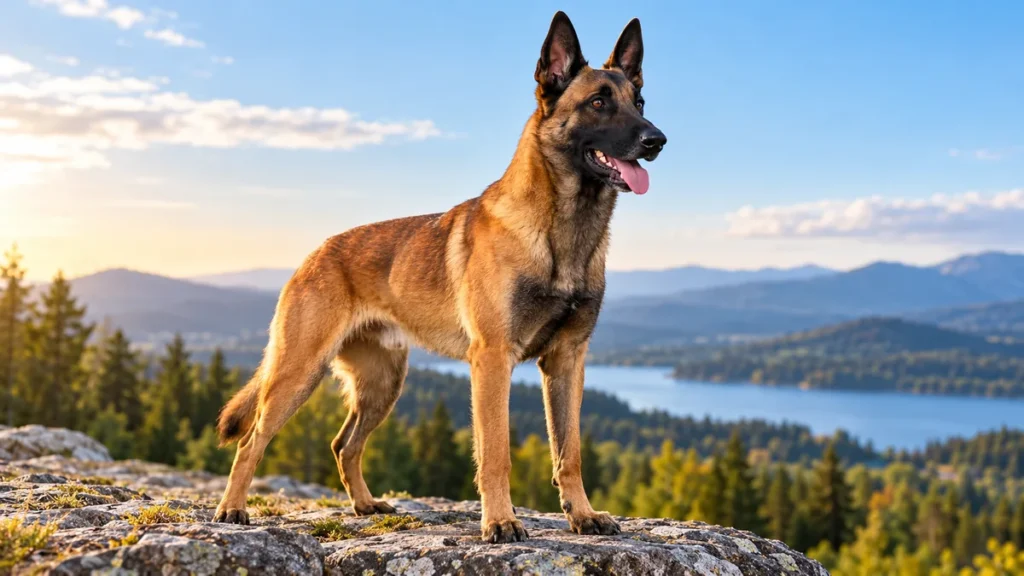
The Belgian Malinois has a short double coat consisting of a dense undercoat and a straight outer coat.
Typical features include:
- Fawn, rich fawn, or mahogany coloring.
- Black-tipped hairs creating a darker overlay.
- A distinctive black facial mask.
- Dark ears, usually with strong black pigmentation.
- A lighter underside and occasional limited white markings.
The coat is generally slightly longer around the neck and tail than on the head, ears, and lower legs.
Although black Belgian Shepherds exist, a solid black coat is not the standard appearance of the Belgian Malinois under the AKC breed standard. The long-haired black Belgian Shepherd variety is known as the Groenendael.
Physical Characteristics
One of the breed’s most recognizable features is its alert expression.
A typical Malinois has upright triangular ears, dark almond-shaped eyes, a moderately pointed muzzle, and a strong but elegant body.
Its movement is smooth and seemingly effortless. This efficiency allows the dog to accelerate quickly, turn sharply, and work for extended periods when properly conditioned.
Belgian Malinois Temperament and Personality
The Belgian Malinois temperament is often described as confident, observant, loyal, and highly responsive. These traits make the breed impressive in skilled hands but challenging for inexperienced owners.
Intelligence and Working Drive
The Malinois learns quickly and often anticipates patterns in training.
However, intelligence does not automatically mean easy ownership. A dog that learns commands rapidly can also learn undesirable behaviors when routines are inconsistent.
Many Malinois have strong prey, chase, and toy drives. These traits can be useful in detection work and dog sports, but they require careful management around moving objects, small animals, and unfamiliar environments.
A well-adjusted Malinois should be confident and controllable, not unnecessarily aggressive or fearful.
Loyalty and Protective Instincts
Belgian Malinois dogs often develop close relationships with their handlers and families.
They can be naturally watchful and may alert to unfamiliar people or unusual activity. Nevertheless, protective behavior should not be confused with uncontrolled aggression.
Responsible training emphasizes neutrality, obedience, confidence, and safe behavior around strangers rather than encouraging suspicion or confrontation.
Are Belgian Malinois Good Family Dogs?
A Belgian Malinois can live successfully in a family environment, but suitability depends heavily on the individual dog and the household’s experience.
Families should consider several factors:
- The breed requires substantial daily interaction.
- Herding and chase instincts may lead to attempts to control running children.
- High arousal can make rough play difficult to manage.
- Young dogs may nip, jump, or become mouthy without appropriate training.
- Consistent supervision is essential around children.
A properly socialized Malinois can be affectionate and deeply bonded with family members. However, it is generally not the easiest breed for households seeking a relaxed companion.
Can Belgian Malinois Live With Other Pets?
Yes, some can live peacefully with other dogs and cats, particularly when introduced appropriately and raised with careful management.
However, individual prey drive and social compatibility vary.
Introductions should be gradual, with controlled interactions and separate resting areas. Dogs with intense chase instincts may require permanent management around smaller animals.
No amount of socialization guarantees that every Malinois will be safe with every pet.
Belgian Malinois Training: How to Build Good Behavior
Training is a fundamental part of responsible Belgian Malinois ownership.
This breed thrives when it understands expectations, receives clear feedback, and has opportunities to use its intelligence.
Start Training During Puppyhood
Puppy training should focus on everyday life skills before advanced commands.
Priorities include name recognition, recall, loose-leash walking, settling calmly, handling tolerance, and basic cues such as sit, down, and stay.
Short, successful sessions are more effective than prolonged repetition.
Food rewards, toys, praise, and play can all reinforce desired behaviors.
Socialization and Environmental Confidence
Socialization means teaching a puppy to feel comfortable and behave appropriately around different people, animals, sounds, surfaces, and environments.
It does not mean forcing interaction with every stranger or dog.
Useful early experiences include controlled exposure to traffic noises, visitors, veterinary handling, grooming, different walking surfaces, and calm observation of other animals.
Puppies should be introduced gradually, avoiding overwhelming or frightening situations. A veterinarian can advise on safe public exposure based on vaccination status and local disease risks.
Positive Reinforcement Training
Reward-based training is especially useful for a fast-learning, sensitive working dog.
For example, when teaching a reliable recall:
- Begin in a quiet, enclosed environment.
- Say the dog’s name and recall cue once.
- Reward immediately when the dog approaches.
- Gradually increase distance and distractions.
- Practice using a long line before attempting off-leash recall in appropriate, secure areas.
Avoid punishment-based methods that create fear, confusion, or defensive responses.
The goal is a dog that responds reliably because the behavior has been thoroughly taught and reinforced.
Common Belgian Malinois Training Mistakes
A frequent mistake is focusing exclusively on physical exhaustion.
Owners may increase running, chasing, and intense play without teaching the dog how to relax. This can create an extremely fit animal that still struggles to settle indoors.
Other common problems include inconsistent rules, inadequate socialization, rewarding overexcitement, and introducing demanding protection exercises without professional guidance.
A balanced training plan develops impulse control, calm behavior, engagement, and appropriate outlets for natural drives.
Advanced Training and Dog Sports
Once foundational obedience is reliable, the Malinois can excel in structured activities such as:
- Agility
- Scent detection and nose work
- Tracking
- Competitive obedience
- Rally obedience
- Herding trials
- Disc dog activities
- Professionally supervised protection sports
High-impact jumping, repetitive sprinting, and strenuous conditioning should be adjusted for the dog’s age and skeletal maturity.
Belgian Malinois Exercise Requirements and Mental Stimulation
Belgian Malinois exercise needs are considerably higher than those of many companion breeds.
Most healthy adults benefit from substantial daily physical activity combined with training, problem-solving, and opportunities to rest.
How Much Exercise Does a Belgian Malinois Need?
Many adult Malinois need approximately 90–120 minutes or more of appropriately structured daily activity, although there is no universal requirement.
A dog’s actual needs depend on age, health, fitness, temperament, and working background.
Physical exercise might include brisk walks, hiking, controlled retrieving, swimming, tracking, or structured sport training.
Mental activity is equally important. A 15-minute scent-search session can provide valuable enrichment without adding another intense workout.
Example Daily Routine
| Time | Activity | Purpose |
|---|---|---|
| Morning | 30–45-minute walk and obedience practice | Physical exercise and focus |
| Midday | Food puzzle or scent game | Mental stimulation |
| Afternoon | 30–45-minute structured activity | Fitness and enrichment |
| Evening | Short training session and calm interaction | Reinforcement and relaxation |
| Throughout day | Scheduled rest | Recovery and emotional regulation |
This is an illustrative routine, not a fixed prescription. Working dogs may require a different schedule, while puppies and older dogs often need shorter, gentler sessions.
Mental Enrichment Activities
Useful enrichment activities include hiding treats for scent searches, teaching new tricks, using puzzle feeders, practicing impulse-control games, and rotating appropriate chew toys.
Teaching a dog to settle on a mat can be particularly valuable.
Mental stimulation should challenge the dog without keeping it in a constant state of excitement.
Can Belgian Malinois Live in an Apartment?
Apartment living is possible for some Belgian Malinois, but it is demanding.
The more important considerations are exercise access, owner availability, noise management, enrichment, and the dog’s ability to settle indoors.
A large yard does not replace training or companionship. Likewise, a smaller home does not automatically prevent responsible ownership if the dog’s needs are consistently met.
Belgian Malinois Health Problems and Lifespan
The Belgian Malinois is generally an athletic breed, but it can develop inherited and acquired health conditions.
Preventive veterinary care, responsible breeding, suitable nutrition, and age-appropriate exercise can improve overall well-being.
Hip and Elbow Dysplasia
Hip dysplasia occurs when the hip joint develops abnormally, potentially leading to pain, instability, and arthritis.
Elbow dysplasia involves developmental abnormalities of the elbow joint.
Possible symptoms include stiffness after rest, reluctance to jump, limping, reduced activity, or difficulty rising.
Screening programs such as those offered through the Orthopedic Foundation for Animals (OFA) help breeders assess joint health.
Eye Conditions
Belgian Malinois may be affected by inherited eye disorders, including progressive retinal atrophy (PRA), as well as other ocular diseases.
Some conditions can gradually impair vision.
Regular veterinary examinations and appropriate breeding-stock eye screening are important preventive measures.
Epilepsy and Neurological Concerns
Epilepsy and other neurological conditions have been reported in the breed.
Seizures can have several causes, including inherited disorders, toxic exposure, metabolic abnormalities, or structural brain disease.
Any first-time seizure requires veterinary evaluation. Prolonged or repeated seizures without recovery are emergencies.
Gastric Dilatation-Volvulus (Bloat)
As a deep-chested dog, the Malinois can be susceptible to gastric dilatation-volvulus (GDV), although risk varies between individuals.
GDV occurs when the stomach becomes distended and twists, disrupting circulation.
Warning signs include unsuccessful attempts to vomit, abdominal enlargement, severe restlessness, drooling, weakness, or collapse.
Suspected GDV is an immediate veterinary emergency.
Lifespan and Preventive Care
Belgian Malinois commonly live around 12–14 years, with individual variation.
Routine veterinary visits should address vaccinations, parasite prevention, dental health, weight management, and age-related screening.
Prospective owners should also ask about documented hip, elbow, and eye evaluations in breeding lines rather than relying on appearance alone.
Belgian Malinois Grooming, Feeding, and Everyday Care
Although its training and exercise demands are high, the Belgian Malinois is relatively straightforward to groom.
Coat Care and Shedding
The short double coat sheds throughout the year, with heavier seasonal shedding.
Weekly brushing is usually sufficient during normal periods. More frequent brushing can help remove loose undercoat during seasonal shedding.
Bathing should be based on dirt, odor, and skin condition rather than an unnecessarily frequent schedule.
Routine care should also include nail trimming, ear inspection, and dental cleaning.
Diet and Nutrition
Belgian Malinois dogs need a complete and balanced diet appropriate for their life stage and activity level.
Food requirements vary according to body weight, metabolism, age, reproductive status, and exercise intensity.
Working dogs may need different calorie levels from household companions.
Rather than relying on a fixed feeding amount for the entire breed, owners should monitor body condition and adjust portions with veterinary guidance.
Fresh water must always be available, particularly during strenuous activity or hot weather.
Caring for a Belgian Malinois Puppy
Puppies need a balance of exploration, socialization, training, play, and substantial sleep.
Their developing joints should not be subjected to excessive repetitive jumping, forced distance running, or strenuous adult-level workouts.
Feeding a suitable growth diet and maintaining a lean body condition support healthy development.
Crate training, when introduced positively, can help establish a safe resting space. A crate should never replace appropriate companionship, exercise, or toilet breaks.
Heat and Weather Safety
Belgian Malinois dogs can work in a variety of climates, but they are not immune to heat exhaustion or heatstroke.
Exercise should be reduced during extreme heat and humidity. Provide shade, cool water, and rest periods.
Signs of dangerous overheating include excessive panting, weakness, confusion, vomiting, or collapse.
Heatstroke requires immediate cooling and emergency veterinary treatment.
Belgian Malinois vs German Shepherd: Key Differences
The Belgian Malinois and German Shepherd are frequently compared because both breeds are intelligent, athletic, and widely used in professional working roles.
However, they differ in body structure, coat characteristics, and common behavioral tendencies.
| Feature | Belgian Malinois | German Shepherd |
|---|---|---|
| Origin | Belgium | Germany |
| Typical build | Lean, square, athletic | Generally larger and more substantial |
| Coat | Short double coat | Medium or long double coat |
| Energy level | Extremely high | High |
| Training | Highly responsive, often intense | Highly trainable and versatile |
| Working style | Fast, agile, strongly driven | Powerful, versatile, adaptable |
| Grooming | Relatively simple | Often more extensive |
| Family suitability | Best with experienced, active households | Can suit a broader range of experienced households |
| Common working roles | Detection, patrol, protection sports | Detection, patrol, service, search and rescue |
These are broad tendencies rather than rules. Individual breeding lines, socialization, training, and temperament can create substantial differences within either breed.
Which Breed Is More Intelligent?
Both breeds are exceptionally capable learners.
The Belgian Malinois often displays rapid responses and intense motivation, particularly when trained with rewards it finds highly valuable.
German Shepherds also demonstrate advanced problem-solving abilities and excel across numerous professional disciplines.
There is no reliable single measure proving that one breed is universally more intelligent than the other.
Which Breed Is Better for Protection?
Both breeds have histories of guarding and protection work.
The Malinois is frequently selected for physically demanding operations because of its speed, agility, and strong working drive. German Shepherds are also widely valued for their strength, versatility, and trainability.
For household safety, stable temperament, reliable obedience, and responsible management matter more than a breed’s reputation.
Untrained aggression creates danger rather than dependable protection.
Why Are Belgian Malinois Used in Police and Military Work?
The Belgian Malinois has become closely associated with law enforcement and military working dog programs.
Its popularity reflects several characteristics that can be valuable in specialized environments.
Detection and Scent Work
Dogs possess a highly developed sense of smell, allowing properly trained individuals to detect particular odors.
Malinois may be trained to locate explosives, narcotics, missing people, or other target scents.
Their enthusiasm for searching and ability to work in distracting environments can make them effective detection partners.
Speed, Agility, and Endurance
The breed’s relatively lightweight, athletic frame supports rapid acceleration and agile movement.
This can be useful when navigating obstacles, searching buildings, or working across varied terrain.
However, physical performance depends on conditioning, health, training, and individual ability rather than breed identity alone.
Handler Focus and Trainability
Many working-line Malinois show strong motivation to engage with their handlers.
They can learn complex sequences and perform tasks under challenging conditions when trained systematically.
Professional programs assess individual dogs for health, environmental confidence, temperament, and task suitability.
Not every Belgian Malinois is suitable for police or military work, and working-line breeding does not guarantee professional-level performance.
Belgian Malinois in Search and Rescue
The breed also participates in search and rescue, including wilderness searches, tracking, and disaster-response work.
Successful search dogs require reliable scenting skills, environmental stability, stamina, and the ability to cooperate with human teams.
These skills are developed through extensive specialized training rather than instinct alone.
Is a Belgian Malinois Right for Your Lifestyle?
The Belgian Malinois is not inherently a difficult or dangerous dog, but its physical and behavioral needs are substantial.
A mismatch between the dog’s requirements and the owner’s lifestyle can lead to frustration, destructive behavior, excessive barking, and poor impulse control.
Is a Belgian Malinois Good for First-Time Owners?
Generally, the breed is not recommended for inexperienced dog owners.
Its speed, strength, sensitivity, and high motivation can make training mistakes particularly consequential.
A first-time owner with exceptional commitment, knowledgeable professional support, and an appropriate individual dog may succeed, but should not underestimate the daily responsibility.
How Long Can a Belgian Malinois Be Left Alone?
The appropriate duration depends on age, training, health, and the individual dog’s ability to remain comfortable alone.
Puppies need frequent toilet breaks, supervision, and social interaction. Adult dogs may tolerate longer periods when gradually trained to do so.
However, routinely leaving a highly active Malinois isolated for most of the day can contribute to boredom, distress, and undesirable behavior.
Signs of separation-related problems may include persistent vocalization, destructive behavior near exits, pacing, and attempts to escape.
These behaviors should be assessed rather than dismissed as disobedience.
Advantages and Challenges of Owning a Belgian Malinois
| Advantages | Challenges |
|---|---|
| Highly intelligent and trainable | Requires consistent mental engagement |
| Athletic and versatile | Needs substantial daily exercise |
| Strong handler attachment | May struggle with prolonged isolation |
| Relatively easy coat maintenance | Seasonal shedding |
| Excellent potential for dog sports | High prey and chase drives |
| Naturally alert and watchful | Requires careful socialization |
| Capable of learning advanced tasks | Not generally suitable for inexperienced handlers |
Understanding Working Lines and Companion Temperaments
Belgian Malinois dogs are not all bred for identical purposes.
Some breeding programs emphasize police work, detection, protection sports, or high-intensity competition. Others may place greater emphasis on conformation or balanced companion temperaments.
Working-line dogs can exhibit particularly intense motivation, persistence, and environmental engagement.
However, labels such as working line and show line cannot replace a careful assessment of the individual dog’s behavior, ancestry, and upbringing.
Prospective owners should evaluate the dog’s ability to settle, responsiveness to handling, sociability, and compatibility with their daily routines.
Responsible Breeding and Health Screening
A responsible breeding program should prioritize sound temperament and health alongside working ability or appearance.
The American Belgian Malinois Club recommends hip, elbow, and ophthalmological evaluations for breeding dogs. It also encourages discussion of epilepsy, cardiac and thyroid conditions, and relevant family health history. Amazon Web Services, Inc.+1
Documented screening is valuable because apparently healthy parents can still carry inherited risks.
Rescue organizations may also provide adult Malinois with more established temperaments, allowing potential owners to better assess individual behavior before making a long-term commitment.
Belgian Malinois Myths and Misconceptions
Several common assumptions about the breed can create unrealistic expectations.
Are Belgian Malinois Naturally Aggressive?
No. Aggression is not an inevitable breed characteristic.
The official breed standard emphasizes confidence, alertness, responsiveness, and the absence of inappropriate fear or aggression. ABMC+1
Nevertheless, strong drives, poor socialization, fear, pain, and inadequate management can contribute to unsafe behavior.
Do Belgian Malinois Need Constant Exercise?
They need substantial activity, but constant exercise is neither practical nor healthy.
Rest, recovery, sleep, and emotional regulation are essential parts of responsible care.
A dog that cannot relax may benefit from structured settling exercises and a review of its overall routine rather than simply more physical activity.
Are Belgian Malinois the Same as Dutch Shepherds?
No. The Belgian Malinois and Dutch Shepherd are distinct breeds with related herding backgrounds.
Dutch Shepherds commonly have brindle coats, while the typical Belgian Malinois has fawn-to-mahogany coloring with a black mask.
Both can be highly capable working dogs, but their breed standards and historical development differ.
Are Belgian Malinois Dangerous Around Children?
The breed is not automatically dangerous around children, but its strength, speed, and chase instincts require supervision.
A dog may attempt to herd running children through chasing or nipping.
Teaching appropriate behavior, managing excitement, providing safe separation spaces, and supervising interactions are essential.
Children should also learn not to disturb dogs while eating, sleeping, or resting.
Final Thoughts on the belgian malinois
The belgian malinois is an extraordinary working breed with remarkable intelligence, athletic ability, loyalty, and versatility. Its success in herding, detection, police work, and competitive dog sports reflects generations of selection for demanding tasks.
Those same qualities make responsible ownership a serious commitment. This is a dog that benefits from structured exercise, thoughtful socialization, consistent reward-based training, mental enrichment, and a strong relationship with its handler.
For active, experienced owners who appreciate a highly engaged working companion, the Belgian Malinois can be deeply rewarding. For households seeking a low-maintenance or naturally relaxed pet, a less demanding breed may be a better fit.
The most important consideration is not how impressive the breed looks or performs, but whether its everyday needs can be met throughout its life.