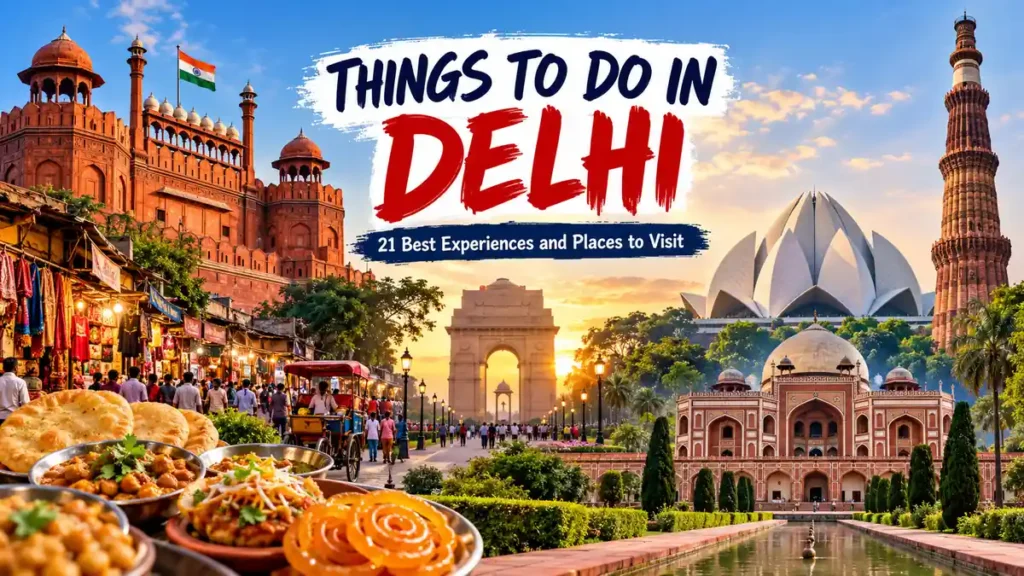
Delhi is the kind of city where a single day can move from a centuries-old Mughal fort to a crowded spice market, a peaceful garden, a monumental government avenue, and dinner in a modern neighborhood. The contrast is not a side attraction—it is what makes India’s capital fascinating.
The best things to do in delhi include exploring the Red Fort, Qutub Minar and Humayun’s Tomb, walking through Chandni Chowk, visiting India Gate, experiencing places of worship such as Jama Masjid and Gurudwara Bangla Sahib, relaxing in Lodhi Garden, discovering museums and trying Delhi’s famous street food. Delhi’s official tourism resources highlight this same mix of heritage, culture, cuisine, gardens, museums and religious landmarks. Delhi Tourism
1. Explore the Red Fort and the Heart of Old Delhi
Start with one of Delhi’s defining landmarks: the Red Fort, or Lal Qila.
Commissioned by Mughal emperor Shah Jahan in the 17th century, the vast red-sandstone complex was at the center of Mughal power. Its halls, gateways, gardens and defensive walls make it far more than a photo stop. Incredible India
Allow enough time to walk through the complex rather than simply photographing the Lahori Gate. The scale becomes much clearer once you are inside.
The fort also makes an excellent starting point for Old Delhi because Chandni Chowk and Jama Masjid are nearby.
Quick takeaway: Combine the Red Fort, Jama Masjid and Chandni Chowk on the same half-day rather than traveling back and forth across Delhi.
2. Get Lost in Chandni Chowk
If monuments explain Delhi’s history, Chandni Chowk shows how that history still lives.
Created during Shah Jahan’s reign and associated with his daughter Jahanara Begum, this historic commercial district stretches through a maze of lanes specializing in food, jewelry, textiles, spices and wedding goods. Incredible India
Instead of treating Chandni Chowk as one attraction, explore its smaller bazaars.
Dariba Kalan is associated with jewelry, Kinari Bazaar with decorative and wedding items, and Khari Baoli with the spice trade. Food is equally important, with everything from parathas and chaat to sweets and traditional Mughlai dishes.
The area can be overwhelming during busy periods. Comfortable shoes and patience help enormously.
3. See Jama Masjid
A short distance from the Red Fort stands Jama Masjid, one of the great architectural landmarks of Old Delhi.
Its red sandstone and white marble create a striking contrast with the tightly packed streets surrounding it. More importantly, visiting provides another perspective on Shahjahanabad, the Mughal city that developed around the Red Fort.
Remember that Jama Masjid remains an active place of worship. Dress respectfully, follow instructions concerning shoes and photography, and avoid disrupting prayers.
Afterward, explore the surrounding lanes for some of Old Delhi’s best-known food experiences.
4. Visit Qutub Minar and the Qutub Complex
Qutub Minar is much more interesting when you give the entire archaeological complex time rather than rushing in for a photograph.
The tower rises 72.5 meters and forms part of a UNESCO World Heritage Site representing an important period in Delhi’s early Indo-Islamic architecture. The surrounding monuments include the Quwwatu’l-Islam Mosque and Alai Darwaza. Ministry of Culture
Look closely at the different architectural styles, inscriptions and stonework as you walk through the complex.
The famous Iron Pillar is another reason not to leave immediately after seeing the minaret.
Combine Qutub Minar with Mehrauli
Travelers interested in history can continue into the wider Mehrauli area.
Mehrauli Archaeological Park contains tombs, ruins and historic structures from different periods. It offers a quieter contrast to Delhi’s headline monuments and helps reveal just how many historical layers survive across the city.
5. Walk Through Humayun’s Tomb
Humayun’s Tomb is one of the most rewarding historical places to visit in Delhi.
Built in the 16th century, it became the first major garden-tomb on the Indian subcontinent. Its Persian-influenced design and formal charbagh garden represented an important development in Mughal architecture and influenced later monuments, including the Taj Mahal. Ministry of Culture
The symmetry is part of the experience. Walk through the gardens before approaching the main structure so you can appreciate how the monument was designed as a complete landscape.
Humayun’s Tomb, Qutub Minar and the Red Fort are Delhi’s three UNESCO World Heritage properties highlighted by Delhi Tourism. Delhi Tourism
6. Slow Down at Sunder Nursery
Next to Humayun’s Tomb, Sunder Nursery provides a completely different pace.
This landscaped heritage park combines restored monuments, gardens, water features, walking paths and open lawns. It is particularly appealing after several hours of sightseeing in crowded parts of Delhi.
Visit in the cooler morning or late afternoon if you want to walk comfortably.
Pairing Sunder Nursery with Humayun’s Tomb is one of the easiest ways to combine major history with a relaxed outdoor experience.
7. Walk Around India Gate and the National War Memorial
India Gate is among the most recognizable landmarks in New Delhi.
The monument stands within the grand ceremonial landscape of central Delhi and commemorates Indian soldiers who died while serving in the British Indian Army during World War I and related conflicts. Nearby, the National War Memorial honors members of India’s armed forces. India’s official tourism portal includes both among Delhi’s principal attractions. Incredible India
The surrounding area is particularly pleasant around sunset and into the evening.
Continue along Kartavya Path for broader views of New Delhi’s monumental government district.
8. See Rashtrapati Bhavan and Central Delhi
Delhi isn’t only Mughal.
New Delhi’s broad avenues, government buildings and carefully planned administrative district tell the story of another important period in the city’s development.
Rashtrapati Bhavan, Parliament House and the wider Central Vista area form a dramatic architectural contrast with Old Delhi’s narrow lanes. Delhi Tourism specifically identifies these landmarks as part of the city’s colonial-era architectural heritage. Delhi Tourism
Even without entering the buildings, a walk or drive through this part of the capital helps visitors understand Delhi’s extraordinary urban contrasts.
9. Find Quiet at the Lotus Temple
The Lotus Temple offers one of the most distinctive modern architectural experiences in Delhi.
The Bahá’í House of Worship is instantly recognizable for its lotus-inspired form. But the building’s visual appearance is only half the experience.
Inside, silence is central.
People from different religions and backgrounds are welcome, making the temple a peaceful counterpoint to Delhi’s traffic and crowded streets. It consistently appears among major attractions recommended by both Delhi Tourism and contemporary travel guides. Delhi Tourism
Avoid rushing through simply to take photographs. Give yourself time to experience the quiet interior.
10. Experience Swaminarayan Akshardham
Swaminarayan Akshardham is another major religious and cultural complex.
The elaborate stone architecture, landscaped grounds and exhibitions make it possible to spend several hours here. It is particularly impressive later in the day when the changing light emphasizes the carvings and architectural details.
Security procedures can be strict, and rules regarding phones, cameras and personal belongings may apply. Check current visitor regulations before going.
Delhi Tourism and India’s national tourism portal both identify Akshardham as a major Delhi attraction. Delhi Tourism
11. Visit Gurudwara Bangla Sahib
Gurudwara Bangla Sahib provides one of Delhi’s most meaningful cultural experiences.
The white-marble Sikh gurdwara, its golden dome and large sarovar create a remarkably calm atmosphere despite its central location.
Visitors should cover their heads, remove their shoes and behave respectfully.
One particularly valuable part of the experience is learning about langar, the Sikh tradition of serving free community meals without distinction of religion, status or background.
Rather than treating Bangla Sahib purely as another sightseeing stop, observe how the religious and community spaces function together.
12. Walk Through Lodhi Garden
When Delhi starts feeling intense, head for Lodhi Garden.
The landscaped park combines greenery with historic tombs and structures from the Sayyid and Lodi periods. Locals use it for morning walks, exercise, picnics and quiet breaks from city traffic.
It is also one of the easiest historical attractions to enjoy without following a formal sightseeing route.
Recent Delhi travel coverage continues to recommend morning walks here, particularly during the city’s cooler autumn weather. The Indian Express
Explore Lodhi Art District Too
If you enjoy contemporary art, extend your walk toward Lodhi Colony.
Large-scale murals have transformed walls throughout the neighborhood into an open-air art experience. Lonely Planet includes the area’s murals among its recommended Delhi experiences. Lonely Planet
Together, Lodhi Garden and Lodhi Art District create an easy half-day mixing history, greenery and modern creativity.
13. Discover Agrasen Ki Baoli
Agrasen Ki Baoli feels surprisingly hidden for a monument located near central Delhi.
This historic stepwell descends below street level through a series of stone steps and arches. Its geometric form makes it popular with photographers, but the real appeal is the unusual sense of enclosure created as you descend.
Because it doesn’t require as much time as a fort or museum, Agrasen Ki Baoli works well alongside Connaught Place, Jantar Mantar or nearby central Delhi attractions.
It is included among Delhi Tourism’s notable heritage sites. Delhi Tourism
14. Spend an Evening in Connaught Place
Connaught Place—usually called CP—is one of the easiest places to experience modern central Delhi.
Its circular layout contains restaurants, cafés, shops and entertainment venues within recognizable colonial-era architecture. Janpath Market, Jantar Mantar and Gurudwara Bangla Sahib are also nearby.
Time Out describes Connaught Place as a central hub combining shopping, food and historic architecture. Time Out Worldwide
Come in the late afternoon, browse the shops, walk through the colonnades and stay for dinner.
For budget shopping, nearby Janpath is an easy addition.
15. Shop and Eat at Dilli Haat
Dilli Haat offers a more organized alternative to Delhi’s sprawling traditional markets.
The open-air complex brings together handicrafts, textiles, jewelry and regional foods associated with different parts of India. India’s national tourism portal lists Dilli Haat among Delhi’s visitor attractions. Incredible India
It is especially useful for first-time international visitors who want to explore Indian crafts without navigating a large wholesale bazaar.
Take time to look at the regional food stalls rather than treating Dilli Haat solely as a shopping destination.
16. Try Delhi’s Street Food
Food should be considered one of the essential things to do in delhi, not something squeezed between monuments.
Old Delhi is the obvious starting point.
Chandni Chowk and its surrounding lanes are associated with parathas, chaat, kebabs, sweets, lassi and generations-old food businesses. India’s official tourism portal describes the area as both a shopping destination and a major place to experience local and Mughlai cuisine. Incredible India
Popular foods to look for include:
- Paratha
- Chole bhature
- Dahi bhalla
- Aloo tikki and chaat
- Jalebi
- Kebabs
- Kulfi
- Butter chicken
- Nihari and other Mughlai dishes
Street-food hygiene varies considerably. Busy stalls with high turnover are generally a more practical choice, and travelers with sensitive stomachs may prefer freshly cooked food served hot.
17. Visit Hazrat Nizamuddin Dargah
For a different side of Delhi’s spiritual life, visit the area around Hazrat Nizamuddin Dargah.
The shrine is associated with the revered Sufi saint Nizamuddin Auliya and remains an important religious and cultural site. Humayun’s Tomb was itself located near the saint’s shrine, reflecting Nizamuddin’s historical significance. DMS Southeast Delhi
The surrounding neighborhood is dense and atmospheric, with narrow lanes leading toward the shrine.
Qawwali performances are strongly associated with the dargah, but schedules and access arrangements can change. Verify current timings before planning a visit specifically around a performance.
Dress modestly and remember that this is an active religious site rather than a staged tourist attraction.
18. Explore Hauz Khas
Hauz Khas illustrates another of Delhi’s unusual combinations: medieval ruins beside contemporary urban life.
The historic reservoir and monuments provide the area’s cultural anchor, while nearby streets contain cafés, restaurants and shops.
It works particularly well for travelers who have already seen Delhi’s major monuments and want a less formal afternoon or evening.
Lonely Planet highlights Hauz Khas Village among Delhi experiences beyond the city’s headline heritage attractions. Lonely Planet
19. Visit a Delhi Museum
Delhi’s museums can easily fill a rainy, extremely hot or heavily polluted day.
Depending on your interests, consider the National Gallery of Modern Art, National Rail Museum, National Science Centre, National Crafts Museum & Hastkala Academy, Pradhanmantri Sangrahalaya or Kiran Nadar Museum of Art.
India’s official tourism portal includes these institutions among the capital’s significant visitor attractions. Incredible India
Museum schedules can change, and some institutions close on particular weekdays. Always confirm current opening hours before making a special journey.
20. Discover Jantar Mantar
Jantar Mantar is an unusual scientific landmark in the center of New Delhi.
Its large masonry instruments were designed for astronomical observations, making the complex quite different from Delhi’s forts, tombs and religious buildings.
It is compact enough to combine with Connaught Place, Janpath, Agrasen Ki Baoli and Bangla Sahib.
The site is particularly worthwhile if you’re interested in astronomy, mathematics or the history of scientific observation in India. Delhi Tourism includes Jantar Mantar within its heritage attractions. Delhi Tourism
21. Explore Delhi Beyond the Famous Attractions
Once you have covered the headline monuments, Delhi becomes even more interesting.
Try Purana Qila for another chapter of the city’s fortified history, Safdarjung’s Tomb for late Mughal architecture, Raj Ghat for its association with Mahatma Gandhi, or Tughlaqabad Fort for dramatic ruins away from the busiest tourist circuit.
Nature lovers can explore Deer Park, Garden of Five Senses and other green spaces. Delhi Tourism’s attraction directory also includes places such as Hauz Khas Fort, National Police Memorial and numerous parks and gardens. Delhi Tourism
Travelers interested in contemporary culture can investigate Mandi House, which remains an important district for theater, visual arts and performance. Time Out Worldwide
Best Things to Do in Delhi for First-Time Visitors
If you only have a short stay, prioritize experiences that reveal different sides of the city rather than trying to tick off every monument.
A strong first visit might include:
- Old Delhi: Red Fort, Jama Masjid, Chandni Chowk and street food.
- South Delhi heritage: Qutub Minar and Mehrauli.
- Mughal architecture: Humayun’s Tomb and Sunder Nursery.
- Central Delhi: India Gate, Kartavya Path, Connaught Place and Bangla Sahib.
- Spiritual Delhi: Lotus Temple, Akshardham or Nizamuddin Dargah.
- Local life: Lodhi Garden, Dilli Haat or a neighborhood food experience.
This balance prevents a common mistake: spending an entire Delhi trip moving from one sandstone monument to another.
Free and Budget-Friendly Things to Do in Delhi
You do not need a large sightseeing budget to experience the capital.
Many of Delhi’s rewarding experiences involve neighborhoods, religious sites, public spaces, gardens and cultural districts rather than expensive attractions. Time Out’s coverage of free activities similarly emphasizes heritage, green spaces and cultural experiences. Time Out Worldwide
Walking through Lodhi Garden, exploring Connaught Place, experiencing Chandni Chowk’s atmosphere and visiting places of worship can make a full day even before paid monuments are added.
Public transport also helps keep costs manageable.
Things to Do in Delhi With Family
Families can mix historical attractions with more interactive experiences.
The National Science Centre can break up a monument-heavy itinerary, while the National Rail Museum appeals particularly to children interested in trains. Parks such as Lodhi Garden provide space to relax between sightseeing stops.
Akshardham can also occupy a substantial portion of a day because the complex extends beyond its main temple.
Avoid scheduling too many distant attractions on the same day. Delhi’s size and traffic can turn a seemingly short itinerary into an exhausting one.
What Is the Best Time to Visit Delhi?
Weather has a major impact on how enjoyable Delhi sightseeing feels.
The cooler months are generally the most comfortable for extensive outdoor exploration. Autumn can also be particularly pleasant once monsoon conditions recede and temperatures become more suitable for walking. The Indian Express
Summer can be extremely hot, making early mornings, indoor attractions and evening activities more practical.
During monsoon periods, carry rain protection and leave additional travel time.
Air quality can also fluctuate significantly, particularly during parts of autumn and winter, so check current conditions during your trip rather than relying on seasonal averages.
How Many Days Do You Need in Delhi?
Two days can cover several major landmarks, but the schedule will be busy.
Three days is a better starting point for first-time visitors. It gives you enough time to separate Old Delhi, central New Delhi and South Delhi rather than racing between them.
With four or five days, you can add museums, markets, parks, Mehrauli, Nizamuddin and neighborhoods such as Hauz Khas at a more comfortable pace.
A Simple 3-Day Delhi Itinerary
Day 1: Old Delhi
Begin at the Red Fort, continue to Jama Masjid and spend the afternoon exploring Chandni Chowk. Finish with an Old Delhi food experience.
Day 2: South and Central Delhi
Visit Qutub Minar early, followed by the Lotus Temple. Later, explore India Gate, Kartavya Path and Connaught Place.
Day 3: Humayun’s Tomb and Local Delhi
Start with Humayun’s Tomb and Sunder Nursery. Continue to Lodhi Garden and Dilli Haat, or spend the evening around Nizamuddin.
The exact order should depend on current opening days and hours.
How to Get Around Delhi
Delhi is enormous, so planning attractions by area is one of the simplest ways to save time.
The Delhi Metro connects large parts of the city and is particularly useful for avoiding road traffic on longer journeys. Delhi Tourism describes the city as having an extensive Metro network connecting its different areas. Delhi Tourism
Metro travel can be combined with auto-rickshaws, taxis or app-based rides for the final stretch.
In Old Delhi, walking is often necessary because many lanes are narrow and congested.
A practical rule is to group sightseeing geographically. Red Fort, Jama Masjid and Chandni Chowk belong together; Humayun’s Tomb and Sunder Nursery belong together; Connaught Place, Jantar Mantar, Agrasen Ki Baoli and Bangla Sahib can form another cluster.
Practical Tips for Exploring Delhi
Delhi rewards preparation without requiring a rigid minute-by-minute itinerary.
Start outdoor sightseeing early when possible. Carry drinking water, but be careful about unfamiliar water sources. Wear comfortable footwear because monuments and markets involve much more walking than their map locations suggest.
Dress modestly when visiting mosques, temples, gurdwaras and dargahs. Some religious complexes require visitors to remove shoes or cover their heads.
Traffic can be unpredictable, so don’t judge travel times purely by distance.
Most importantly, verify current opening days, entry rules, ticket prices and security restrictions directly with the attraction or an official tourism source before visiting. These details change more frequently than the monuments themselves.
Making the Most of the Best things to do in delhi
The most memorable things to do in delhi are not limited to checking famous monuments off a list. The city’s appeal comes from moving between different versions of Delhi: Mughal Shahjahanabad, medieval Mehrauli, monumental New Delhi and the neighborhoods where contemporary life unfolds around centuries of history.
See the Red Fort and Qutub Minar, but also walk through Chandni Chowk. Admire Humayun’s Tomb, then slow down in Sunder Nursery. Visit India Gate, eat local food, enter a place of worship and leave room for an unplanned market or neighborhood walk.
That combination of history, food, faith, architecture, gardens and everyday street life is what turns sightseeing in Delhi into an experience of the city itself.