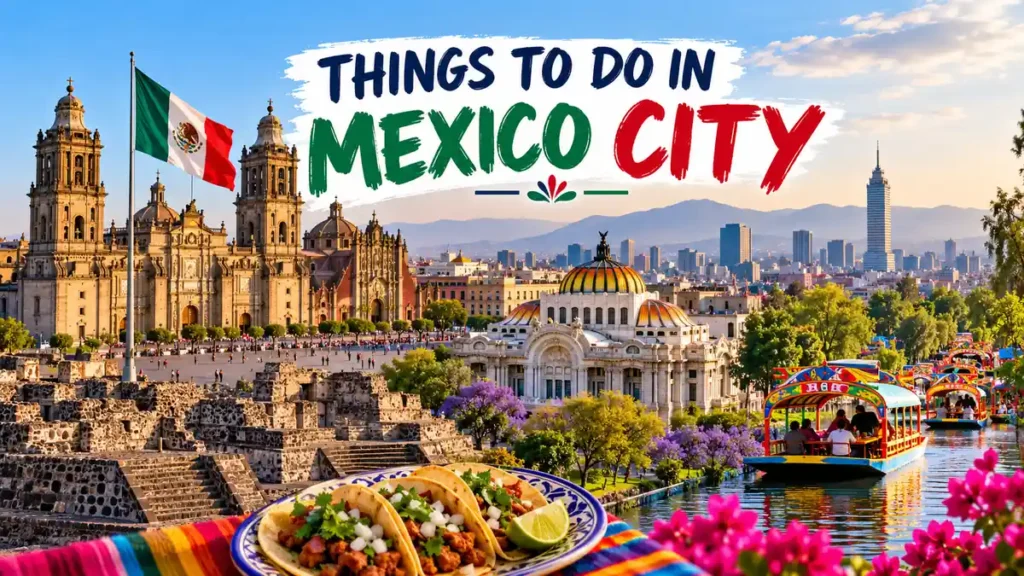
Mexico City can feel almost impossible to summarize. Ancient ruins sit beside colonial churches, world-class museums border enormous parks, and quiet neighborhood streets lead to some of the most exciting food in Mexico.
For first-time visitors, the challenge isn’t finding things to do in mexico city. It’s deciding which experiences deserve your limited time.
The best things to do in Mexico City include exploring the Centro Histórico, seeing the ruins of Templo Mayor, visiting the National Museum of Anthropology, walking through Chapultepec, discovering Frida Kahlo’s Casa Azul, eating tacos and market food, riding a trajinera in Xochimilco, and taking a day trip to Teotihuacán. The city’s official tourism guide organizes its major experiences around many of these same cultural areas.
This guide combines the essential landmarks with neighborhoods, food, museums, outdoor spaces, nightlife, and practical ways to experience the Mexican capital without turning your trip into a race between attractions.
1. Explore Mexico City’s Historic Center
If you’re visiting for the first time, start in the Centro Histórico. It gives you the clearest introduction to the layers of history that define Mexico City.
The historic center is remarkably dense. Pre-Hispanic archaeology, colonial architecture, monumental government buildings, museums, restaurants, pedestrian streets, and busy plazas all occupy the same part of town.
The official Mexico City visitor guide recommends a walking route connecting the Zócalo and Templo Mayor, making these natural starting points for exploring downtown.
Walk across the Zócalo
The Plaza de la Constitución, better known as the Zócalo, is the enormous central square at the heart of Mexico City.
Stand in the plaza for a few minutes before rushing anywhere else. From here you can appreciate the scale of the Metropolitan Cathedral and the surrounding historic buildings while watching daily city life unfold.
The square also hosts ceremonies, cultural events, exhibitions, celebrations, and seasonal installations, so the experience can look completely different depending on when you visit.
See the Metropolitan Cathedral
The Metropolitan Cathedral dominates the northern side of the Zócalo.
Its architecture reflects centuries of construction and changing artistic styles. Even travelers who aren’t particularly interested in religious architecture can appreciate the building as part of the historical landscape surrounding Mexico City’s main square.
Walk along Avenida Francisco I. Madero
From the Zócalo, follow the pedestrianized Madero corridor toward Alameda Central.
It’s busy, energetic, and packed with historic architecture, shops, churches, restaurants, and street activity. Walking rather than driving also makes it easier to notice architectural details that disappear when you’re moving through the city by car.
Quick takeaway: Allow at least half a day for Centro Histórico. Trying to squeeze it into an hour means missing much of what makes this part of Mexico City special.
2. Discover the Ancient Templo Mayor
One of the most fascinating things about Mexico City is that the modern capital stands where Tenochtitlan, the capital of the Mexica Empire, once flourished.
The archaeological remains of Templo Mayor sit just beside the Metropolitan Cathedral.
That physical contrast is extraordinary: pre-Hispanic ruins, colonial architecture, and the modern city occupy almost the same visual frame.
Visit the archaeological site and Museo del Templo Mayor rather than simply looking at the ruins from outside. The official tourism guide lists Museo del Templo Mayor among the city’s principal museum attractions.
Understanding Templo Mayor early in your trip also changes the way you experience Mexico City afterward. Street names, archaeological fragments, museums, monuments, and even the city’s geography begin to make more sense.
3. See Palacio de Bellas Artes
Few Mexico City landmarks are as instantly recognizable as the Palacio de Bellas Artes.
The building is impressive from outside, but its cultural importance goes much deeper. It is one of the city’s major venues for visual and performing arts, and the museum inside introduces visitors to important works of Mexican art.
The official city’s must-see route connects the ancient Templo Mayor with Palacio de Bellas Artes as part of the cultural journey through the Historic Center.
After visiting, walk through nearby Alameda Central, one of the most pleasant green spaces in downtown Mexico City.
Get a higher view of Bellas Artes
For a different perspective, look for an elevated viewpoint around the area. Seeing the palace’s distinctive dome against Mexico City’s dense skyline helps put the historic center into perspective.
This is especially worthwhile for photographers.
4. Spend a Day in Bosque de Chapultepec
When sightseeing starts feeling overwhelming, head to Bosque de Chapultepec.
Chapultepec isn’t simply a city park. It’s an enormous cultural and recreational district containing museums, gardens, lakes, monuments, wooded areas, cultural venues, and historic sites.
The official visitor guide describes the park as covering about 686 hectares and being divided into four sections.
You could easily spend an entire day here.
Walk beneath the trees, visit a museum, stop beside the lake, explore the botanical areas, or simply take a break from Mexico City’s busiest streets.
Among the attractions associated with the wider Chapultepec area are the National Museum of Anthropology, Chapultepec Castle, Museo Tamayo, Museo de Arte Moderno, the Natural History Museum, botanical garden, Audiorama, and other cultural spaces.
Don’t attempt to see everything in a single visit. Choose two or three major attractions and leave time for walking.
5. Visit Chapultepec Castle
Rising above the park from Chapultepec Hill, Castillo de Chapultepec offers history and some memorable views over the city.
The building has served several purposes throughout Mexican history, including an imperial residence and military institution. Today it houses the Museo Nacional de Historia.
The official city guide highlights its gardens, historic rooms, architecture, and panoramic terraces.
The climb uphill takes some effort, particularly at Mexico City’s altitude, so don’t rush.
Once at the top, spend time on the terraces. The views toward Paseo de la Reforma provide a useful visual lesson in just how enormous Mexico City really is.
6. Explore the National Museum of Anthropology
If you visit only one museum in Mexico City, the Museo Nacional de Antropología is an excellent candidate.
Its collections help explain Mexico’s Indigenous civilizations and cultural history through archaeology, monumental sculpture, artifacts, reconstructions, and ethnographic exhibits.
Among its famous objects is the Sun Stone, while other galleries explore civilizations and cultures from different regions of Mexico.
The official city guide identifies the museum as one of the key cultural attractions in Chapultepec and notes that it opened in 1964 in a building designed by architect Pedro Ramírez Vázquez.
Give yourself several hours rather than trying to rush through every gallery.
A useful strategy is to choose the civilizations or periods you’re most interested in and explore those rooms carefully. Museum fatigue is real, and this museum is large enough to cause it.
7. Walk Paseo de la Reforma
Paseo de la Reforma is one of Mexico City’s defining avenues.
It connects important districts and is lined with skyscrapers, historic monuments, cultural institutions, hotels, businesses, and public spaces.
One of its most recognizable landmarks is El Ángel de la Independencia, commonly called El Ángel.
The broader Chapultepec–Reforma corridor combines parks, museums, monuments, historic sites, and contemporary architecture, making it especially useful for visitors who enjoy exploring cities on foot.
Rather than treating Reforma as one attraction, use it as a route between several places you already want to visit.
8. Explore Roma Norte and Condesa
For a slower day, spend time walking through Roma Norte and Condesa.
These neighboring areas offer a different experience from monumental Centro Histórico.
You’ll find tree-lined streets, cafés, bakeries, restaurants, independent shops, galleries, parks, and architecture ranging from early-20th-century mansions to Art Deco apartment buildings.
Mexico City’s official tourism guide groups Roma, Condesa, and Polanco among its modern neighborhoods and highlights their design, architecture, and pedestrian-scale urban life.
Relax in Parque México
Parque México is one of Condesa’s most pleasant gathering spaces.
Instead of arriving with a sightseeing checklist, walk around, sit for a while, watch dogs racing through the park, and explore the surrounding streets.
Wander through Roma Norte
Roma rewards aimless walking.
Look for architectural details, small plazas, galleries, cafés, bookstores, restaurants, and neighborhood businesses.
This is one part of Mexico City where leaving an afternoon deliberately unplanned often works better than following a strict itinerary.
9. Visit Frida Kahlo’s Casa Azul
In Coyoacán, the Museo Frida Kahlo, commonly known as Casa Azul, occupies the distinctive blue house associated with one of Mexico’s most internationally recognized artists.
The museum provides an intimate perspective on Frida Kahlo’s life through her home, personal possessions, photographs, artwork, clothing, and other objects.
Lonely Planet highlights Casa Azul as one of its essential Mexico City experiences, emphasizing both Kahlo’s personal artifacts and the connection between the house and her life.
Because the museum is extremely popular, planning ahead is wise.
More importantly, don’t travel to Coyoacán only for Casa Azul. The surrounding neighborhood deserves several additional hours.
10. Spend an Afternoon in Coyoacán
Coyoacán feels noticeably different from central Mexico City.
Its plazas, older homes, cobblestone streets, churches, markets, cafés, trees, and neighborhood atmosphere make it ideal for slower exploration.
Walk around Jardín Centenario and the surrounding historic streets, browse the market, eat something locally, and stop for coffee.
Coyoacán works especially well when combined with Casa Azul, but avoid scheduling every minute. Much of the appeal comes from simply walking around.
If you’re interested in art, architecture, and Mexican cultural history, southern Mexico City contains several additional attractions that can turn this into a full-day excursion.
11. Ride a Trajinera Through Xochimilco
For an experience unlike anything in central Mexico City, travel south to Xochimilco.
The area is famous for its canals and colorful flat-bottomed boats known as trajineras.
But Xochimilco is more than a boat ride.
Its canal landscape preserves elements of the ancient lake environment and chinampa agricultural system. The official Mexico City guide notes that Xochimilco’s canals, chinampas, and historic communities form part of its UNESCO-recognized heritage.
Understand the chinampas
Chinampas are highly productive agricultural plots associated with the shallow lake environment of the Valley of Mexico.
Learning about them transforms Xochimilco from a colorful photo opportunity into a window onto the ecological and agricultural history of the region.
Choose your Xochimilco experience
Some visitors want music, food, groups of friends, and a lively trajinera ride.
Others prefer quieter ecological tours focused on canals, wildlife, agriculture, and chinampas.
Both experiences exist, so know which one you’re looking for before arriving.
12. Take a Day Trip to Teotihuacán
One of the most rewarding excursions from Mexico City is Teotihuacán.
The enormous archaeological complex lies outside the central city and is known for monumental structures including the Pyramid of the Sun, Pyramid of the Moon, and Avenue of the Dead.
The official Mexico City visitor guide includes Teotihuacán among the archaeological experiences connected with exploring the wider capital region.
Arrive early when possible. The archaeological zone is exposed, walking distances are significant, and midday heat can make exploring more tiring.
Bring water, comfortable shoes, sun protection, and enough time to appreciate the site’s scale.
Teotihuacán is not simply another attraction to photograph. Its urban planning and monumental architecture provide essential context for understanding the civilizations that flourished in central Mexico long before the Spanish conquest.
13. Eat Your Way Through Mexico City
Food should be treated as an activity in Mexico City, not something squeezed between attractions.
Street stands, neighborhood taquerías, bakeries, markets, traditional restaurants, contemporary kitchens, and fine-dining establishments all contribute to the city’s food culture.
Try several styles rather than searching for one definitive “best taco.”
Depending on where you go, you might encounter:
- Tacos al pastor
- Tacos de suadero
- Barbacoa
- Carnitas
- Tamales
- Tlacoyos
- Quesadillas
- Chilaquiles
- Pozole
- Mole
- Churros
- Pan dulce
Start with busy establishments where food turnover is high.
If you’re unfamiliar with street food, ordering small portions from several stalls is a good way to explore without committing to one huge meal.
Don’t assume every quesadilla contains cheese
Mexico City’s quesadilla terminology surprises many visitors.
If you specifically want cheese, saying so clearly avoids confusion. Small linguistic details like this are part of the fun of eating your way around the capital.
14. Explore Mexico City’s Markets
Markets reveal a side of Mexico City that museums can’t reproduce.
Fresh produce, flowers, prepared food, household goods, crafts, spices, sweets, and everyday neighborhood commerce come together in spaces that are simultaneously practical and cultural.
For flowers and sheer visual impact, Mercado de Jamaica is a memorable option. Lonely Planet includes Jamaica Market among the city’s colorful market experiences.
Food-focused travelers can also explore traditional neighborhood markets.
Go hungry, carry small denominations of pesos, and remember that these are working markets rather than staged tourist attractions.
15. Experience Lucha Libre
For an energetic evening, watch lucha libre.
Mexican professional wrestling mixes athletic performance, dramatic rivalries, colorful masks, humor, crowd participation, and decades of popular culture.
Arena México is one of the best-known venues.
Lonely Planet identifies lucha libre as a standout Mexico City experience and points to Arena México and Arena Coliseo among the venues associated with the tradition.
Even if you don’t normally watch wrestling, the atmosphere makes the experience accessible.
Pay attention to the crowd as much as the ring. Chants, reactions, jokes, and rivalries are a huge part of the night.
16. Visit Museo Soumaya
The striking exterior of Museo Soumaya makes it immediately recognizable in Polanco.
Inside is an extensive art collection spanning different periods and traditions.
It’s especially useful on an itinerary that already includes Polanco or nearby attractions rather than as an isolated trip across town.
The official Mexico City museum guide includes Museo Soumaya among its recommended must-see museums.
Afterward, explore the surrounding district for restaurants, shopping, architecture, and contemporary urban spaces.
17. Discover Mexico City’s Art Beyond the Famous Museums
The National Museum of Anthropology and Casa Azul attract enormous attention, but Mexico City’s cultural scene extends far beyond them.
The official tourism directory lists well over a hundred museum venues, covering archaeology, history, fine art, contemporary culture, science, and specialized subjects.
Depending on your interests, consider places such as:
- Museo Nacional de Arte
- Museo de Arte Moderno
- Museo Tamayo
- Museo Anahuacalli
- Museo del Templo Mayor
- Museo del Palacio de Bellas Artes
If you love art, dedicate an entire day to museums rather than trying to fit one between unrelated attractions.
Look for murals
Mexico’s mural tradition also makes public and institutional buildings part of the art experience.
Works associated with artists such as Diego Rivera, José Clemente Orozco, and David Alfaro Siqueiros provide a powerful introduction to 20th-century Mexican art and political history.
Check current access arrangements before planning a trip around a specific mural because restoration, exhibitions, or building restrictions can affect availability.
18. Spend an Evening at Plaza Garibaldi
For visitors interested in traditional Mexican music, Plaza Garibaldi offers one of Mexico City’s most famous nighttime experiences.
Mariachi musicians have long been associated with the plaza, and the surrounding area reflects an important part of the city’s popular musical culture.
The official tourism guide includes Plaza Garibaldi within its broader markets-and-gastronomy cultural route.
Go for the atmosphere rather than expecting a polished concert hall.
As with nightlife anywhere in a large city, stay aware of your surroundings, arrange transportation sensibly, and avoid wandering unfamiliar streets late at night without a plan.
19. Find a View Over Mexico City
Mexico City’s size is difficult to understand from street level.
Seeing it from above changes that.
Elevated viewpoints reveal dense neighborhoods stretching toward mountains and volcanoes on clearer days.
Several central buildings and observation areas offer skyline views. Chapultepec Castle also provides panoramic perspectives over the city and Reforma corridor.
Try to visit when visibility is good.
Late afternoon can be particularly atmospheric as daylight fades and the city begins to illuminate.
20. Experience Mexico City Like a Neighborhood City
The biggest mistake first-time visitors make is treating Mexico City as a collection of isolated attractions.
It’s better experienced neighborhood by neighborhood.
Instead of crossing the city repeatedly, group nearby places together.
A practical structure looks like this:
| Area | Experiences to Combine |
|---|---|
| Centro Histórico | Zócalo, Cathedral, Templo Mayor, Bellas Artes, Alameda Central |
| Chapultepec | Castle, Anthropology Museum, park, Reforma |
| Roma & Condesa | Architecture, parks, cafés, restaurants |
| Coyoacán | Casa Azul, plazas, market, neighborhood walks |
| Xochimilco | Trajineras, canals, chinampas |
| Polanco | Museo Soumaya, dining, architecture |
| Teotihuacán | Archaeological site and a dedicated day trip |
This approach reduces travel time and gives you more opportunities to notice ordinary city life between major attractions.
Best Free Things to Do in Mexico City
Mexico City can be surprisingly rewarding for travelers trying to control their budget.
Walking through the Zócalo, Centro Histórico, Roma, Condesa, Coyoacán, Reforma, and many public parks costs nothing.
You can also enjoy architecture, plazas, public monuments, neighborhood markets, and outdoor spaces without paying admission.
Chapultepec is particularly useful for budget travelers because simply walking through the forest and its public areas can occupy several hours. Some individual museums and attractions charge admission, while certain cultural spaces are free. For example, the Chapultepec Site Museum and Visitors Center currently lists free admission and Tuesday-to-Sunday opening.
Always check current admission policies before visiting, since schedules and prices can change.
Things to Do in Mexico City at Night
Mexico City doesn’t shut down when museums close.
Evenings can revolve around food, music, performance, wrestling, cocktail bars, neighborhood restaurants, or simply walking through lively areas before dinner.
Good nighttime experiences include:
- Watching lucha libre
- Listening to mariachi around Plaza Garibaldi
- Having dinner in Roma Norte
- Exploring Condesa’s restaurant and bar scene
- Seeing illuminated landmarks in Centro Histórico
- Attending a cultural performance
- Trying late-night tacos
Don’t schedule every evening.
Some of the best nights begin with dinner and develop naturally as you discover what’s happening nearby.
Things to Do in Mexico City With Families
Families don’t have to limit themselves to children’s attractions.
Chapultepec works particularly well because museums, outdoor spaces, walking paths, and family-oriented venues are concentrated in one enormous area.
The city’s Chapultepec route includes attractions such as Papalote Museo del Niño, the Natural History Museum, botanical spaces, and other recreational venues.
Other family-friendly possibilities include Xochimilco, selected museums, parks, food experiences, and archaeological excursions.
The key is pacing.
Mexico City’s altitude, traffic, distances, and enormous museums can exhaust younger travelers. One major attraction in the morning and a relaxed neighborhood activity later often works better than an ambitious sightseeing marathon.
How Many Days Do You Need in Mexico City?
You can see major highlights in three days, but four or five days gives Mexico City room to breathe.
A three-day trip might cover Centro Histórico, Chapultepec, the Anthropology Museum, Coyoacán, and one additional experience.
With five days, you can add Xochimilco, Roma and Condesa, more museums, food exploration, and potentially Teotihuacán without rushing constantly.
A seven-day visit makes it easier to explore less-touristed neighborhoods and spend longer in museums and markets.
The city’s official visitor resources themselves provide itineraries for different trip lengths, including one-, three-, and seven-day visits, reflecting how much the capital can offer across stays of very different durations.
A Simple 3-Day Mexico City Itinerary
Day 1: Historic Mexico City
Begin at the Zócalo.
Visit Templo Mayor and the Metropolitan Cathedral, then walk west through Centro Histórico toward Palacio de Bellas Artes and Alameda Central.
Spend the evening eating in the center or travel to Roma Norte for dinner.
Day 2: Chapultepec, Anthropology and Reforma
Start early at the National Museum of Anthropology.
Afterward, explore Bosque de Chapultepec and visit Chapultepec Castle.
Finish by walking part of Paseo de la Reforma and seeing El Ángel de la Independencia.
Day 3: Coyoacán and Xochimilco
Visit Casa Azul in the morning if you have secured admission.
Spend some time walking around Coyoacán before continuing south to Xochimilco for a trajinera ride.
Return to central Mexico City for dinner.
If Teotihuacán is a priority, add another day rather than trying to squeeze it into this schedule.
Getting Around Mexico City
Mexico City is huge, so transportation planning matters almost as much as choosing attractions.
The city’s Integrated Mobility Network connects different public transportation systems, and the official visitor site provides transportation information and a network map for travelers.
Depending on your route, useful options can include Metro, Metrobús, buses, Cablebús, light rail, taxis, ride-hailing services, cycling, and walking.
Don’t judge distance only by the map
Two places that look relatively close can take much longer to travel between than expected.
Traffic is one reason. The sheer scale of the metropolitan area is another.
Group attractions geographically whenever possible.
Use walking strategically
Centro Histórico, Roma, Condesa, Coyoacán, and sections around Chapultepec are enjoyable on foot.
But Mexico City isn’t one giant walkable tourist district. Sometimes public transport or a vehicle is far more practical than trying to walk between neighborhoods.
Practical Tips for Visiting Mexico City
A few decisions can make the trip significantly easier.
Take the altitude seriously
Mexico City sits at a high elevation.
Some travelers notice shortness of breath, fatigue, headaches, or reduced exercise tolerance during their first days.
Drink water, don’t overload your first day, and take uphill walks more slowly than you normally would.
Carry some cash
Cards are widely useful, but cash remains convenient for markets, street food, small purchases, and certain local businesses.
Smaller denominations are especially helpful.
Learn basic Spanish phrases
You can visit without fluent Spanish, particularly in major tourist areas, but simple phrases improve everyday interactions.
Greetings, numbers, ordering food, asking prices, and requesting directions go a long way.
Check opening days before building your itinerary
Museums don’t all follow identical schedules.
Some attractions may also require timed admission or advance booking.
Verify official hours shortly before visiting rather than relying on an old itinerary or travel post.
Leave space in your schedule
Mexico City rewards curiosity.
You may discover a bakery while walking through Roma, a small museum downtown, an interesting market stall in Coyoacán, or a plaza where something unexpected is happening.
A schedule packed from breakfast until midnight leaves no room for those discoveries.
What Should You Not Miss in Mexico City?
If your trip is short, prioritize experiences that reveal different sides of the capital rather than visiting ten similar attractions.
For a first visit, a balanced shortlist would include:
- Centro Histórico and the Zócalo
- Templo Mayor
- Palacio de Bellas Artes
- Bosque de Chapultepec
- National Museum of Anthropology
- Chapultepec Castle
- Roma and Condesa
- Coyoacán and Casa Azul
- Mexican street food
- Xochimilco or Teotihuacán
Together, these experiences cover archaeology, Indigenous history, colonial architecture, art, food, neighborhoods, nature, and modern urban culture.
When Is the Best Time to Visit Mexico City?
Mexico City can be visited throughout the year, but conditions change with the seasons.
Spring often brings warm daytime weather, while the rainy season generally means a greater chance of afternoon or evening showers. Later in the year, cooler conditions can make long days of walking comfortable.
Seasonal events can completely change the atmosphere.
Día de Muertos, Independence celebrations, exhibitions, festivals, concerts, and temporary cultural programs can add experiences that aren’t available year-round. The city’s official tourism portal maintains a current cultural calendar and seasonal visitor information, which is worth checking shortly before your trip.
Whatever month you choose, pack for temperature changes during the day and check the forecast before long outdoor excursions.
Final Thoughts on Things to Do in Mexico City
The most memorable things to do in mexico city aren’t limited to famous landmarks.
Yes, you should stand in the Zócalo, see Templo Mayor, walk through Chapultepec, explore the National Museum of Anthropology, and experience places such as Coyoacán and Xochimilco. Those attractions help explain the extraordinary history of the city.
But leave time for everything between them.
Eat tacos at a busy neighborhood stand. Walk a few extra blocks through Roma. Sit in a Coyoacán plaza. Browse a market without buying anything. Watch Mexico City move around you.
That’s when the capital stops feeling like a checklist of attractions and starts feeling like a place—vast, layered, complicated, and endlessly worth exploring.