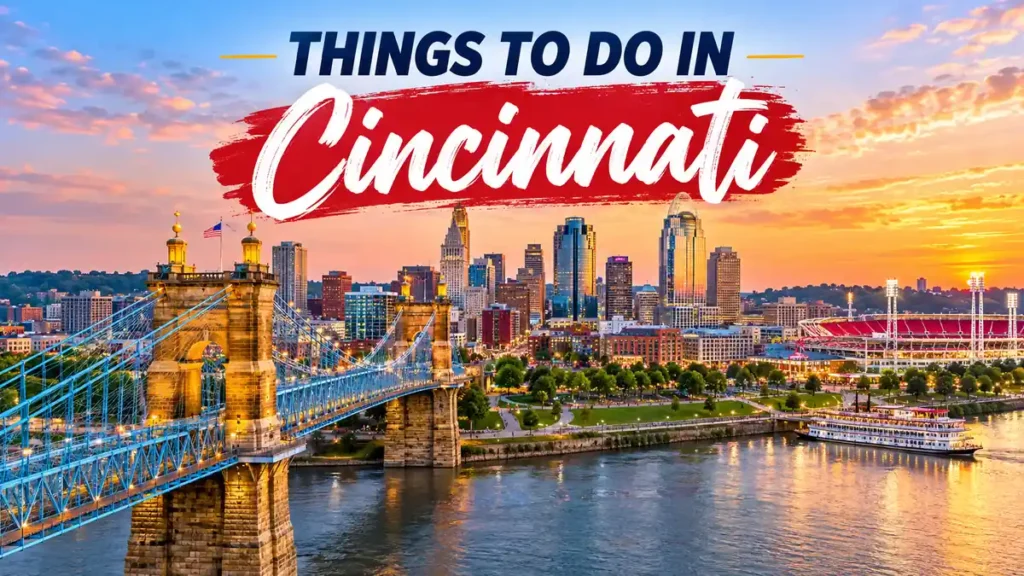
Cincinnati is the kind of city that rewards curiosity. One hour you can be exploring an Art Deco train terminal, and the next you are walking beside the Ohio River, browsing a historic public market, seeing world-class art, or wandering streets lined with 19th-century architecture.
If you are searching for things to do in cincinnati, start with the Cincinnati Zoo & Botanical Garden, Cincinnati Museum Center at Union Terminal, Findlay Market, Over-the-Rhine, Smale Riverfront Park, Cincinnati Art Museum, National Underground Railroad Freedom Center, and the John A. Roebling Suspension Bridge. Together, these attractions cover the city’s history, food, architecture, family activities, culture, and riverfront scenery.
Cincinnati works especially well for a weekend because many major attractions are concentrated around Downtown, the riverfront, Over-the-Rhine, and nearby neighborhoods. The free Cincinnati Connector streetcar also makes it easier to travel between several central districts without constantly moving your car.
Best Things to Do in Cincinnati for First-Time Visitors
First-time visitors do not need to see everything. A better strategy is to combine a few major attractions with time to walk through Cincinnati’s neighborhoods and riverfront.
Here are some of the city’s standout experiences:
| Attraction | Best For | Typical Visit |
|---|---|---|
| Cincinnati Zoo & Botanical Garden | Families, animals, gardens | Half day |
| Cincinnati Museum Center | History, science, architecture | 3–5 hours |
| Findlay Market | Local food and atmosphere | 1–2 hours |
| Over-the-Rhine | Architecture, dining, nightlife | 2–4 hours |
| Smale Riverfront Park | River views, walking, families | 1–2 hours |
| Cincinnati Art Museum | Art and free activities | 2–3 hours |
| Freedom Center | American history | 3–4 hours |
| Roebling Suspension Bridge | Views and photography | 30–60 minutes |
| Fountain Square | Downtown atmosphere | 30–60 minutes |
| Great American Ball Park | Baseball and sports | 3+ hours |
You can comfortably combine several downtown attractions in one day, while the zoo or Museum Center usually deserves a larger block of time.
1. Explore the Cincinnati Zoo & Botanical Garden
The Cincinnati Zoo & Botanical Garden is one of the city’s signature family attractions and an easy choice when deciding what to do in Cincinnati with kids.
Rather than treating it as a quick stop, allow several hours. Animal activity can change throughout the day, and the zoo notes that many animals have access to indoor and outdoor areas and may move between them.
The botanical side of the property also deserves attention. Seasonal plantings and landscaped areas make the experience more than a sequence of animal habitats.
What actually works
Arrive near opening time if possible. You will generally have more time to explore before afternoon fatigue sets in, particularly when traveling with children.
Check the zoo’s official schedule before visiting because operating hours, animal availability, encounters, and seasonal programming can change.
2. Visit Cincinnati Museum Center at Union Terminal
Even travelers who normally skip museums should consider Union Terminal.
Cincinnati Union Terminal opened in 1933 and is one of the city’s defining examples of Art Deco architecture. Today, the building houses multiple museums, an OMNIMAX theater, archives, and other cultural attractions.
The Cincinnati Museum Center complex includes the Cincinnati History Museum, Museum of Natural History & Science, and Children’s Museum.
Do not rush straight through the rotunda.
Look up, study the architecture and mosaics, and take a few minutes to appreciate the building itself. The terminal is as much a Cincinnati attraction as the institutions housed inside it.
Quick Takeaway
Choose Union Terminal when you want an indoor attraction that can occupy several hours and still appeal to people with different interests.
3. Walk Through Findlay Market
Findlay Market is one of the best places to experience Cincinnati through food rather than sightseeing alone.
The historic public market is closely associated with the Over-the-Rhine neighborhood and brings together food vendors, specialty products, local businesses, and a lively neighborhood atmosphere. Visit Cincy describes it as one of the country’s oldest public markets.
Come hungry.
Instead of deciding on one restaurant beforehand, walk around first. See what is open, compare stalls, and turn the visit into an informal tasting experience.
The surrounding streets also make Findlay Market a natural starting or ending point for exploring Over-the-Rhine.
4. Discover Over-the-Rhine
Over-the-Rhine, usually shortened to OTR, is one of the neighborhoods that gives Cincinnati its distinctive character.
Its preserved architecture, restaurants, bars, shops, entertainment venues, and public spaces make it suitable for both daytime wandering and an evening out.
Architecture is a major part of the appeal. Cincinnati’s tourism organization highlights OTR’s Italianate facades and the city’s substantial collection of preserved historic architecture.
A good OTR visit is deliberately unhurried.
Start around Washington Park or Findlay Market, walk several blocks, notice the building details, stop somewhere that interests you, and continue exploring on foot.
5. Relax at Smale Riverfront Park
When the weather cooperates, the riverfront should be part of almost any Cincinnati itinerary.
Smale Riverfront Park provides open space along the Ohio River close to major downtown attractions. It is particularly useful for families who need a break between museums and structured activities.
The surrounding riverfront also gives you access to skyline views, walking routes, bridges, stadiums, and other downtown landmarks.
Visit Cincy specifically recommends combining Smale Riverfront Park with the Roebling Suspension Bridge when exploring the downtown riverfront.
Visit around sunset if your schedule allows. The changing light over the river and Northern Kentucky makes this one of the easiest scenic experiences in the city.
6. Walk Across the John A. Roebling Suspension Bridge
Few activities give you a stronger sense of Cincinnati’s relationship with the Ohio River than crossing the John A. Roebling Suspension Bridge.
The bridge connects Cincinnati with Covington, Kentucky, allowing visitors to experience two states on foot during the same outing.
It also has major engineering significance. Visit Cincy notes that the bridge was once the world’s longest suspension bridge and preceded John A. Roebling’s better-known Brooklyn Bridge.
Pedestrian access makes it particularly appealing for sightseeing and photography.
Pair the crossing with Smale Riverfront Park rather than making a separate trip solely for the bridge.
7. Learn at the National Underground Railroad Freedom Center
The National Underground Railroad Freedom Center is one of Cincinnati’s most significant historical institutions.
Its location beside the Ohio River carries particular meaning. The river represented a major geographic boundary between slave states to the south and free states to the north, giving Cincinnati an important place in Underground Railroad history.
The museum uses permanent and temporary exhibitions to explore the Underground Railroad and broader struggles for freedom.
This is not a museum to squeeze into an hour between other attractions. The institution recommends allowing roughly three to four hours.
Give the exhibits enough time to register rather than approaching the museum as a checklist stop.
8. See the Cincinnati Art Museum
The Cincinnati Art Museum is particularly valuable for travelers looking for free things to do in Cincinnati.
Located in Eden Park, the museum was founded in 1881 and has a collection spanning thousands of years of artistic history. Visit Cincy reports a collection of approximately 73,000 works spanning about 6,000 years.
General admission to the museum’s permanent collection is free, although special exhibitions may require tickets.
That makes it easy to adapt the visit to your schedule. Spend an hour focusing on selected galleries or devote several hours to exploring more thoroughly.
Combining the museum with Eden Park is particularly effective on a pleasant day.
9. Spend Time in Eden Park
Eden Park offers a quieter contrast to Downtown Cincinnati.
The park’s green spaces and elevated setting make it useful when you want scenery and a slower pace after spending several hours inside museums.
Because the Cincinnati Art Museum is located here, the two attractions pair naturally.
Instead of driving elsewhere immediately after visiting the museum, leave some time to walk around the park and enjoy the surroundings.
10. Visit Krohn Conservatory
Krohn Conservatory is another reason to include Eden Park in your Cincinnati plans.
The conservatory provides an indoor botanical experience that can work particularly well during cold, rainy, or excessively hot weather.
It is also manageable when you have limited time. You do not necessarily need half a day, making it easy to combine with the Cincinnati Art Museum and other nearby attractions.
For travelers interested in gardens, plants, photography, or simply a calm break from downtown sightseeing, it is worth considering.
11. Experience Fountain Square
Fountain Square functions as one of Cincinnati’s central gathering spaces.
Located downtown, it regularly hosts activities and events and provides an easy reference point for exploring the surrounding business and entertainment districts. Visit Cincy describes it as the unofficial heart of the city.
You do not need to schedule hours here.
Instead, use Fountain Square as part of a downtown walking route. Stop for photos, see what is happening, then continue toward the riverfront, restaurants, museums, or nearby streets.
12. Explore Washington Park
Washington Park is one of the most useful stopping points while exploring Over-the-Rhine.
Its location near Cincinnati Music Hall makes it particularly attractive for architecture enthusiasts. The surrounding blocks provide a strong introduction to the neighborhood’s historic character.
Families may appreciate having an open outdoor space between meals, shopping, and other attractions.
The Cincinnati Connector streetcar makes the broader OTR and Downtown area easier to navigate without a car. The route runs a 3.6-mile loop through central Cincinnati.
13. Admire Cincinnati Music Hall
Cincinnati Music Hall is worth seeing even if you are not attending a performance.
The historic building stands beside Washington Park and is one of the city’s major architectural landmarks. Visit Cincy identifies it as a notable example of Victorian Gothic architecture.
If your trip dates align with a performance, seeing the building while attending a concert or other event gives you a more complete experience.
Otherwise, include the exterior while walking through Over-the-Rhine.
14. Catch a Cincinnati Reds Game
Baseball has unusually deep roots in Cincinnati, making a Reds game more than a generic professional sporting event.
Great American Ball Park sits beside the Ohio River, so the location itself adds to the experience.
If there is no game during your trip, you can still explore the riverfront area around the stadium and combine it with Smale Riverfront Park and the Roebling Suspension Bridge.
On game days, expect the riverfront and surrounding restaurants to become much busier.
15. See the Cincinnati Bengals
Football fans visiting during the NFL season may want to build their itinerary around a Cincinnati Bengals home game.
The stadium’s downtown riverfront location means you can combine the game with other central Cincinnati activities rather than treating it as an isolated excursion.
Allow additional time for crowds, security, parking, and pregame activity.
If attending a game is a priority, arrange that part of your itinerary first and fit flexible attractions around it.
16. Experience FC Cincinnati
Soccer has become another major part of Cincinnati’s sports culture.
FC Cincinnati plays at TQL Stadium near Over-the-Rhine, putting visitors close to restaurants, bars, Findlay Market, and other attractions.
A match can therefore become the centerpiece of an entire neighborhood outing rather than simply a few hours inside the stadium.
For sports travelers, checking the schedules of FC Cincinnati, the Reds, and Bengals before booking your trip can reveal opportunities you might otherwise miss.
17. Discover Cincinnati’s Public Art and Murals
You do not need to enter a museum to find art in Cincinnati.
Murals and other public artworks appear throughout the urban core, adding another layer to walking tours through Downtown and Over-the-Rhine.
Visit Cincy emphasizes that public art is spread throughout the region and is a significant part of Cincinnati’s arts identity.
Rather than trying to find every mural, treat them as discoveries while walking between attractions.
This turns ordinary travel time into sightseeing.
18. Visit the Contemporary Arts Center
For modern and contemporary work, the Contemporary Arts Center provides a very different experience from the Cincinnati Art Museum.
Its downtown building was designed by architect Zaha Hadid and opened in 2003. Visit Cincy highlights both the architecture and the institution’s multiple floors of exhibition space.
It works particularly well for travelers interested in contemporary culture, architecture, and experimental exhibitions.
Pair it with Fountain Square and other downtown destinations to minimize travel time.
19. See the American Sign Museum
The American Sign Museum is one of Cincinnati’s more unusual attractions.
Instead of traditional fine art or local history displays, it focuses on commercial signage and the visual history of American advertising.
That makes it a good alternative when you have already visited major art and history museums or simply want something different.
It is also among the museums highlighted by Cincinnati’s tourism organization as part of the city’s broad cultural offering.
Photography enthusiasts may find the colorful displays especially appealing.
20. Explore Cincinnati’s Brewing Heritage
Beer is closely tied to Cincinnati’s German-American history, particularly around Over-the-Rhine.
Today, that heritage appears in breweries, historic buildings, tours, and neighborhood culture.
The wider Cincinnati region has more than 60 active breweries, according to Visit Cincy.
If you drink alcohol, a brewery visit can be an enjoyable evening activity. If you do not, you can still explore the historical side of Cincinnati’s brewing story through neighborhood walks and local history.
The key is to think beyond individual drinks: brewing played an important role in the city’s economic and immigrant history.
21. Try Cincinnati-Style Chili
Cincinnati-style chili is one of those local foods that makes more sense when you stop expecting conventional chili.
It is commonly served over spaghetti or hot dogs and topped in different combinations with ingredients such as shredded cheese, beans, and onions.
Visitors often have strong reactions to it, which is part of the fun.
Approach it as a regional specialty rather than comparing it directly with Texas-style or other traditional chili.
Trying local food is one of the simplest ways to add something distinctly Cincinnati to an otherwise standard sightseeing itinerary.
22. Take a River Cruise
The Ohio River is fundamental to Cincinnati’s geography and history, so seeing the city from the water offers a perspective that walking downtown cannot provide.
Sightseeing cruises operated in the region allow visitors to view the skyline, bridges, and riverfront from the river. Visit Cincy specifically highlights BB Riverboats as one way to experience the surrounding landscape from the water.
Cruises work particularly well for couples, families, and travelers who want sightseeing without spending several hours walking.
Schedules can be seasonal, so verify availability before building your day around one.
23. Explore Northern Kentucky
One of Cincinnati’s advantages is that another state is directly across the river.
Covington and Newport, Kentucky, can easily become part of a Cincinnati trip rather than requiring a separate vacation.
Walking across the Roebling Suspension Bridge is one option for reaching Northern Kentucky, while the broader riverfront transportation network provides additional connections.
Visit Cincy’s regional itineraries frequently combine Cincinnati with Northern Kentucky because attractions on both sides are geographically close.
This is especially useful for a two- or three-day visit when you want variety without spending hours driving.
24. Visit Newport Aquarium
Families looking for additional indoor activities can cross into Newport, Kentucky, for Newport Aquarium.
Although technically outside Cincinnati, it is part of the broader Cincy visitor experience and appears prominently among regional attractions recommended by the area’s official tourism organization.
The aquarium can occupy a significant portion of a family day.
Visit Cincy’s one-day regional itinerary suggests allowing roughly two hours when incorporating Newport Aquarium into a packed sightseeing schedule.
Afterward, enjoy views across the river toward Cincinnati before returning downtown.
25. Explore Cincinnati’s Neighborhoods
One of the most common travel mistakes is spending an entire Cincinnati trip moving from attraction to attraction without experiencing the neighborhoods between them.
Cincinnati has dozens of neighborhoods with distinct identities. Visit Cincy describes the region as having 70 neighborhoods and emphasizes the different atmosphere each offers.
Over-the-Rhine is the obvious starting point, but it should not necessarily be the end of your neighborhood exploration.
Depending on your interests, devote some unstructured time to walking, eating, browsing local businesses, and observing the architecture.
Those unscheduled hours are often where a city begins to feel like a place rather than a collection of tourist attractions.
Free Things to Do in Cincinnati
Cincinnati can be surprisingly manageable for budget travelers.
Some of the most enjoyable experiences do not require an admission ticket.
You can walk the riverfront, explore Smale Riverfront Park, cross the Roebling Suspension Bridge, visit Fountain Square, wander through Over-the-Rhine, browse Findlay Market, look for public murals, explore Washington Park, and ride the Cincinnati Connector streetcar.
The Cincinnati Art Museum is another standout because general admission is free, although certain special exhibitions may be ticketed.
A budget-focused day could therefore include the Art Museum, Eden Park, Downtown, Fountain Square, the riverfront, and the Roebling Bridge while keeping attraction costs minimal.
Things to Do in Cincinnati With Kids
Families have several strong choices, but trying to fit too many into one day usually backfires.
For younger visitors, prioritize interactive or outdoor experiences:
- Cincinnati Zoo & Botanical Garden
- Cincinnati Museum Center and Children’s Museum
- Smale Riverfront Park
- Newport Aquarium
- Eden Park
- Krohn Conservatory
- Riverfront walks
- Cincinnati Reds games
The Museum Center is especially useful during poor weather because several experiences are housed within Union Terminal.
The zoo, meanwhile, is better treated as the main event for the day rather than something squeezed between other attractions.
A simple rule helps: choose one major attraction, one flexible outdoor stop, and a relaxed meal. That usually produces a better family day than racing between five ticketed attractions.
Things to Do in Cincinnati for Couples
Couples can build a Cincinnati day around neighborhoods, food, art, and the river rather than conventional romantic attractions.
Start with the Cincinnati Art Museum and Eden Park, explore Over-the-Rhine in the afternoon, have dinner nearby, and finish with a riverfront walk.
A sunset crossing of the Roebling Suspension Bridge is another simple option.
For an evening-focused itinerary, consider live music, performing arts, a river cruise, a sporting event, or one of Cincinnati’s entertainment venues.
Cincinnati has longstanding opera, symphony, ballet, and performing-arts institutions as well as large and small live-music venues.
Indoor Things to Do in Cincinnati
Rain does not have to ruin a Cincinnati trip.
The city has enough museums and cultural institutions to fill multiple days indoors.
Good choices include Cincinnati Museum Center, the Cincinnati Art Museum, National Underground Railroad Freedom Center, Contemporary Arts Center, American Sign Museum, and Krohn Conservatory.
If the forecast looks poor, avoid rigidly scheduling outdoor attractions.
Move museums to the rainy portion of your trip and save the riverfront, bridge, parks, and neighborhood walking for clearer weather.
That small amount of flexibility can substantially improve a weekend visit.
Best Things to Do in Cincinnati at Night
Cincinnati’s evening options vary considerably by neighborhood.
Over-the-Rhine is a natural starting point for restaurants, bars, breweries, entertainment, and live performances.
Sports events can dominate an evening when the Reds, Bengals, or FC Cincinnati are playing at home.
The city’s performing-arts scene offers another alternative. Depending on the calendar, visitors may find ballet, opera, symphony performances, theater, comedy, concerts, and smaller live-music events.
For something quieter, walk the riverfront and enjoy the illuminated skyline and bridges.
Always check venue schedules before your trip rather than assuming a particular performance or event runs every night.
How to Spend One Day in Cincinnati
If you only have one day, concentrate on Downtown and Over-the-Rhine.
Morning: Findlay Market and Over-the-Rhine
Begin at Findlay Market.
Have breakfast or an early lunch, then walk through Over-the-Rhine toward Washington Park and Cincinnati Music Hall.
Afternoon: Downtown and History
Continue toward Downtown.
Choose either the National Underground Railroad Freedom Center or another central museum based on your interests.
If you prefer a less museum-heavy itinerary, explore Fountain Square and Cincinnati’s public art instead.
Late Afternoon: Riverfront
Walk through Smale Riverfront Park and toward the Roebling Suspension Bridge.
Crossing the bridge gives you excellent views of the Cincinnati skyline and puts you briefly in Northern Kentucky.
Evening: Food, Sports, or Entertainment
Return to Downtown or Over-the-Rhine for dinner.
If there is a Reds, Bengals, or FC Cincinnati game, live performance, or concert during your visit, make that the final activity.
This approach minimizes transportation and gives you history, architecture, food, neighborhoods, and river views in a single day.
How to Spend a Weekend in Cincinnati
Two days provide enough time to see the city without constantly checking the clock.
Day 1: Downtown, OTR, and the River
Start at Findlay Market and explore Over-the-Rhine.
See Washington Park and Cincinnati Music Hall before moving Downtown. Visit the Freedom Center or Contemporary Arts Center, then finish around Smale Riverfront Park and the Roebling Suspension Bridge.
Have dinner in Downtown or OTR.
Day 2: Choose a Major Attraction
Make the Cincinnati Zoo & Botanical Garden or Cincinnati Museum Center the centerpiece of your second day.
If you choose the Museum Center, spend time admiring Union Terminal itself.
Alternatively, combine Cincinnati Art Museum, Eden Park, and Krohn Conservatory for a more relaxed arts-and-nature day.
With additional time, cross the river into Newport or Covington.
What Is Cincinnati Best Known For?
Cincinnati is known for its Ohio River setting, historic architecture, German-American heritage, professional sports, museums, arts institutions, brewing culture, Cincinnati-style chili, and distinctive neighborhoods.
Its location also shapes its identity.
The city sits where different regional influences meet, and the Ohio River historically connected Cincinnati to commerce while also forming a critical boundary in the history of slavery and freedom in the United States. The Freedom Center’s riverfront location reflects that history directly.
For visitors, the result is a destination where architecture, food, American history, sports, and outdoor sightseeing can all fit into the same trip.
Is Cincinnati Worth Visiting?
Cincinnati is particularly worthwhile for travelers who enjoy city breaks where attractions are varied but relatively close together.
You can spend one morning in a historic market, tour an Art Deco landmark in the afternoon, watch professional sports in the evening, and explore museums, parks, historic neighborhoods, and another state the following day.
The city also works for different budgets because several major experiences—riverfront walks, public parks, neighborhoods, architecture, murals, the streetcar, and general admission to the Cincinnati Art Museum—can be enjoyed for free.
When Is the Best Time to Visit Cincinnati?
There is no single ideal season because the best time depends on what you want to do.
Spring is attractive for gardens, parks, and comfortable sightseeing. Summer brings longer days, baseball, outdoor events, and riverfront activity, although heat and humidity can affect walking-heavy itineraries.
Fall works particularly well for neighborhood exploration, sports, and seasonal events. Winter shifts the emphasis toward museums, performances, indoor attractions, restaurants, and holiday activities.
Always check Cincinnati’s current event calendar before finalizing dates. Festivals, games, concerts, temporary exhibitions, and major events can dramatically change what is available during a particular weekend. Visit Cincy’s current calendar, for example, lists changing arts, festival, and seasonal programming throughout the region.
How to Get Around Cincinnati
You can explore much of central Cincinnati without driving between every attraction.
Downtown is compact enough for walking, and pedestrian routes connect the urban core with the riverfront.
The Cincinnati Connector is particularly helpful. The free streetcar follows a 3.6-mile loop through central areas and connects Downtown with Over-the-Rhine and destinations such as Washington Park and Findlay Market.
For a first visit, group attractions geographically:
Downtown and Riverfront: Fountain Square, Freedom Center, Smale Riverfront Park, stadiums, Roebling Suspension Bridge.
Over-the-Rhine: Findlay Market, Washington Park, Cincinnati Music Hall, restaurants and historic architecture.
Eden Park: Cincinnati Art Museum, Krohn Conservatory and park scenery.
Union Terminal: Cincinnati Museum Center and related museums.
Avondale area: Cincinnati Zoo & Botanical Garden.
This approach saves time and reduces unnecessary driving.
Practical Tips for Visiting Cincinnati
Check official attraction websites shortly before visiting. Hours, ticket policies, temporary exhibitions, animal availability, special events, construction, and transportation conditions can change.
This is particularly important around the riverfront. The National Underground Railroad Freedom Center currently advises visitors that Brent Spence Bridge Corridor construction and related ramp closures may affect travel routes.
Wear comfortable shoes if your itinerary includes Downtown and Over-the-Rhine. Cincinnati is walkable in key visitor areas, but you may cover considerably more ground than expected.
Avoid overscheduling museums. Cincinnati Museum Center, the zoo, and the Freedom Center can each consume a substantial part of a day.
Finally, leave room for spontaneous stops. Findlay Market, OTR, Downtown, and the riverfront are more enjoyable when every 30 minutes is not assigned to a different attraction.
Final Thoughts on Things to Do in Cincinnati
The best things to do in cincinnati are not limited to one type of traveler. The city combines major family attractions such as the Cincinnati Zoo, serious cultural institutions such as the Freedom Center and Cincinnati Art Museum, distinctive architecture at Union Terminal, local food at Findlay Market, professional sports, historic neighborhoods, and an accessible Ohio River waterfront.
For a first trip, keep the plan simple: explore Over-the-Rhine, visit one major museum or the zoo, spend time along the riverfront, walk the Roebling Suspension Bridge, and try something distinctly local.
That combination provides a much better introduction to Cincinnati than racing through a long checklist—and leaves enough unexplored to make another visit worthwhile.