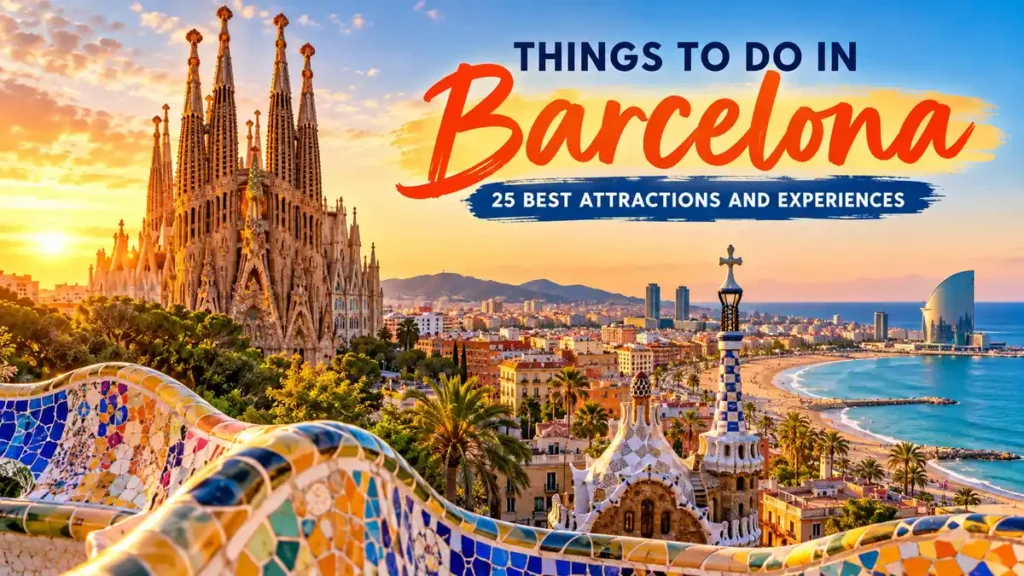
Barcelona rewards curiosity. One moment you are standing beneath the extraordinary towers of the Sagrada Família; an hour later, you could be wandering medieval lanes, eating tapas at a neighborhood bar, or watching the Mediterranean from the beach.
The best things to do in barcelona include visiting Antoni Gaudí’s Sagrada Família and Park Güell, exploring the Gothic Quarter, seeing Casa Batlló and La Pedrera, walking La Rambla, eating at local markets, relaxing on Barceloneta Beach, discovering Montjuïc, visiting art museums, and exploring neighborhoods such as El Born and Gràcia. Lonely Planet
The city’s biggest strength is variety. Barcelona combines architecture, Catalan history, beaches, food, museums, nightlife, parks, and walkable neighborhoods in a way that makes even a short visit feel remarkably varied.
1. Visit the Sagrada Família
No first visit to Barcelona feels complete without seeing the Sagrada Família.
Designed by Catalan architect Antoni Gaudí, the basilica is Barcelona’s defining landmark. Its exterior combines monumental towers with extraordinarily detailed façades, while the interior feels completely different. Branching columns rise toward the ceiling like trees, and colored light pours through enormous stained-glass windows.
Don’t make the mistake of seeing it only from outside. Much of Gaudí’s architectural vision becomes clearer once you enter.
The basilica uses timed admission, and official information recommends arranging tickets ahead of your visit. Opening hours vary by season and can change for special events. Sagrada Família
Quick takeaway: If you book only one paid attraction in Barcelona, the Sagrada Família is the obvious place to start.
2. Explore Park Güell
Park Güell shows another side of Gaudí.
Instead of a monumental church, you get colorful mosaics, curving structures, gardens, unusual stonework, and sweeping views across Barcelona.
The famous serpentine bench overlooking the city is one of the park’s signature sights, but don’t rush directly there. Give yourself time to notice how architecture and landscape blend together throughout the site.
Morning can be pleasant if you prefer cooler temperatures, while later in the day can produce beautiful city views.
Wear comfortable shoes—the park includes slopes and uneven sections.
3. Get Lost in the Gothic Quarter
Barcelona’s Barri Gòtic, or Gothic Quarter, is a place where getting slightly lost is part of the experience.
Its narrow streets reveal small plazas, historic churches, stone buildings, cafés, shops, and fragments of Barcelona’s much older past.
The district preserves traces of Roman Barcino alongside the medieval city that later developed here. Barcelona’s official tourism organization describes it as a neighborhood where the Roman and medieval layers of the city meet its modern life. Barcelona Turisme
Look for landmarks including:
- Barcelona Cathedral
- Plaça Reial
- Plaça Sant Jaume
- Plaça del Rei
- Roman remains
- Pont del Bisbe
Visit some major landmarks, but also allow yourself to turn down streets simply because they look interesting.
4. See Casa Batlló
On Passeig de Gràcia, Casa Batlló looks unlike almost any conventional apartment building.
Its flowing façade, colorful ceramic details, unusual balconies, curved windows, and organic forms demonstrate how far Gaudí was willing to depart from traditional architectural rules.
The interior is equally imaginative.
Doors, staircases, ventilation systems, windows, and furniture reveal how carefully Gaudí considered both appearance and function.
Casa Batlló works particularly well for travelers who want to understand Gaudí beyond the Sagrada Família.
5. Tour La Pedrera — Casa Milà
A short walk along Passeig de Gràcia brings you to another Gaudí masterpiece: Casa Milà, commonly known as La Pedrera.
Its rippling stone façade immediately stands out, but the rooftop is the real surprise.
Sculptural chimneys and ventilation towers transform functional architectural elements into something resembling an open-air artwork.
Visiting both Casa Batlló and La Pedrera provides an excellent introduction to Catalan Modernisme, the architectural movement that helped shape Barcelona’s visual identity.
6. Walk Down La Rambla
Few Barcelona streets are better known than La Rambla.
The broad pedestrian boulevard runs through the historic center toward the waterfront, passing shops, cafés, historic buildings, cultural venues, and markets.
Barcelona’s tourism authority describes walking La Rambla as one of the city’s characteristic rituals, linking landmarks such as the Canaletes fountain, Liceu, Boqueria, and Columbus Monument. Barcelona Turisme
It is worth seeing, particularly on a first trip, but don’t spend your entire day there.
The smaller streets branching into the Gothic Quarter and El Raval often reveal more of everyday Barcelona.
As in other crowded tourist areas, keep valuables secure and remain aware of your surroundings.
7. Eat Your Way Through La Boqueria
Just off La Rambla sits Mercat de Sant Josep de la Boqueria, better known as La Boqueria.
Its stalls display fruit, seafood, meat, cheeses, olives, sweets, and other ingredients associated with Spanish and Catalan cooking.
Rather than treating the market as simply another attraction, use it as an introduction to Barcelona’s food culture.
Go beyond whatever stall is closest to the entrance and explore deeper into the market.
Barcelona also has neighborhood markets that can offer a less tourist-focused experience, so La Boqueria can be the beginning rather than the end of your market exploration. Barcelona’s official visitor resources highlight markets and Catalan cuisine as important parts of the city’s gastronomic identity. Barcelona Turisme
8. Discover El Born
El Born balances historic architecture with contemporary city life.
Walk through its narrow streets and you’ll find boutiques, cafés, bars, galleries, medieval buildings, and cultural attractions.
One major landmark is the Basilica of Santa Maria del Mar, one of Barcelona’s most recognizable Gothic churches.
Nearby, El Born Centre de Cultura i Memòria occupies a former market structure and preserves archaeological remains connected with Barcelona around 1700 and the events surrounding 1714. Barcelona Turisme
El Born works especially well in the late afternoon. Explore the streets, visit a cultural site, stop for a drink, and stay for dinner.
9. Relax on Barceloneta Beach
Barcelona gives you something relatively unusual for a major European city: sightseeing and beach time in the same trip.
Barceloneta is the city’s best-known beach area and one of the easiest to combine with the historic center.
Swimming and sunbathing are obvious options in warmer weather, but the waterfront remains useful outside peak summer. You can walk, cycle, sit beside the Mediterranean, or continue along the coast.
Barcelona’s official tourism site notes that the city’s climate makes its beaches usable throughout the year for different seaside activities. Barcelona Turisme
If Barceloneta feels crowded, continue farther along the coast toward other city beaches.
10. Spend Half a Day on Montjuïc
Montjuïc deserves more time than many first-time visitors give it.
The hill rises above the port and contains gardens, museums, viewpoints, sporting facilities, and cultural attractions.
Places to consider include:
- Museu Nacional d’Art de Catalunya (MNAC)
- Fundació Joan Miró
- Montjuïc Castle
- Olympic facilities
- Poble Espanyol
- Botanical gardens
- Scenic viewpoints
The MNAC is particularly significant for visitors interested in Catalan art, with collections extending from medieval works through later artistic periods. Barcelona Turisme
Montjuïc also provides a welcome break from the dense streets of central Barcelona.
11. Visit the Museu Nacional d’Art de Catalunya
Even travelers who aren’t dedicated museum visitors should consider the Museu Nacional d’Art de Catalunya, commonly abbreviated as MNAC.
The museum covers centuries of Catalan art. Its Romanesque collection is especially notable, while later galleries extend through Gothic, Renaissance, Baroque, modern, and other periods.
The setting is part of the experience.
MNAC occupies the imposing Palau Nacional on Montjuïc, and the surrounding terraces provide broad views toward the city.
12. Explore the Picasso Museum
Barcelona played an important role in Pablo Picasso’s early development, making the city’s Picasso Museum particularly interesting for anyone curious about his formative years.
The museum is located around medieval Carrer Montcada in El Born.
That location adds another layer to the visit. Barcelona’s tourism authority describes Carrer Montcada as a street of medieval, Renaissance, and Baroque palaces associated with the city’s historic elite. Barcelona Turisme
Allow time afterward to explore El Born rather than immediately moving to another part of the city.
13. See the Palau de la Música Catalana
Gaudí isn’t the only architect responsible for Barcelona’s Modernista reputation.
The Palau de la Música Catalana, designed by Lluís Domènech i Montaner, demonstrates a different interpretation of Catalan Modernisme.
Its richly decorated concert hall combines sculpture, mosaics, stained glass, decorative columns, and intricate architectural details.
The building is recognized as a UNESCO World Heritage Site and is one of Barcelona’s major architectural attractions. Barcelona Turisme
You can attend a performance or explore the architecture through a visit.
14. Visit Recinte Modernista de Sant Pau
One of the smartest additions to a Barcelona architecture itinerary is the Recinte Modernista de Sant Pau.
Also associated with Domènech i Montaner, the former hospital complex features decorated pavilions, gardens, tiled roofs, mosaics, and interconnected spaces.
Barcelona’s tourism authority describes Sant Pau as Europe’s foremost Art Nouveau complex. Barcelona Turisme
It also pairs naturally with the Sagrada Família because the two landmarks are relatively close.
If your schedule allows, walk between them rather than taking transport.
15. Wander Through Gràcia
If central Barcelona begins to feel dominated by sightseeing, head to Gràcia.
Once an independent town, the neighborhood still has a strong local identity. Its smaller streets and public squares create a different atmosphere from the monumental avenues of Eixample.
Spend time around neighborhood plazas, browse independent shops, have coffee, or stay for dinner.
Gràcia also makes a natural addition to a Park Güell day.
Instead of leaving the area immediately after the park, walk downhill through the neighborhood and experience a more everyday side of Barcelona.
16. Walk Through Parc de la Ciutadella
Parc de la Ciutadella provides a green break near El Born.
Its paths, lawns, trees, monuments, and surrounding cultural institutions make it a convenient place to slow down between attractions.
You can combine it with the nearby Arc de Triomf, El Born, or the waterfront.
Barcelona has more green space than first-time visitors sometimes expect. The city’s tourism resources highlight numerous parks and gardens spread throughout its neighborhoods. Barcelona Turisme
17. Photograph the Arc de Triomf
Barcelona’s red-brick Arc de Triomf was constructed as the main entrance for the 1888 Barcelona Universal Exposition.
Today, the broad pedestrian promenade beneath and around it is popular with walkers, cyclists, street performers, and photographers.
It isn’t an attraction requiring hours of your day.
Instead, use it as part of a walking route:
Arc de Triomf → Parc de la Ciutadella → El Born → waterfront
That produces a much more efficient sightseeing day than visiting each location separately.
18. Experience Barcelona’s Food Culture
Some of the most memorable things to do in Barcelona happen at a table rather than inside a landmark.
Try Catalan and Spanish dishes and ingredients such as:
- pa amb tomàquet
- escalivada
- bombas
- croquettes
- seafood
- cured meats
- Catalan cheeses
- crema catalana
Tapas can be part of the experience, but don’t assume every local meal consists of tapas.
Barcelona’s food scene extends from traditional Catalan restaurants and neighborhood bars to markets, bakeries, contemporary dining, and internationally recognized restaurants. The city’s official tourism resources emphasize Catalan cuisine, food markets, wine, and modern gastronomy as distinct parts of Barcelona’s food culture. Barcelona Turisme
One practical approach is to eat slightly away from the most heavily visited landmarks. A restaurant on the busiest tourist street is not automatically bad, but exploring residential neighborhoods usually gives you more choices.
19. Watch the Sunset From a Viewpoint
Barcelona’s grid of streets, mountains, Mediterranean coastline, and distinctive architecture becomes easier to understand from above.
Montjuïc provides several excellent viewpoints, but it isn’t your only option.
Popular elevated perspectives include areas around:
- Montjuïc
- Park Güell
- Turó de la Rovira
- Tibidabo
- city rooftop terraces
The Turó de la Rovira, often associated with the Bunkers del Carmel viewpoint, has become particularly popular for panoramic city views.
Sunset attracts crowds, so arriving earlier can make the experience more relaxed.
20. Discover Barcelona’s Roman History
Modernisme gets much of the attention, but Barcelona’s history stretches far beyond Gaudí.
The Roman settlement of Barcino occupied part of what is now the Gothic Quarter.
Fragments of Roman walls and archaeological remains survive around the old city, allowing visitors to trace a Barcelona that existed centuries before its medieval streets took shape.
This deeper historical layer is one reason walking through the Gothic Quarter is more rewarding when you understand what you’re seeing. Official Barcelona tourism material specifically connects today’s Barri Gòtic with both Roman Barcino and the later medieval city. Barcelona Turisme
History lovers should consider adding the city’s history and archaeological collections to their itinerary.
21. Visit Fundació Joan Miró
Art lovers should make time for Fundació Joan Miró on Montjuïc.
Dedicated to Catalan artist Joan Miró, the foundation contains a substantial collection of his work alongside temporary exhibitions and contemporary art programming.
Barcelona’s tourism authority says the institution holds more than 14,000 exhibits connected with the artist and its collection. Barcelona Turisme
The building and its Montjuïc setting also make the visit appealing beyond the individual artworks.
Pair it with MNAC, Montjuïc’s gardens, or the castle rather than making a separate trip up the hill.
22. Explore Poble Espanyol
Built for Barcelona’s 1929 International Exhibition, Poble Espanyol brings together architectural styles inspired by different parts of Spain.
Today, the open-air complex includes reconstructed streets and squares alongside workshops, shops, restaurants, exhibitions, and cultural activities.
Barcelona’s tourism authority describes it as an open-air museum combining architecture with crafts, restaurants, shops, and activities. Barcelona Turisme
Because it’s on Montjuïc, Poble Espanyol fits easily into a larger day exploring the hill.
23. Take a Trip to Tibidabo
Look toward the hills behind Barcelona and you’ll notice Tibidabo rising above the city.
The mountain provides expansive views and a completely different atmosphere from the historic center.
It is particularly popular with families because of the amusement park, while the Temple of the Sacred Heart of Jesus adds another distinctive feature to the skyline.
Tibidabo takes more effort to reach than central attractions, so it works best when you have at least three or four days in Barcelona rather than trying to squeeze everything into one afternoon.
24. Experience Barcelona After Dark
Barcelona doesn’t simply shut down when museums close.
Evenings are an important part of experiencing the city.
Start with a neighborhood walk, stop for a drink or vermouth, have dinner, and then decide whether you want live music, cocktails, dancing, or simply another stroll through the illuminated streets.
El Born, Gràcia, Eixample, Poble-sec, and parts of the old city each offer different evening atmospheres.
For something more culturally focused, check the program at Palau de la Música Catalana or another performance venue.
The key is pacing yourself. Barcelona is often enjoyed later than cities where dinner begins early.
25. Take a Day Trip Beyond Barcelona
Once you’ve covered the major Barcelona attractions, several worthwhile destinations can extend your trip.
Montserrat is among the most popular. Its dramatic mountain landscape and monastery provide a striking contrast to Barcelona’s dense urban environment.
Other possibilities include:
Girona, for medieval streets, historic architecture, and its old quarter.
Sitges, for beaches and a relaxed coastal atmosphere.
Figueres, particularly for travelers interested in Salvador Dalí.
Don’t sacrifice your only full day in Barcelona for a day trip. But with four or five days available, exploring beyond the city can add useful variety.
Best Free Things to Do in Barcelona
You can experience plenty of Barcelona without constantly paying entrance fees.
Walking through the Gothic Quarter, exploring Gràcia and El Born, strolling along La Rambla, relaxing beside the Mediterranean, visiting Parc de la Ciutadella, photographing Arc de Triomf, exploring public squares, and enjoying city viewpoints can fill much of a day.
Architecture fans can also see the façades of Casa Batlló, La Pedrera, Sagrada Família, and numerous Modernista buildings from public streets.
That makes Barcelona relatively easy to adapt to different budgets.
Save your admission budget for the interiors that matter most to you rather than trying to enter every famous building.
Things to Do in Barcelona With Families
Barcelona works well for family trips because sightseeing doesn’t have to mean spending entire days inside museums.
Children may particularly enjoy:
- Barcelona’s beaches
- Parc de la Ciutadella
- CosmoCaixa science museum
- Tibidabo
- Poble Espanyol
- Park Güell
- Montjuïc
- cable-car rides
- waterfront walks
CosmoCaixa is especially useful on bad-weather days. Barcelona’s tourism authority describes it as an interactive science and environment museum designed to make scientific subjects entertaining and accessible. Barcelona Turisme
Mix major monuments with parks, beaches, and hands-on activities rather than scheduling several architecture tours back-to-back.
What to Do in Barcelona in One Day
With only one day, concentrate on the essentials rather than crossing the city repeatedly.
Start with the Sagrada Família, then continue toward Passeig de Gràcia to see Casa Milà and Casa Batlló.
Spend the afternoon exploring the Gothic Quarter and La Rambla before continuing toward El Born or the waterfront.
Finish near Barceloneta or at a viewpoint if time allows.
A one-day itinerary inevitably leaves major attractions out, but it gives you a strong introduction to Gaudí, historic Barcelona, and the Mediterranean side of the city.
What to Do in Barcelona in Three Days
Three days gives you enough time to organize sightseeing geographically.
Day 1: Gaudí and Modernisme
Start at Sagrada Família, visit Recinte Modernista de Sant Pau, and continue toward Park Güell and Gràcia.
Day 2: Old Barcelona and the Waterfront
Explore the Gothic Quarter, La Rambla, La Boqueria, El Born, Parc de la Ciutadella, and Barceloneta.
Day 3: Montjuïc and Eixample
Spend the morning around Casa Batlló and La Pedrera before heading to Montjuïc for MNAC, Fundació Joan Miró, gardens, viewpoints, or Poble Espanyol.
This neighborhood-based approach minimizes unnecessary travel and gives you more time actually experiencing Barcelona.
How Many Days Do You Need in Barcelona?
Three full days is a useful minimum for a first visit.
That gives you enough time for Gaudí’s major works, the old city, several neighborhoods, and either the beach or Montjuïc without rushing constantly.
Four days provides more breathing room.
Five days allows you to add museums, lesser-known neighborhoods, longer meals, and potentially a day trip.
Barcelona can certainly be visited in a weekend, but trying to check off every major attraction in two days usually means spending too much of the trip moving between sights.
Best Time to Visit Barcelona
Spring and autumn are particularly attractive periods for travelers who want comfortable sightseeing weather without relying entirely on beach activities.
Summer offers long days and excellent conditions for combining sightseeing with the coast, but popular attractions can be busy and daytime temperatures can make long walking routes tiring.
Winter provides a quieter city experience, although beach activities become less central.
Barcelona remains a year-round destination because many of its biggest attractions—architecture, food, museums, historic neighborhoods, markets, and cultural venues—don’t depend on summer weather.
Practical Tips for Visiting Barcelona
A few decisions can make a significant difference to your trip.
Book major Gaudí attractions ahead. Sagrada Família uses online ticketing and timed entry, and its official site says tickets can currently be purchased roughly two months ahead. Sagrada Família
Organize days by neighborhood. Pair the Gothic Quarter with El Born, Park Güell with Gràcia, and Montjuïc’s attractions with one another.
Walk when practical. Barcelona is particularly rewarding at street level because architecture, plazas, cafés, and neighborhood life often become part of the sightseeing.
Use public transport for longer journeys. The metro is useful when moving between areas that aren’t naturally connected on foot.
Wear comfortable shoes. Historic streets, hills, parks, and long walking days can quickly add up.
Leave unscheduled time. Barcelona is one of those cities where a plaza, market, bakery, side street, or neighborhood bar you didn’t plan to visit can become a highlight.
Making the Most of the Best Things to Do in Barcelona
The best things to do in barcelona aren’t limited to checking famous monuments off a list. The city becomes far more interesting when you combine its landmarks with its neighborhoods, food, history, art, parks, viewpoints, and Mediterranean coastline.
Start with Sagrada Família and Gaudí’s architecture, wander through the Gothic Quarter and El Born, spend time on Montjuïc, experience the markets and Catalan food culture, and leave room for Gràcia, the beach, and places you discover accidentally.
That’s the real advantage of Barcelona: the journey between its famous attractions can be every bit as memorable as the attractions themselves.