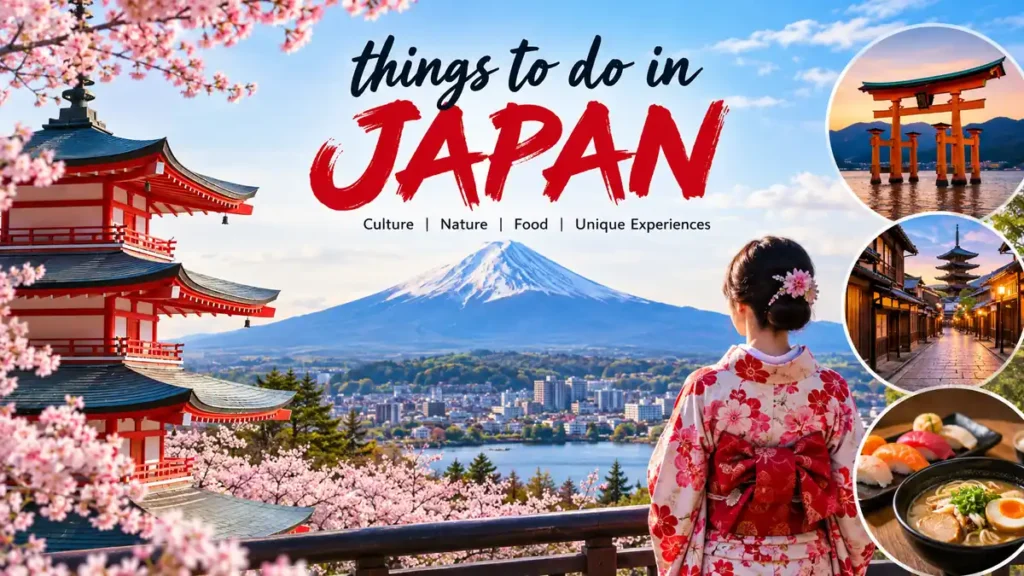
Japan can feel almost impossible to summarize. One morning you can walk through a centuries-old Shinto shrine, spend the afternoon inside a futuristic digital-art installation, and finish the day eating ramen beneath Tokyo’s neon signs. Travel a few hours and the landscape changes again—from alpine mountains and hot springs to subtropical beaches.
For first-time visitors, the best things to do in japan combine Tokyo’s modern energy, Kyoto’s temples and traditional neighborhoods, Osaka’s food culture, the Shinkansen, an authentic onsen, a ryokan stay, regional Japanese cuisine, and at least one journey into the country’s mountains, islands, or countryside.
Japan rewards travelers who treat it as more than a checklist of famous attractions. The memorable moments often happen between landmarks: buying an onigiri at a konbini before a train ride, walking through a quiet neighborhood at dawn, soaking in a mountain hot spring, or discovering a regional dish you had never heard of.
Here are 25 experiences that show just how varied a trip to Japan can be.
1. Explore Tokyo’s Different Personalities
Tokyo isn’t really one experience. It is dozens of distinct neighborhoods connected by one of the world’s most useful urban rail systems.
Start in Asakusa, where Senso-ji provides a glimpse of older Tokyo. Walk through Kaminarimon Gate and Nakamise shopping street before exploring the quieter lanes around the temple.
Then jump forward several centuries in Shibuya. The famous Shibuya Crossing is busiest after dark, when enormous screens and illuminated buildings transform the intersection into one of Japan’s most recognizable urban scenes.
Other areas reveal completely different sides of the capital:
- Shinjuku for skyscrapers, entertainment streets, restaurants, and nightlife
- Harajuku for youth fashion and pop culture
- Meiji Jingu for a peaceful shrine surrounded by forest
- Akihabara for anime, manga, electronics, arcades, and gaming culture
- Ginza for architecture, department stores, galleries, and polished shopping
- Shinjuku Gyoen National Garden for a break from the city’s density
Senso-ji and Shinjuku Gyoen remain among Tokyo’s prominent visitor attractions.
Don’t Try to “Finish” Tokyo
A common first-trip mistake is racing across the city to collect landmarks.
Tokyo works better neighborhood by neighborhood. Pick two adjoining areas for each half-day and leave enough time to wander. A tiny shrine, basement food hall, stationery shop, jazz bar, or neighborhood ramen counter may become more memorable than the attraction you originally came to see.
2. Walk Through Kyoto’s Temples and Shrines
Kyoto is the cultural centerpiece of many first journeys through Japan.
Its biggest draw is not a single monument but the concentration of temples, shrines, gardens, traditional streets, crafts, and seasonal landscapes.
Fushimi Inari-taisha is particularly memorable. Thousands of vermilion torii gates climb the wooded slopes of Mount Inari, creating tunnels of red-orange pillars.
Tripadvisor currently lists Fushimi Inari-taisha among Japan’s highest-profile attractions, alongside Kyoto’s Kinkaku-ji, the celebrated Golden Pavilion.
Also make time for:
Kiyomizu-dera: A historic temple complex overlooking eastern Kyoto.
Kinkaku-ji: The gold-covered pavilion reflected in its surrounding pond is one of Kyoto’s classic scenes.
Gion and Higashiyama: Traditional streets where old wooden machiya buildings survive among restaurants, teahouses, temples, and shops.
Arashiyama: Known for its bamboo grove, temples, river scenery, and surrounding hills.
JNTO highlights Kyoto and Nara as major gateways to traditional Japanese culture while also encouraging visitors to explore less-visited cultural destinations elsewhere in the country.
Visit Kyoto Early
Kyoto’s most famous places can become extremely crowded.
At locations such as Fushimi Inari and popular Higashiyama streets, arriving early in the morning changes the experience dramatically. You’ll get quieter paths, cooler temperatures during warmer months, and more time to notice architectural and landscape details.
3. Eat Your Way Through Osaka
Osaka is one of Japan’s great food cities.
The most famous place to begin is Dotonbori, where illuminated signs reflect in the canal and restaurants compete for attention with giant crabs, octopuses, dragons, and other extravagant storefront decorations.
Try takoyaki, bite-sized balls of batter traditionally filled with octopus, and okonomiyaki, a savory pancake associated strongly with Osaka.
Then explore beyond Dotonbori.
Markets, izakaya, standing bars, neighborhood restaurants, and shopping streets reveal a less polished but often more interesting side of the city.
JNTO specifically highlights Dotonbori and Shinsaibashi among Japan’s food-and-drink destinations.
Osaka also makes an excellent base for visiting Kyoto, Nara, Kobe, and other destinations in the Kansai region.
4. Ride the Shinkansen Bullet Train
The Shinkansen is transportation that doubles as a travel experience.
Japan’s high-speed railway connects major destinations quickly and comfortably, making journeys such as Tokyo to Kyoto straightforward.
For many travelers, the first bullet-train ride is a highlight in itself. Stations are busy but highly organized, trains are comfortable, and watching cities turn into countryside through the window gives you a better sense of Japan’s geography.
On certain Tokyo–Kyoto journeys, clear weather can produce excellent views of Mount Fuji, so check which side of the train offers the appropriate view when reserving your seat.
Bring an ekiben, a boxed meal designed for railway journeys, and the trip becomes part of the sightseeing rather than dead travel time.
One practical point: don’t automatically assume a nationwide Japan Rail Pass is cheaper. Calculate the cost of your planned journeys against individual tickets and regional passes before deciding.
5. See Mount Fuji
Few landscapes symbolize Japan as powerfully as Mount Fuji.
You don’t have to climb it to appreciate it.
The Fuji Five Lakes area, including Lake Kawaguchiko, offers some of the most accessible views of the mountain and is among JNTO’s recommended areas.
Visibility matters. Fuji can disappear behind clouds even when the surrounding weather seems pleasant, so an overnight stay gives you more opportunities than a tightly scheduled day trip.
Can You Climb Mount Fuji?
Yes, but climbing and simply visiting are very different activities.
The official climbing season is limited, routes and regulations can change, and conditions near the summit are considerably colder and harsher than at lower elevations. Anyone planning the climb should check current official trail information before departure rather than relying on an old itinerary.
Outside the climbing season, enjoy Fuji from viewpoints, lakes, museums, hot springs, and nearby towns instead.
6. Stay in a Traditional Ryokan
A ryokan turns accommodation into part of the trip.
Traditional rooms commonly feature tatami flooring, low furniture, futon bedding, and Japanese hospitality practices that differ considerably from a conventional Western hotel.
Many ryokan are located in hot-spring towns and include communal or private bathing facilities.
Some stays also include elaborate multi-course meals.
You don’t need to spend every night in traditional accommodation. One carefully chosen ryokan stay—particularly in a smaller town or onsen destination—can provide a useful contrast to city hotels in Tokyo and Osaka.
7. Soak in an Onsen
Few experiences feel more distinctly Japanese than soaking in a steaming onsen surrounded by mountain scenery.
Hot-spring culture exists throughout the country, from famous resort towns to remote rural inns.
JNTO highlights destinations including Beppu and Yufuin, as well as Tohoku hot-spring areas such as Nyuto Onsenkyo and Zao Onsen.
Before entering, learn the basic bathing etiquette. Wash thoroughly before entering the bath, don’t wear a swimsuit unless the facility specifically allows it, and keep the small bathing towel out of the water.
Tattoo policies vary significantly. Some facilities welcome tattooed guests, some permit small tattoos if covered, and others have restrictions. Check before visiting rather than assuming.
8. Experience a Japanese Tea Ceremony
A tea ceremony offers a quieter introduction to Japanese aesthetics.
The preparation of matcha involves carefully structured movements, utensils, seasonal details, architecture, and hospitality. What appears simple at first reveals layers of ritual and attention.
Kyoto has many visitor-friendly tea experiences, but tea culture extends well beyond the city.
For someone rushing between temples, a formal tea experience also provides something increasingly rare on busy itineraries: an hour in which slowing down is the entire point.
9. Discover Japanese Food Beyond Sushi
Eating is easily one of the best things to do in japan because cuisine changes dramatically from region to region.
Start with the obvious favorites—sushi, ramen, tempura, yakitori and udon—but keep going.
Traditional Japanese cuisine is commonly described as washoku, while yoshoku refers broadly to Japanese interpretations of Western-style foods. JNTO also emphasizes how regional and seasonal ingredients shape Japanese dining from Hokkaido through Kyushu and Okinawa.
Look for:
- Kaiseki for carefully presented seasonal multi-course dining
- Shojin ryori for Buddhist vegetarian cuisine
- Izakaya for casual shared dishes and drinks
- Yatai for street-stall dining
- Soba and udon for regional noodle traditions
- Tonkatsu for breaded pork cutlets
- Yakitori for grilled skewers
- Okonomiyaki for savory griddled pancakes
- Regional seafood wherever you are near the coast
Ramen alone has enormous regional variation, including shoyu, miso and tonkotsu styles.
Eat Regionally
One of the easiest ways to improve a Japan itinerary is to stop ordering the same famous dishes everywhere.
Look for each region’s meibutsu, or local specialty. Regional foods can tell you something about local climate, agriculture, fishing, history, and trade that a generic restaurant cannot.
10. Visit Nara and Meet the Deer
Nara is an easy addition to a Kansai itinerary and was one of Japan’s ancient capitals.
The free-roaming deer around Nara Park attract much of the attention, but the city’s temples and cultural heritage are the stronger reason to stay beyond a quick photo stop.
Visit Todai-ji, home to its monumental Great Buddha, then explore the park and nearby shrines on foot.
Buy only designated deer crackers if you want to feed the animals. Remember that the deer are accustomed to people but remain animals rather than props; avoid teasing them with food or crowding them for photographs.
11. See Hiroshima Peace Memorial Park and Miyajima
Hiroshima adds an essential historical dimension to a trip through Japan.
The Hiroshima Peace Memorial, including the surviving Atomic Bomb Dome, stands as a reminder of the destruction of 1945. JNTO recognizes the Hiroshima Peace Memorial as a UNESCO site and describes it as a structural reminder of a painful past.
Give the museum and memorial area enough time. It deserves more than a rushed stop between trains.
Then experience a very different atmosphere on nearby Miyajima, officially Itsukushima, famous for Itsukushima Shrine and its torii gate near the water.
Together, Hiroshima and Miyajima make one of Japan’s most powerful combinations of history, spirituality, landscape, and reflection.
12. See the Cherry Blossoms
Sakura season transforms parks, riversides, castle grounds, temples, and neighborhoods.
The custom of appreciating blossoms is known as hanami, often involving walks or picnics beneath flowering trees.
Timing is the challenge.
Cherry blossoms don’t bloom across Japan simultaneously. The flowering season moves geographically and varies from year to year according to weather.
If blossoms are a priority, don’t rely on a generic statement such as “visit Japan in April.” Follow current forecasts closer to your trip and consider multiple destinations.
Also remember that Japan has four rewarding seasons. Missing peak sakura doesn’t mean missing Japan.
13. Experience Japan’s Autumn Colors
Autumn can rival cherry-blossom season for sheer beauty.
Maples turn brilliant red and orange around temples, mountains, gardens, and hiking trails. Because the country stretches across different climates and elevations, autumn colors appear at different times in different regions.
Kyoto is particularly famous, but it can also become extremely busy.
Mountainous regions offer another approach: combine fall foliage with hiking, rural towns, scenic rail journeys, or hot springs.
14. Attend a Japanese Festival
A matsuri can completely change the atmosphere of a destination.
Depending on the festival, you might encounter decorated floats, traditional music, dancing, lanterns, processions, shrine rituals, fireworks, or enormous neighborhood celebrations.
JNTO lists local festivals among the country’s key cultural experiences.
Major festivals are spectacular, but smaller community events can be equally memorable because they show traditions as lived culture rather than as staged attractions.
Check the local calendar for your exact travel dates. Japan’s seasonal events are highly date-specific.
15. Watch Sumo Wrestling
Sumo combines elite sport with centuries of ceremony.
If your visit overlaps with a major tournament, watching professional sumo live provides context that television cannot: the rituals before each bout, the crowd’s reactions, the referee’s clothing, and the sudden intensity of matches that can end within seconds.
When tournament timing doesn’t work, other sumo-related experiences may be available.
Be cautious about activities that treat wrestlers or traditions as novelty entertainment. A well-run experience should explain the sport’s history, stable system, rituals, and rules rather than reducing it to a photo opportunity.
16. Experience teamLab and Contemporary Japanese Art
Japan’s cultural identity isn’t confined to temples and castles.
Contemporary art provides an entirely different perspective.
Immersive installations associated with teamLab have become particularly popular with international visitors. Tokyo also has major museums, galleries, architecture, design spaces, and smaller independent art venues.
For a bigger detour, head to Naoshima in the Seto Inland Sea.
The island has become internationally known for contemporary art, architecture, museums, and outdoor works, including art associated with Yayoi Kusama. Lonely Planet includes Naoshima among its standout Japanese art experiences.
17. Spend a Night at a Buddhist Temple
For something quieter, consider shukubo, or temple lodging.
The experience varies by temple, but stays may include simple accommodation, vegetarian Buddhist meals, meditation, or participation in morning prayers.
Koyasan is one of Japan’s best-known destinations for temple stays and Buddhist heritage. JNTO includes a journey through Koyasan’s mountain spirituality among its suggested itineraries.
Approach a temple stay differently from a hotel. The point is not luxury or entertainment; it is an opportunity to experience a living religious environment respectfully.
18. Explore a Japanese Castle
Japan’s castles tell stories of samurai rule, regional power, warfare, reconstruction, and preservation.
Himeji Castle is a standout choice for travelers interested in historical architecture.
Other castles, including Matsumoto and surviving or reconstructed complexes throughout the country, can add depth to an itinerary.
Osaka Castle is extremely prominent and easy to include while exploring Osaka, although travelers interested specifically in surviving historic castle architecture may want to compare different castle types before deciding where to spend their time.
The broader lesson is useful: not every Japanese castle you see today is an untouched original. Some are reconstructions, while others retain substantial historical structures.
19. Hike an Ancient Trail
Japan becomes a very different destination once you leave its giant metropolitan areas.
Historic routes pass through mountains, cedar forests, pilgrimage landscapes, old post towns, and rural communities.
The Nakasendo is particularly approachable for visitors wanting to combine hiking with preserved Edo-period settlements in the Kiso Valley.
The Kumano Kodo pilgrimage routes offer a deeper walking experience through the Kii Peninsula.
JNTO specifically recommends ancient trails as a hands-on way to encounter Japanese culture.
Bring appropriate footwear and research transport carefully. Rural buses and trains can operate far less frequently than Tokyo’s transit network.
20. Cycle the Shimanami Kaido
The Shimanami Kaido is one of Japan’s best-known cycling journeys.
The route connects islands across the Seto Inland Sea using a series of bridges, combining ocean views, small communities, citrus-growing landscapes, and impressive infrastructure.
JNTO features cycling the Shimanami Kaido among its recommended itineraries.
You don’t necessarily need to be an elite cyclist. Different itineraries allow travelers to adjust distance and pace, although weather and fitness still matter.
Plan time to stop. Racing across the route misses much of what makes island travel appealing.
21. Ski or Snowboard in Japan
Winter reveals another side of the country.
Hokkaido, particularly the Niseko area, is internationally known for skiing and powder snow. Mountain regions elsewhere in Japan also offer major resorts and winter activities.
A snow trip can be paired with one of Japan’s best winter combinations: skiing during the day and soaking in an outdoor onsen afterward.
Not interested in skiing?
Winter still offers snow-covered temples, illumination events, hot-spring towns, seafood, and unusual landscapes such as the snow formations associated with Zao, which JNTO lists among Japan’s natural attractions.
22. Escape to Okinawa’s Islands and Beaches
Japan isn’t only bullet trains, temples, and snowy mountains.
Far to the south, Okinawa offers subtropical islands, beaches, coral-rich waters, distinctive cuisine, and a cultural history different from mainland Japan.
That diversity surprises many first-time visitors.
Snorkeling, diving, kayaking, island hopping, and slower beach days can turn a Japan trip into something completely different from the standard Tokyo–Kyoto–Osaka route.
JNTO emphasizes Japan’s islands and white-sand beaches alongside its better-known urban and cultural attractions.
If you have already visited Japan’s main cities, Okinawa can feel like discovering another country within the same national borders.
23. Try Karaoke, Arcades and Japanese Pop Culture
Not every cultural experience needs to be historic.
Book a private karaoke room with friends, explore a multi-floor arcade, browse manga stores in Akihabara, investigate fashion around Harajuku, or visit shops devoted to your favorite games and characters.
These experiences belong to contemporary Japan just as much as temples belong to historical Japan.
Arcades are particularly fun after dark, when Tokyo and Osaka’s entertainment districts come alive.
If anime or gaming is one of your main interests, resist spending your entire trip shopping. Mix pop-culture districts with museums, food, neighborhood walks, gardens, and historic areas to get a fuller picture of the country that produced them.
24. Discover the Everyday Joy of a Konbini
It sounds strange to recommend a convenience store as a travel experience until you’ve spent time in Japan.
A konbini—such as 7-Eleven, FamilyMart, or Lawson—is useful for quick breakfasts, onigiri, sandwiches, desserts, drinks, emergency toiletries, and other everyday needs.
Lonely Planet specifically includes picking up fresh onigiri from a konbini among its recommended Japanese experiences.
Don’t treat convenience stores as replacements for Japan’s restaurants, markets, and regional cuisine. Their appeal is different.
They’re a small window into everyday urban life and an extraordinarily convenient resource on busy travel days.
25. Go Beyond the Tokyo–Kyoto–Osaka Route
The classic route is popular because it works. Tokyo provides scale and modern culture, Kyoto provides exceptional historical depth, and Osaka delivers food and nightlife.
But Japan has much more.
Consider Kanazawa for gardens, traditional districts, crafts, and regional cuisine; Takayama for mountain-town atmosphere; Hokkaido for landscapes and winter sports; Kyushu for volcanic scenery, hot springs, food, and historic cities; Shikoku for pilgrimage routes and quieter travel; and Tohoku for mountain landscapes, festivals, snow, and onsen.
Japan is divided into eight broad regions, each offering different landscapes, cuisines, traditions, and travel experiences.
Even one overnight detour away from the busiest corridor can make a first trip feel more personal.
Best things to do in japan for First-Time Visitors
If you have limited time, prioritize variety rather than trying to visit every famous landmark.
| Experience | Good Base | Why It Matters |
|---|---|---|
| Explore contrasting neighborhoods | Tokyo | Shows modern, historic, and everyday urban Japan |
| Visit temples and shrines | Kyoto | Introduces religious heritage and traditional architecture |
| Explore the food scene | Osaka | Excellent introduction to casual regional cuisine |
| Ride the Shinkansen | Tokyo–Kyoto | Turns intercity transport into an experience |
| Stay in a ryokan | Onsen town | Introduces traditional accommodation and hospitality |
| Soak in an onsen | Hakone, Tohoku, Kyushu or elsewhere | Provides a distinctly Japanese relaxation experience |
| See Mount Fuji | Fuji Five Lakes | One of Japan’s defining landscapes |
| Visit Hiroshima | Hiroshima | Adds essential modern historical context |
| Explore Nara | Kansai | Combines ancient heritage, temples, and parkland |
| Visit the countryside | Kiso Valley, Shikoku, Tohoku or Kyushu | Reveals a side of Japan cities cannot show |
For a first trip of around 10–14 days, Tokyo, Kyoto, and Osaka form a practical core, while one or two side destinations add valuable contrast. Several current travel guides likewise identify this corridor as a common foundation for first-time itineraries.
Free and Low-Cost things to do in japan
Japan doesn’t require an expensive attraction every day.
Some of the country’s strongest experiences involve simply being somewhere interesting.
Walk through older neighborhoods. Explore shrine grounds. Visit public parks. Browse department-store food halls. Wander along rivers. Watch the lights come on in Shinjuku. Explore local shopping streets. Visit free viewpoints where available. Photograph architecture. Walk sections of historic routes.
Temples and gardens sometimes charge modest admission fees, while other shrines and public spaces can be explored without charge.
Food can also be approached flexibly. A memorable meal doesn’t automatically mean kaiseki or an expensive sushi counter. Ramen shops, soba restaurants, bakeries, curry shops, izakaya lunches, supermarkets, and neighborhood eateries can provide excellent meals without luxury prices.
Quick takeaway: Spend money selectively. A special ryokan night, museum, or memorable meal can sit comfortably alongside free neighborhood walks, shrines, parks, and inexpensive local food.
Cultural Experiences You Shouldn’t Rush
Japan’s most famous attractions naturally dominate itineraries, but cultural experiences often become more meaningful when you understand the behavior surrounding them.
At a shrine, notice the transition from street to sacred space rather than treating the torii gate purely as a photograph.
At an onsen, learn the bathing routine beforehand.
At a ryokan, pay attention to how the room changes between daytime and sleeping arrangements.
At an izakaya, order several small dishes rather than expecting the meal to work like a Western restaurant.
When visiting traditional neighborhoods such as Gion, remember that people live and work there. Private property remains private even when the surrounding streets are picturesque.
That basic mindset—curiosity without treating everyday life as a theme park—improves almost every cultural encounter.
When Is the Best Time to Visit Japan?
There isn’t one universally best month.
Each season changes what you can do.
Spring: March to May
Spring is associated with cherry blossoms, comfortable sightseeing weather, and gardens bursting into color.
It is also one of the most popular periods.
Peak blossom dates vary by region and year, so travelers specifically chasing sakura should monitor seasonal forecasts.
Summer: June to August
Summer brings festivals, fireworks, green mountain landscapes, and the main Mount Fuji climbing period.
It can also be very hot and humid in much of the country.
Northern regions and higher elevations can offer alternatives when major cities become uncomfortable.
Autumn: September to November
Autumn combines generally pleasant sightseeing conditions with spectacular foliage later in the season.
Typhoons can affect travel during parts of the earlier autumn period, so flexible planning and current weather information matter.
Winter: December to February
Winter is ideal for skiing, snow scenery, seasonal seafood, and onsen.
Tokyo, Kyoto, and Osaka can also be rewarding during winter, with fewer of the heat-related challenges of summer.
Practical Tips That Make Japan Easier
Japan’s transport system is excellent, but a little preparation prevents unnecessary frustration.
Use an IC Card for Everyday Transport
Rechargeable transport cards such as Suica and PASMO can simplify local train and subway journeys in compatible areas and are also useful for various small purchases.
Exact availability and mobile compatibility can change, so check current information before traveling.
Don’t Assume Every Train Is the Same
Local, rapid, express, limited express, subway, private railway, JR, and Shinkansen services can behave differently.
Always check the service type as well as the platform.
Carry Some Cash
Card and contactless acceptance is widespread, especially in cities, but cash remains useful at smaller restaurants, temples, rural businesses, ticket machines, and older establishments.
Take Your Trash With You
Public bins can be less common than some visitors expect. Carry a small bag and dispose of rubbish appropriately when you find the correct facilities.
Don’t Tip by Default
Tipping isn’t generally expected in ordinary Japanese service situations. Lonely Planet’s current practical guidance also advises visitors that tipping is not customary.
Learn a Few Japanese Words
You can travel through major tourist destinations without speaking fluent Japanese, but basic phrases make interactions smoother.
Simple greetings, “sumimasen” for getting someone’s attention or apologizing, and “arigato gozaimasu” for thanks go a long way.
Plan Around Major Holiday Periods
Japanese domestic holidays can significantly affect accommodation, trains, highways, and attractions.
Golden Week is particularly important when planning spring travel, and advance accommodation planning is recommended for popular periods including cherry-blossom season.
Common Japan Travel Mistakes
The first is planning too much.
Tokyo may look compact on a map until station transfers, walking distances, queues, meals, and spontaneous discoveries begin consuming the day.
The second is changing hotels constantly. Japan’s trains make day trips practical, so a few well-positioned bases often work better than packing every morning.
The third is visiting famous places only at peak hours. Early mornings can dramatically improve Kyoto temples, popular shrines, gardens, and scenic destinations.
The fourth is assuming Japan is culturally uniform. Food, dialects, landscapes, architecture, climate, and traditions change as you travel between Hokkaido, Tohoku, Kanto, Kansai, Chugoku, Shikoku, Kyushu, and Okinawa.
Finally, don’t schedule every meal from a viral recommendation. Some of Japan’s best travel memories begin when you walk into an ordinary neighborhood restaurant because it looks interesting.
How Many Days Do You Need in Japan?
Seven days can provide an enjoyable introduction, but it requires focus.
A 10–14 day trip allows you to combine Tokyo with Kyoto and Osaka while adding destinations such as Nara, Hakone, Hiroshima, or the Fuji area without moving at an exhausting pace.
Two to three weeks creates room for regional travel—to Hokkaido, Tohoku, the Japanese Alps, Kyushu, Shikoku, Okinawa, or the Seto Inland Sea.
The key isn’t maximizing the number of cities.
It’s minimizing wasted movement while maximizing different experiences.
Choosing the Best things to do in japan for Your Trip
The most rewarding things to do in japan aren’t simply the country’s most photographed attractions.
See Tokyo’s scale, but also walk a residential side street. Visit Kyoto’s temples, but make time for tea or a quiet garden. Eat sushi, but also try the local noodle dish you’ve never heard of. Ride the Shinkansen, then slow down completely at a mountain ryokan.
For a first visit, build your trip around three layers: one major city experience, one deep cultural experience, and one encounter with Japan’s natural or rural side.
That might mean Tokyo, Kyoto, and Mount Fuji. Or Osaka, Koyasan, and the Shimanami Kaido. In winter, it could mean Tokyo, a historic town, and a snowy onsen.
Japan’s greatest strength is contrast. Ancient shrines and digital art, ramen counters and kaiseki dining, bullet trains and pilgrimage trails, snowy mountains and Okinawan beaches can all belong to the same journey.
Choose fewer experiences, give them enough time, and leave some space for the things you never planned to find.