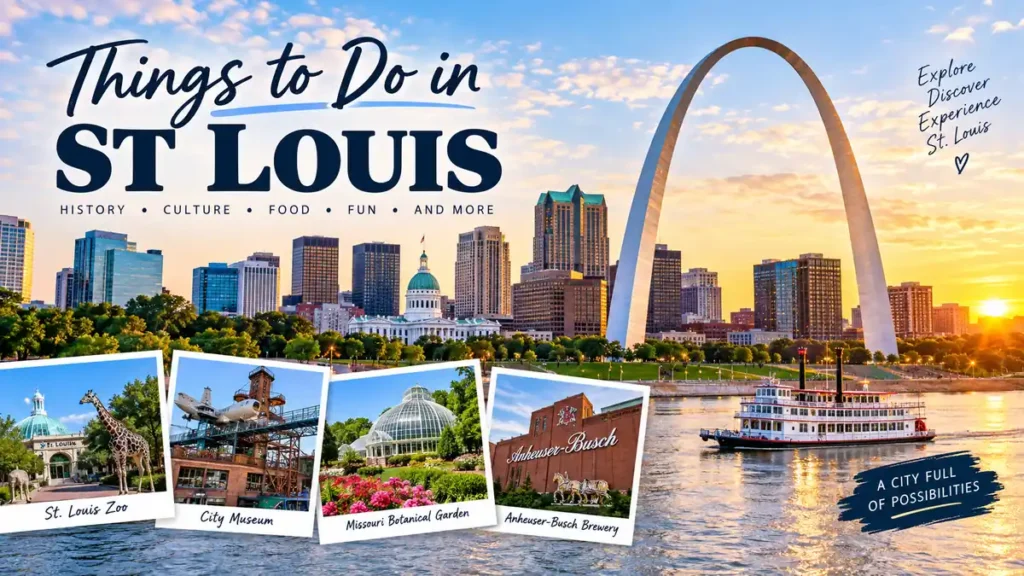
St. Louis is one of those cities that becomes more interesting the longer you explore it. The Gateway Arch may dominate the skyline, but the real experience stretches from Forest Park’s museums and the climbing tunnels of City Museum to historic neighborhoods, baseball, blues, botanical gardens, and distinctly local food.
If you’re looking for the best things to do in st louis, start with the Gateway Arch, City Museum, Forest Park, Saint Louis Zoo, Saint Louis Art Museum, Missouri Botanical Garden, Busch Stadium, and the city’s historic neighborhoods. Many major attractions offer free admission, making St. Louis unusually easy to explore without building an expensive itinerary.
Best things to do in st louis for first-time visitors
A first trip is easier if you don’t treat St. Louis as one giant checklist. Attractions naturally fall into several areas, particularly Downtown, Forest Park, Midtown, Central West End, South City, and the surrounding county.
These are the places worth putting near the top of your itinerary.
1. Ride to the top of the Gateway Arch
The Gateway Arch is the obvious starting point, but it deserves its reputation.
Designed by Finnish-American architect Eero Saarinen, the stainless-steel monument rises 630 feet above the Mississippi River. Its height and width at ground level are both 630 feet, and construction was completed in 1965.
The most memorable experience is the enclosed tram ride to the observation area at the top. On a clear day, the narrow windows provide sweeping views over downtown St. Louis, the Mississippi River, Missouri, and Illinois.
Don’t immediately leave after coming back down. The underground Museum at the Gateway Arch explains St. Louis’ role in westward expansion and places that history in a broader context. The museum and visitor center do not charge an entrance fee, although the tram requires a ticket and timed reservations can apply.
Quick takeaway: Reserve the tram ahead of time when your schedule is tight, but leave additional time for the museum and riverfront.
2. Explore Gateway Arch National Park and the Old Courthouse
The Arch is only one part of Gateway Arch National Park.
Walk the landscaped grounds, follow the paths toward the Mississippi River, and look back toward the monument from different angles. The park encompasses 91 acres and connects the Arch with the historic riverfront landscape.
The nearby Old Courthouse adds a much deeper historical dimension. Construction began in 1839, and the building is particularly associated with the Dred Scott freedom suit; the first two trials of the case took place there in 1847 and 1850.
Combining the Arch, museum, grounds, and courthouse makes more sense than treating the monument as a quick photo stop.
3. Get lost inside City Museum
City Museum is difficult to describe because “museum” doesn’t really capture it.
Think architectural playground, enormous art installation, maze, climbing structure, collection of salvaged objects, caves, slides, tunnels, and controlled chaos inside one attraction.
You might find yourself squeezing through passages, entering the Enchanted Caves, wandering MonstroCity, spotting a giant whale, visiting a pinball hall, or climbing toward the rooftop. The roof includes attractions such as Big Eli, a Ferris wheel, a school bus, and the giant praying mantis.
City Museum works for families, but adults shouldn’t assume it’s just a children’s attraction.
Wear comfortable clothes and closed-toe shoes. If you plan to crawl through the tighter passages, trousers or durable clothing are far more practical than dressing for a conventional museum.
Allow at least three hours; energetic visitors can easily stay much longer.
Free things to do in st louis around Forest Park
If you’re trying to keep travel costs under control, Forest Park is where St. Louis really stands out.
The park covers roughly 1,300 acres, making it larger than New York City’s Central Park. It opened in 1876 and later hosted major events connected with the 1904 World’s Fair. Today, it combines trails and green spaces with several of the city’s major cultural institutions.
4. Spend a morning at the Saint Louis Zoo
Saint Louis Zoo is one of the strongest answers to the question, “What can you do for free in St. Louis?”
General admission is free, although some individual attractions and services carry charges.
The zoo is large enough that rushing through it rarely works well. Give yourself several hours, especially with children. An early arrival is useful both for comfortable walking temperatures in warmer months and for fitting another Forest Park attraction into the afternoon.
5. See world-class art without paying admission
Walk across Forest Park to the Saint Louis Art Museum.
Its permanent collection spans cultures and historical periods, and regular museum admission is free every day. Main ticketed exhibitions are also free on Fridays.
That makes it easy to customize your visit. Art enthusiasts can spend half a day inside; casual visitors can choose a few galleries and continue exploring the park.
The location overlooking Art Hill is part of the appeal. Even if you’re not usually a museum person, the combination of architecture, art, and surrounding parkland makes this an easy addition to a first-time itinerary.
6. Experiment at the Saint Louis Science Center
The Saint Louis Science Center is another major free attraction.
General entry is free, while experiences such as certain special exhibitions, OMNIMAX films, planetarium shows, the Discovery Room, and simulators can require separate tickets.
Inside you’ll find interactive science experiences covering subjects ranging from dinosaurs and engineering to space, agriculture, energy, and Earth sciences.
It’s especially useful on very hot, cold, or rainy days.
7. Learn how the city became St. Louis
The Missouri History Museum adds context that makes the rest of a trip more meaningful.
Rather than viewing St. Louis simply as the city with the Arch, you’ll begin to understand its relationship with the Mississippi River, migration, transportation, the 1904 World’s Fair, local communities, and the development of the region.
Pairing the history museum with the Gateway Arch museum gives visitors a much fuller picture of the city’s past.
8. Walk, bike, picnic, or paddle through Forest Park
Don’t spend your entire Forest Park visit indoors.
Walk the paths around the waterways, relax on Art Hill, bring a picnic, rent a boat when available, or simply wander without trying to complete another attraction.
The park includes recreational facilities, golf, tennis, museums, cultural institutions, and quieter areas for walking and reading.
This is one of the best places in St. Louis to deliberately leave part of your schedule empty.
Cultural and historic things to do in st louis
St. Louis has enough history and cultural institutions to fill several days. Some of the most rewarding stops are outside the typical Arch-and-zoo itinerary.
9. Wander through the Missouri Botanical Garden
Missouri Botanical Garden has been operating since 1859 and is one of the nation’s oldest botanical gardens in continuous operation.
Its 79 acres include extensive horticultural displays, historic architecture, rare plants, and a 14-acre Japanese strolling garden. The institution also functions as an important center for botanical research, conservation, and education.
The garden is particularly good when you need a slower half-day after several busy attractions.
Give yourself enough time to actually walk rather than racing from one landmark to another.
10. Look up inside the Cathedral Basilica
From the street, the Cathedral Basilica of Saint Louis is impressive.
Inside, it becomes extraordinary.
The cathedral is famous for the immense mosaic program covering its interior. Millions of individual pieces of glass form biblical, historical, and decorative scenes across domes, arches, and walls.
Even visitors who aren’t interested in religious sites often find the craftsmanship worth seeing.
Remember that this remains an active place of worship. Visit respectfully and avoid interrupting services or private ceremonies.
11. Discover St. Louis’ blues heritage
Music belongs in any serious St. Louis itinerary.
The city’s musical identity intersects with blues, jazz, ragtime, rock and roll, and generations of performers. The National Blues Museum provides an accessible way to explore the development and cultural importance of the blues rather than treating it simply as background music for an evening out.
Afterward, look for a live performance. St. Louis’ musical history makes more sense when you hear the music as well as read about it.
12. See outdoor art at Laumeier Sculpture Park
For something less conventional, head to Laumeier Sculpture Park.
The park combines contemporary sculpture with woodland and open landscapes, so visiting feels somewhere between an art museum and a nature walk.
General access is free, and the park is normally open daily from 7 a.m. until 30 minutes after sunset, apart from certain special events.
It’s particularly enjoyable in spring and fall when spending a couple of hours outdoors feels effortless.
Fun things to do in st louis with kids
Families have an unusually broad selection here because several major educational attractions are either free or relatively easy to combine.
13. Make City Museum your big adventure day
If your children enjoy climbing rather than quietly looking at display cases, City Museum will probably become one of their favorite memories of St. Louis.
The important planning mistake to avoid is squeezing it between several other attractions.
Give it a substantial block of time. Parents should also expect to participate rather than simply stand to one side while children explore.
14. Meet animals at Grant’s Farm
Grant’s Farm blends wildlife, family entertainment, and local history.
The property was once farmed by Ulysses S. Grant and now features more than 900 animals, scenic tram rides, historic sites, and the famous Budweiser Clydesdales.
General admission is free, although arriving by car requires paid parking and some experiences inside cost extra.
That distinction matters when you’re comparing “free” attractions: check parking and add-on costs rather than assuming the entire outing will cost nothing.
15. Spend a rainy day at the Science Center
For younger travelers who need something interactive, the Science Center is a reliable option.
Hands-on exhibits make it easier to hold children’s attention than a traditional museum, while the planetarium and OMNIMAX theater can turn a short visit into most of a day.
16. Explore St. Louis Union Station
St. Louis Union Station has evolved from a major historic railway terminal into an entertainment complex.
Families can find the St. Louis Aquarium, St. Louis Wheel, carousel, miniature golf, ropes activities, mirror maze, and other entertainment in and around the complex.
Unlike the free institutions in Forest Park, several Union Station activities are separately ticketed. Decide what you actually want to do before buying multiple attractions simply because they’re located together.
Sports, beer, and classic St. Louis experiences
Some activities reveal the city’s personality more clearly than another museum ever could.
17. Watch the Cardinals at Busch Stadium
Baseball is woven into St. Louis culture.
Seeing the St. Louis Cardinals play at Busch Stadium is one of the best things to do downtown when the team is home.
Even without a game, stadium tours offer another option. The classic guided tour can include areas such as club spaces, the broadcast booth, warning track or dugout when available, plus the Cardinals Hall of Fame and Museum. Routes can change depending on games and stadium operations.
The views toward the Gateway Arch also make this one of America’s most recognizable baseball settings.
18. Tour the historic Anheuser-Busch Brewery
Beer has played a major role in St. Louis’ industrial and immigrant history.
At the historic Anheuser-Busch Brewery, visitors can choose among several brewery experiences, see the campus, learn about brewing, and encounter the Budweiser Clydesdales.
Even if beer itself isn’t your main interest, the architecture, industrial history, and connection between the brewery and St. Louis make the site culturally relevant.
19. See a musical under the stars at The Muny
During summer, check the schedule at The Muny.
The outdoor theater has been part of the Forest Park experience for more than a century. One tradition makes it particularly accessible: nearly 1,500 seats for each performance are offered free on a first-come, first-served basis.
Arrive early if you’re hoping for a free seat.
A warm evening in Forest Park followed by an outdoor musical is one of those experiences that feels distinctly St. Louis rather than interchangeable with another American city.
Explore the best St. Louis neighborhoods
One of the biggest mistakes first-time visitors make is spending all their time inside major attractions.
St. Louis describes itself as a city of neighborhoods, and moving between them reveals different architecture, food, nightlife, and local history.
20. Eat your way through The Hill
The Hill is the city’s best-known Italian-American neighborhood.
Come hungry.
This is the place to try pasta, sandwiches, bakeries, markets, and one of the foods most closely associated with St. Louis: toasted ravioli.
Despite its name, toasted ravioli is generally breaded and fried rather than toasted. It’s usually filled with meat or cheese, topped with grated cheese, and served with marinara sauce.
Multiple local establishments are connected with stories about the dish’s creation, so the precise origin is better treated as local lore than settled history. What isn’t disputed is how deeply toasted ravioli has become associated with St. Louis food culture.
Don’t rush The Hill just to eat one plate and leave. Walking the residential streets, visiting specialty shops, and stopping for dessert makes the neighborhood more enjoyable.
21. Walk around Soulard
Historic Soulard combines brick architecture, restaurants, bars, music, and one of the city’s most famous markets.
Soulard Farmers Market has roots stretching back more than two centuries and is described by the City of St. Louis as the longest continuously operating market west of the Mississippi.
Visit when the market is active rather than simply photographing the building.
Soulard becomes much livelier around major events, particularly Mardi Gras, so the atmosphere varies dramatically depending on when you arrive.
22. Spend an evening in the Delmar Loop
The Delmar Loop is a good choice when you want shops, food, entertainment, and nightlife without committing to one major attraction.
Browse record shops and independent businesses, eat somewhere casual, catch live music, and look for the stars along the St. Louis Walk of Fame.
The Loop works best as an evening neighborhood rather than a hurried daytime stop between museums.
23. Explore Central West End
The Central West End offers another side of the city, with historic architecture, restaurants, cafés, shops, and convenient access to Forest Park.
It pairs naturally with the Cathedral Basilica because you can see the mosaics and then spend time walking the neighborhood rather than driving immediately to another part of the city.
24. Walk through Citygarden downtown
If you need a break between downtown attractions, stop at Citygarden.
The landscaped urban space combines sculpture, gardens, fountains, and water features. It works particularly well between the Gateway Arch and other central downtown sights and is a useful place for families to slow down.
You don’t need hours here. Even 30 to 60 minutes can reset a packed sightseeing day.
Unique things to do near St. Louis
Once you’ve covered the central attractions, a few worthwhile destinations justify traveling beyond the city core.
25. Visit Cahokia Mounds
Cross the Mississippi into Illinois and you’ll reach Cahokia Mounds State Historic Site, the remains of the largest pre-Columbian Native American urban settlement north of Mexico.
At its peak around 1100, the ancient city covered roughly 4,000 acres and may have had a population between 10,000 and 20,000.
Monks Mound is the site’s most imposing earthwork, but the value of Cahokia lies in understanding the scale and sophistication of the civilization that created the settlement.
Visitor facilities have been undergoing renovation, so check current access before going. Current site information indicates that portions of the Interpretive Center are operating while exhibit work continues.
For travelers interested in archaeology and Indigenous North American history, this is one of the region’s most significant places.
Best free things to do in st louis
St. Louis can be remarkably affordable if you build your itinerary around its free cultural institutions.
Among the strongest free options are the Saint Louis Zoo, Saint Louis Art Museum, general entry to the Saint Louis Science Center, Forest Park itself, Laumeier Sculpture Park, Citygarden, and the museum and grounds at Gateway Arch National Park. Grant’s Farm also offers free general admission, although parking and optional activities can cost extra.
During The Muny’s summer season, the free-seat tradition can even add live theater to a low-budget trip.
| Attraction | General admission | Best for |
|---|---|---|
| Saint Louis Zoo | Free | Families, wildlife |
| Saint Louis Art Museum | Free | Art, culture |
| Saint Louis Science Center | Free | Families, science |
| Forest Park | Free | Walking, outdoors |
| Gateway Arch Museum | Free | History |
| Laumeier Sculpture Park | Free | Art, nature |
| Citygarden | Free | Public art, families |
| Grant’s Farm | Free admission; parking extra | Animals, families |
| The Muny free seats | Limited free seats | Summer theater |
“Free admission” doesn’t always mean a zero-cost day. Parking, special exhibitions, rides, films, food, and optional experiences can still carry fees.
What food should you try in St. Louis?
Sightseeing is only half the experience.
Start with toasted ravioli, ideally somewhere around The Hill. Then try St. Louis-style pizza, recognizable by its thin, crisp crust and frequent use of Provel cheese.
For barbecue, expect plenty of debate over where to go and what to order. St. Louis-style ribs and pork steaks are good starting points.
Dessert has its own local celebrity: gooey butter cake, a rich, dense cake traditionally associated with St. Louis.
Another local institution is frozen custard. On warm evenings, standing outside with a concrete-style frozen custard is as much part of the experience as the dessert itself.
A simple St. Louis food checklist is:
- Toasted ravioli
- St. Louis-style pizza
- St. Louis barbecue
- Pork steak
- Gooey butter cake
- Frozen custard
You don’t need to eat all six in one day. Your stomach will appreciate a more strategic itinerary.
Best things to do in st louis at night
Downtown changes character after museums close.
A Cardinals game is an obvious evening choice during baseball season. Live blues, jazz, and other music provide an alternative for travelers more interested in the city’s musical heritage.
The Delmar Loop, Soulard, and parts of the Central West End offer restaurants and nightlife, while seasonal theater at The Muny creates a completely different kind of evening.
City Museum can also operate later on selected dates, and its event calendar includes special programming, so check the schedule rather than assuming daytime hours.
For a quieter evening, walk near the illuminated Gateway Arch and riverfront before dinner.
As with any unfamiliar city, choose well-traveled areas, understand where you’re parking, and use a rideshare or other transportation when it makes the evening simpler.
How many days do you need in St. Louis?
Two days is enough for the highlights.
Spend your first day around downtown: Gateway Arch National Park, the museum, City Museum, and either Busch Stadium or an evening neighborhood.
Use day two for Forest Park, choosing two or three attractions rather than attempting everything.
Three days is better for most first-time visitors. The additional day creates room for the Missouri Botanical Garden, The Hill, Cathedral Basilica, Grant’s Farm, a brewery tour, or another neighborhood.
With four days, you can slow down and add Cahokia Mounds, Laumeier Sculpture Park, longer museum visits, or seasonal events.
The biggest planning error is assuming attractions are small enough to check off quickly. City Museum, the zoo, Forest Park, and the botanical garden can each consume a substantial part of a day.
A practical 3-day St. Louis itinerary
Day 1: Downtown icons
Start early at Gateway Arch National Park. Visit the museum, take the tram to the top, walk the grounds, and explore the Old Courthouse.
Have lunch downtown, then spend the afternoon at City Museum.
If the Cardinals are playing, finish at Busch Stadium. Otherwise, choose downtown dining, live music, or an evening in Soulard.
Day 2: Forest Park and Central West End
Start with the Saint Louis Zoo.
After lunch, choose the Saint Louis Art Museum, Missouri History Museum, or Saint Louis Science Center based on your interests. Trying to see all of them properly in one day defeats the point.
Spend late afternoon walking around Forest Park.
Finish at the Cathedral Basilica and have dinner in the Central West End.
Day 3: Gardens, neighborhoods, and local flavor
Visit Missouri Botanical Garden in the morning.
Head to The Hill for lunch and toasted ravioli, then choose Grant’s Farm, the Anheuser-Busch Brewery, or Laumeier Sculpture Park for the afternoon.
Use the evening for live music, theater, or another neighborhood you haven’t explored.
When is the best time to visit St. Louis?
Spring and fall are generally the easiest seasons for combining museums, parks, neighborhoods, and outdoor attractions.
Spring brings gardens and greener landscapes, although rain can disrupt outdoor plans.
Summer provides the fullest selection of festivals, baseball, outdoor events, and Muny performances, but heat and humidity can make afternoon sightseeing uncomfortable.
Fall is excellent for walking neighborhoods and parks, while winter shifts the emphasis toward museums, food, indoor attractions, and seasonal events.
The best strategy is to mix indoor and outdoor activities. On a hot summer day, for example, spend midday inside the Art Museum or Science Center and save neighborhood walking for morning or evening.
How to get around St. Louis
St. Louis attractions are spread across several districts, so don’t expect to walk everywhere.
Downtown itself is reasonably easy to explore on foot, especially around Gateway Arch National Park, Busch Stadium, and nearby attractions.
MetroLink connects important parts of the region and can be useful for travelers without a car. For a short visit, rideshare services can fill gaps between neighborhoods.
A car provides the greatest flexibility if your plans include Grant’s Farm, Laumeier Sculpture Park, or other destinations outside the central corridor. Parking, however, can add both time and cost.
A useful planning trick is to group attractions geographically:
| Area | Attractions to combine |
|---|---|
| Downtown | Gateway Arch, Old Courthouse, Busch Stadium, Citygarden |
| Downtown West | City Museum, Union Station |
| Forest Park | Zoo, Art Museum, History Museum, Science Center, The Muny |
| Central West End | Cathedral Basilica, dining, cafés |
| South City | Missouri Botanical Garden, The Hill |
| Soulard | Farmers Market, brewery, restaurants |
| St. Louis County | Grant’s Farm, Laumeier Sculpture Park |
That approach saves more time than obsessing over the perfect order of individual attractions.
What should first-time visitors know?
First, don’t underestimate Forest Park. It isn’t a single attraction but a district-sized collection of experiences. Choose what genuinely interests you.
Second, reserve limited-capacity experiences early. The Gateway Arch tram is the clearest example; the National Park Service notes that timed reservations may be needed.
Third, check operating schedules directly before leaving your hotel. Seasonal hours, weather, games, exhibitions, renovations, and special events can change access.
Fourth, distinguish between free admission and a completely free visit. Parking and premium experiences can still cost money.
Finally, leave room for neighborhoods and food. A trip made entirely of major attractions misses much of what gives St. Louis its identity.
Are there enough things to do in St. Louis for a weekend?
Absolutely.
A weekend can combine a nationally recognizable monument, an eccentric architectural playground, major museums, one of America’s great urban parks, a renowned zoo, historic neighborhoods, baseball, blues, Italian-American food, and surprisingly strong free attractions.
What makes St. Louis particularly appealing isn’t simply the number of sights. It’s the variety.
You can stand 630 feet above the Mississippi in the morning, crawl through tunnels inside City Museum after lunch, see major works of art for free the next day, eat toasted ravioli on The Hill, and finish with baseball or live theater.
For a first visit, focus your list of things to do in st louis on three experiences: see the Gateway Arch properly rather than just photographing it, devote meaningful time to Forest Park, and explore at least one neighborhood beyond downtown. Add City Museum, local food, music, gardens, or sports according to your interests, and you’ll get a much better sense of the Gateway City than any rushed checklist can provide.