Most people picture one thing when they hear “Nevada” — neon lights and slot machines. That’s fair, but it’s also about five percent of the story. Drive an hour in almost any direction from Las Vegas and the desert takes over: red rock canyons, a dam that reroutes a river, a national park most Americans have never heard of, and towns that still smell faintly of Basque stew.
Nevada is a desert state in the American Southwest best known for the Las Vegas Strip, but it also holds Lake Tahoe’s alpine shoreline, Hoover Dam, Red Rock Canyon, and Great Basin National Park — home to some of the darkest night skies in the country. Most trips combine a few days in Vegas with a loop through at least one of these.
What Nevada Is Known For
Nevada is the driest state in the country, and that dryness shapes everything about it. The landscape is what geologists call the Basin and Range province — long north-south mountain chains separated by flat desert valleys, over and over, for hundreds of miles. That’s why you can be shivering on a Lake Tahoe chairlift and, six hours later, be sweating by a Las Vegas pool. Same state, two different climates.
Beyond the Strip, Nevada is the birthplace of Burning Man, home to the state’s stubborn Area 51 mythology, and quietly one of the best stargazing destinations in the lower 48. It’s also got a real ranching and mining history that shows up in its Basque food culture and its scattered ghost towns — more than 600 of them, according to state historical estimates.
Las Vegas & the Strip — More Than Casinos
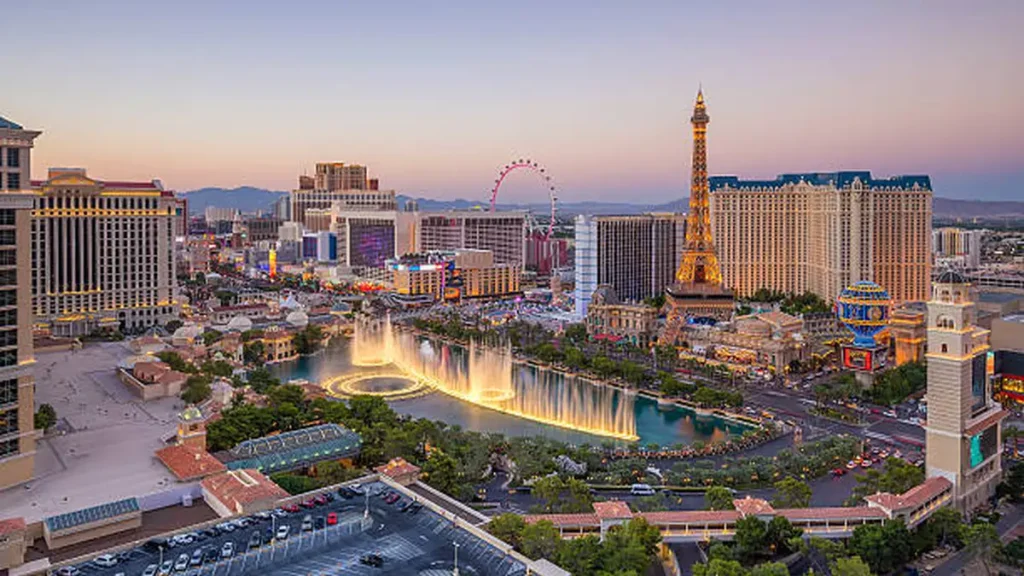
The Strip is still the reason most people fly into Nevada, and it earns the reputation.Driving down the Strip takes you past hotels with a replica Eiffel Tower and Venetian canals, with fountain shows and performances at the Bellagio and the Mirage.Fremont Street, downtown, is the older, grittier counterpart — a pedestrian mall lined with vintage casinos and a canopy of lights overhead.
If you want a break from gaming floors, the Neon Museum (retired casino signs, displayed like sculpture) and the newer Sphere venue are worth an afternoon each. And if you’ve got kids or just miss arcades, the Pinball Hall of Fame packs hundreds of playable machines into a warehouse-sized space — genuinely one of the better cheap afternoons in the city.
Quick takeaway: Budget one full day for the Strip itself, one evening for Fremont Street, and treat everything else as a bonus.
Nature Escapes a Short Drive From Vegas
This is where most first-time visitors get surprised. Within about 45 minutes of the Strip:
- Red Rock Canyon — a 13-mile scenic drive plus hiking trails through banded sandstone. Go early morning in summer; there’s almost no shade.
- Valley of Fire State Park — Nevada’s oldest state park, named for the red sandstone that seems to glow at sunrise and sunset.
- Hoover Dam — the dam serves more than seven million visitors each year and remains one of Nevada’s most visited attractions. Tour the inside if you have three hours; otherwise, the overlook and visitor center take about 45 minutes.
Further out, the Grand Canyon’s West Rim gets marketed hard from Vegas, but it’s worth knowing that’s a different section of the canyon than the classic South Rim views — the actual national park is closer to a five-hour drive.
Lake Tahoe — Nevada’s Alpine Side
Lake Tahoe sits on the California-Nevada border, and the Nevada shore (Incline Village, Sand Harbor) tends to be quieter than the California side. It’s a genuine four-season destination: ski season runs roughly January through March, while summer brings swimming, boating, and hiking to the same shoreline.
If you’re choosing a single month, September comes up again and again in seasonal guides — warm days, thinning crowds, and Sierra foliage starting to turn. Spring (March–May) and fall (September–November) are consistently recommended over peak summer for anyone who wants views without the July-August boat traffic.
| Season | Vibe | Best for |
|---|---|---|
| Winter (Dec–Mar) | Ski resorts, snowy peaks | Skiing/snowboarding |
| Spring (Mar–May) | Melting snow, wildflowers | Hiking, fewer crowds |
| Summer (Jun–Aug) | Beaches, boats, heat | Swimming, water sports |
| Fall (Sep–Nov) | Cooler, golden color | Photography, hiking, value pricing |
Reno, Carson City & Nevada’s Basque Country
Reno bills itself as “the biggest little city,” and it’s genuinely underrated as a base. The Riverwalk District has art galleries, breweries, and the National Automobile Museum. Carson City, the state capital, is smaller and quieter — good for a half-day stop on the way to Tahoe.
The real surprise for most travelers is Basque food. Basque sheepherders settled parts of northern Nevada during the mining boom, and their descendants still run family-style restaurants in towns like Elko and Winnemucca. Expect hearty, shared plates — lamb, marinated pork loin, sourdough — served at long communal tables. It’s not on most Nevada itineraries, and that’s exactly why it’s worth the detour.
Great Basin National Park — Nevada’s Best-Kept Secret
If Nevada has one legitimately underrated attraction, it’s this.Great Basin National Park boasts the twisty, ancient bristlecone pine — the oldest living species on the planet — along with 13,065-foot Wheeler Peak, the highest point in Nevada, plus bald eagles and bighorn sheep.It’s also a designated Dark Sky Park, offering some of the best stargazing in the lower 48, and visitors can take a ranger-guided tour of Lehman Caves.
The catch: cave tours book out weeks ahead in peak season, so reserve before you drive out. It’s remote — a few hours from Vegas or Salt Lake City — which is exactly why it stays uncrowded.
Ghost Towns and Only-in-Nevada Oddities
Nevada’s mining boom left behind hundreds of abandoned towns. Rhyolite, near the Death Valley border, is the most photographed — crumbling bank facades against open desert. Virginia City, in the north, took the opposite path and leaned into tourism, with boardwalks, saloons, and mine tours still running.
Then there’s the stuff that only makes sense in Nevada: Area 51’s mythology still draws curious travelers to the Extraterrestrial Highway, and Burning Man transforms the Black Rock Desert into a temporary art city every August. Neither is for everyone, but both are part of why Nevada has a reputation for weird that’s mostly earned.
Best Time to Visit Nevada, Season by Season
Because Nevada spans desert floor and mountain peak, “best time to visit” really depends on which Nevada you mean.
| Season | Las Vegas / Desert | Lake Tahoe / North |
|---|---|---|
| Spring (Mar–May) | 70s–80s°F, ideal for hiking Red Rock | Melting snow, wildflowers |
| Summer (Jun–Aug) | 100–110°F+, pool weather, early-morning hikes only | 70s–80s°F, prime lake season |
| Fall (Sep–Oct) | Mild, uncrowded, good hiking | Cooler, foliage, Reno Air Races |
| Winter (Nov–Feb) | Mild days, cool nights | Ski season, snow |
Quick takeaway: April, May, September, and October are the sweet spot statewide — mild enough for the desert, not yet snowed-in up north.
Planning Your Trip — Practical Logistics
- Fly into: Harry Reid International (Las Vegas) for southern Nevada; Reno-Tahoe International for the north.
- Do you need a car? Yes, almost everywhere except the Strip itself. Nevada’s best sights are spread out, and public transit between regions is minimal.
- How many days? 3 days covers Vegas and one nearby nature stop. 7–10 days lets you add Lake Tahoe, Reno, or Great Basin without rushing.
- Driving distances: Vegas to Hoover Dam (45 min), Vegas to Red Rock Canyon (30 min), Vegas to Grand Canyon West Rim (2.5 hrs), Vegas to Reno (7 hrs), Reno to Lake Tahoe (1 hr).
The Bottom Line
Nevada rewards anyone willing to leave the Strip for even a day. Pick one nature escape near Vegas if your trip is short; add Lake Tahoe or Great Basin if you’ve got a week. Either way, book cave tours and popular hotels ahead of shoulder-season travel — the secret’s gotten out on when to visit.
Ready to plan the route? Start with a 3-day Vegas-plus-Red Rock itinerary if you’re short on time, or map a 7-day loop through Tahoe and Reno if you want the fuller picture.
For more inspiration like this, take a look at our Southwest USA travel guides.
FAQ Section
What is Nevada known for?
Nevada is best known for the Las Vegas Strip and legalized gambling, but it’s also home to Lake Tahoe, Hoover Dam, Area 51 lore, Burning Man, and Great Basin National Park’s dark skies.
Is Nevada worth visiting outside of Las Vegas?
Yes. Red Rock Canyon, Valley of Fire, Lake Tahoe, and Great Basin National Park are all within a few hours’ drive and offer a completely different side of the state.
What is the best time of year to visit Nevada?
Spring (April–May) and fall (September–October) offer the mildest weather statewide, avoiding both desert summer heat and mountain winter snow.
Is Lake Tahoe in Nevada or California?
Both — the lake straddles the state line, with quieter shores generally found on the Nevada side around Incline Village and Sand Harbor.
What’s the closest national park to Las Vegas?
Technically none are inside city limits, but Red Rock Canyon (a national conservation area) is 30 minutes away, and Great Basin National Park is a several-hour drive northeast.
Do you need a car to get around Nevada?
Yes, outside the Strip itself. Nevada’s attractions are spread across long desert distances with minimal public transit between them.
How many days do you need to see Nevada?
Three days covers Las Vegas plus one nearby nature stop; 7–10 days allows for Lake Tahoe, Reno, and Great Basin National Park.
What food is Nevada known for besides casino buffets?
Basque cuisine, brought by immigrant sheepherders, is a genuine regional specialty in northern towns like Elko and Winnemucca.