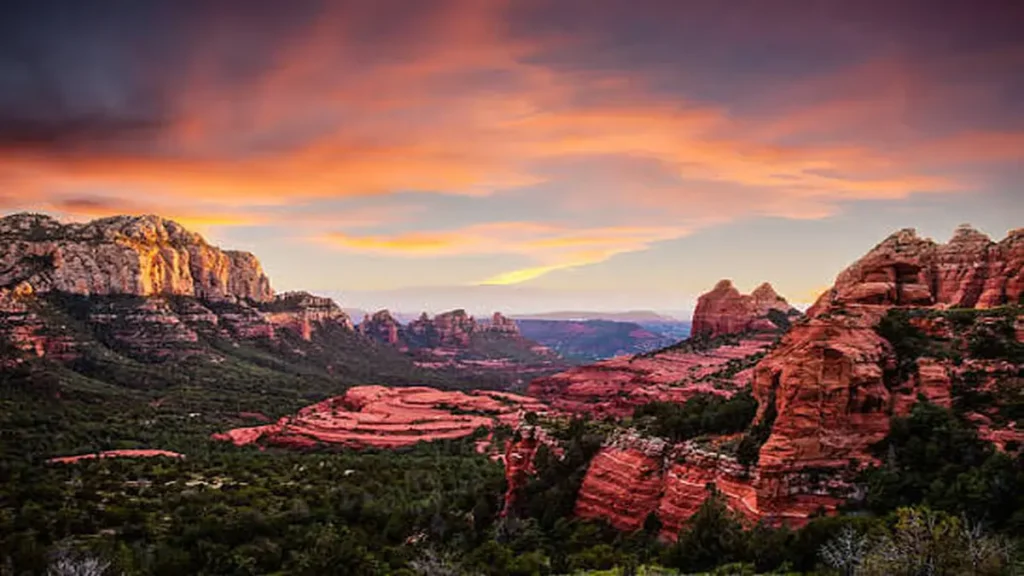
Most people get to Sedona for sunset about twenty minutes too late. The parking lot is full, the light’s already flattening out, and they end up watching the last few minutes from the side of the road instead of the viewpoint they drove out for. It’s a fixable problem, and it comes down to knowing which spot fits your effort level and showing up earlier than feels necessary.
A Sedona sunset is best watched from an elevated red-rock viewpoint 30–45 minutes before the official sunset time, when low-angle light turns the sandstone deep orange and red. Top spots include Airport Mesa, Cathedral Rock, Bell Rock, and Schnebly Hill Road, with each offering different levels of hiking effort and crowd size.
Sedona’s color comes down to iron oxide in the sandstone, which is exactly why the low, warm light of golden hour makes the whole town look like it’s glowing from the inside. That effect is strongest right before the sun actually disappears, not at the moment it does — which is the first thing that trips people up.
Best Sunset Viewpoints You Don’t Have to Hike For
If you don’t want to hike at all, you still have solid options.
Airport Mesa is the one nearly every local recommends first, and for good reason — it’s a short walk from the parking area to an elevated overlook with wide views of the red rock skyline. It’s also one of Sedona’s vortex sites, which is part of why it draws a crowd. Parking fills up fast, so plan to arrive at least 45 minutes early or you’ll be circling the lot instead of watching the sky.
Schnebly Hill Road, particularly the area near the rock formation known as Merry Go Round, works well if you have a high-clearance vehicle or want to book a jeep tour. The eastern-facing peaks along this road give you a long, uninterrupted view west as the sun drops.
For something closer to town with almost zero walking, pull off along the Red Rock Scenic Byway (SR-179), which runs about 7.5 miles and passes multiple turnouts with unobstructed views — it’s one of the easiest ways to catch color from your car.
Quick Takeaway: If your evening plan is “watch sunset, not conquer a mountain,” Airport Mesa or the SR-179 scenic byway will get you there with the least effort and still deliver the postcard shot.
The Best Sunset Hikes, Ranked by Effort
If you’re willing to earn the view, hiking gets you above the crowd noise and closer to the rock itself.
Cathedral Rock is the classic choice, and it’s genuinely one of Sedona’s vortex sites too. The trail to the saddle is only about 1.2 miles, but it’s steep and involves some hands-on scrambling near the top — wear real shoes, not sandals. The reward is a wide, balcony-style view of the surrounding canyons in both directions, so you get the sunset in front of you and warm reflected light on the eastern rocks behind you.
Doe Mountain and Boynton Canyon offer a gentler climb with panoramic 360-degree views, better suited if you want the payoff without the scramble.
Devil’s Bridge, while more famous as a daytime photo spot, gets noticeably quieter in the evening and gives you a dramatic overlook of the valley below as the light fades — a solid alternative if Cathedral Rock’s parking lot is already full (which, by late afternoon, it usually is).
For a quieter, lesser-known option, the Cultural Park Trailhead and Pyramid Mountain loop trail let you watch the sun set over Long Canyon, Boynton Canyon, and the Cockscomb formation without fighting for a spot.
Quick Takeaway: Cathedral Rock is worth the scramble if you’re comfortable with steep terrain. If not, Doe Mountain or Devil’s Bridge give you nearly the same payoff with a fraction of the difficulty.
Scenic Drives That Turn Sunset Into the Whole Point
Not every great sunset requires leaving your car. Driving Schnebly Hill Road up toward the Mogollon Rim gives you panoramic views without a single step of hiking, and the Red Rock Scenic Byway connects Uptown Sedona to the Village of Oak Creek with pull-offs the entire way. If you’d rather be near water, Oak Creek and Red Rock Crossing (Crescent Moon Ranch) give you the added bonus of Cathedral Rock’s reflection in the creek — genuinely one of the more underrated shots in town, and far less crowded than the trailhead itself.
When to Go — Sunset Times, Golden Hour Math, and the Best Season
Sedona’s sunset time swings dramatically across the year, and this is the detail most guides skip.
| Season | Approx. Sunset Time | Best Arrival Window |
|---|---|---|
| Winter (Dec) | ~5:16–5:30 PM | 4:30–4:45 PM |
| Spring (Mar–May) | ~6:15–7:15 PM | 45 min before sunset |
| Summer (Jun) | ~7:30–7:46 PM | 45–60 min before sunset |
| Fall (Sep–Nov) | ~5:45–6:45 PM | 45 min before sunset |
The color you actually want — that deep red-orange wash on the rock faces — peaks about 30 to 45 minutes before the sun officially sets, not at the moment it drops below the horizon. Arrive at “sunset time” and you’ll miss the best light entirely.
As for season, fall (late September through November) is the local favorite: cooler temperatures, crisper air, and noticeably fewer crowds than spring, with light that locals describe as almost too vivid to be real. Spring runs a close second. Summer brings monsoon season starting in early July — which can produce dramatic, moody skies but also real risk: avoid exposed ridges and washes if you hear thunder, since lightning and flash flooding are genuine hazards on open rock.
Vortexes, Crowds, and What Locals Actually Do Differently
Several of Sedona’s best sunset spots — Airport Mesa, Cathedral Rock, and Bell Rock among them — are also considered energy vortex sites, areas locals and visitors associate with a noticeably different, calmer feeling. You don’t need to buy into the concept to notice these overlap almost entirely with the best views in town; it’s not a coincidence, since these are simply the highest, most exposed points around.
What separates a good sunset from a frustrating one usually comes down to logistics, not location. Bell Rock’s parking lot, for instance, is manageable at sunrise but genuinely difficult at sunset — Yavapai is a solid overflow option. Bring a headlamp for the walk back down, since dusk fades faster than you’d expect at elevation, and pack a layer even in warmer months, because temperatures drop fast once the sun’s gone.
Quick Takeaway: Pick your spot for the view, but pick your arrival time for the crowd. The best photo in the world doesn’t help you if you’re stuck at the trailhead when the light peaks.
Sedona doesn’t need much dressing up after the sun goes down — most visitors head back into Uptown or West Sedona for dinner, with plenty of patio seating that keeps the last of the color in view a little longer.
A Sedona sunset rewards a little planning more than any other kind of sightseeing here. Pick a viewpoint that matches your energy for the evening, show up 30 to 45 minutes earlier than the posted sunset time, and bring a layer for the walk back. If you’re building a longer stay around it, fall gives you the best odds of a clear, vivid sky with the smallest crowd. Start with Airport Mesa if it’s your first visit, then work your way toward Cathedral Rock or a quiet spot like Doe Mountain once you know how the light moves across the rocks.
You might also find our Southwest USA travel guides helpful when planning the rest of your trip.
FAQ Section
What time does the sun set in Sedona?
It varies widely by season — around 5:16–5:30 PM in December and up to about 7:46 PM near the summer solstice in late June. Always check the current day’s time rather than assuming, since it shifts noticeably month to month.
What is the best month to see a Sedona sunset?
Late September through November is the local favorite — cooler air, fewer crowds, and crisp, vivid color. Spring (March–May) is a close second with similarly mild weather.
Where is the best place to watch the sunset in Sedona?
Airport Mesa is the most popular no-hike option. For a hike with a payoff, Cathedral Rock’s saddle is the classic pick, while Bell Rock and Devil’s Bridge are strong alternatives when those spots are crowded.
Is Cathedral Rock hard to hike for sunset?
The trail to the saddle is only about 1.2 miles, but it’s steep with some hands-on scrambling near the top. It’s manageable for most fit hikers but wear proper shoes and bring a headlamp for the descent.
Do you need to hike to see a good Sedona sunset?
No. The Red Rock Scenic Byway (SR-179) and Schnebly Hill Road both offer car-accessible views, and Airport Mesa requires only a short walk from parking.
Are Sedona’s vortex sites related to its best sunset spots?
Largely, yes. Airport Mesa, Cathedral Rock, and Bell Rock are all considered vortex sites and also happen to be among the highest, most exposed viewpoints in the area, which is part of why they overlap.
How early should I arrive for a Sedona sunset?
Plan to arrive 30–45 minutes before the official sunset time to catch peak golden-hour color, and add another 15–30 minutes if you need to find parking at popular spots like Cathedral Rock or Bell Rock.
Is a Sedona sunset better than sunrise?
Both are excellent, but sunset draws bigger crowds since it aligns with dinner plans. Sunrise gives you similarly dramatic light on east-facing rocks with a fraction of the people.