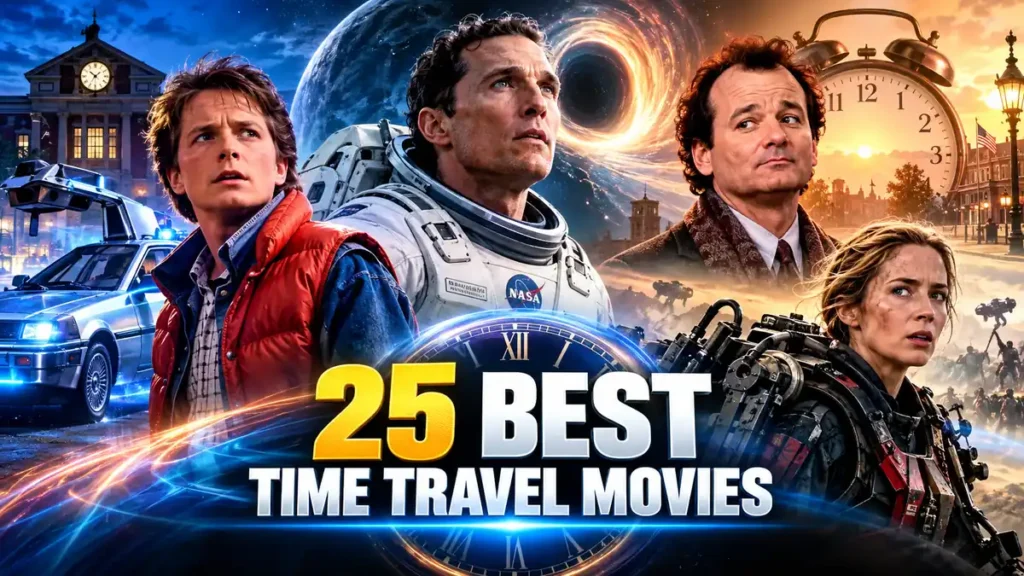
What if you could travel into the past, change a single decision, or discover what happens decades into the future? That’s the fascination behind time travel movies. They turn one impossible idea into stories about love, regret, adventure, identity, and the consequences of changing history.
The best time travel movies include Back to the Future (1985), The Terminator (1984), 12 Monkeys (1995), Groundhog Day (1993), Primer (2004), Interstellar (2014), and Predestination (2014). Some involve machines that transport characters across decades, while others explore repeating days, alternate timelines, predestination paradoxes, or the effects of time dilation.
Not every film follows the same rules. Some treat time travel as a scientific puzzle, while others use it to explore relationships and second chances. This guide covers 25 standout films, explains their different approaches to time, and helps you decide what to watch next.
Best time travel movies at a glance
The following selection combines influential science fiction, popular entertainment, romantic dramas, and lesser-known films. The order reflects variety and cultural significance rather than a definitive ranking.
| Movie | Release year | Genre | Time-travel concept |
|---|---|---|---|
| Back to the Future | 1985 | Sci-fi comedy | Changing the past |
| The Terminator | 1984 | Sci-fi action | Predestination |
| 12 Monkeys | 1995 | Sci-fi thriller | Fixed timeline |
| Groundhog Day | 1993 | Fantasy comedy | Time loop |
| Primer | 2004 | Sci-fi mystery | Overlapping timelines |
| Interstellar | 2014 | Sci-fi drama | Relativistic time dilation |
| Predestination | 2014 | Sci-fi thriller | Causal paradox |
| Looper | 2012 | Sci-fi action | Altering the future |
| About Time | 2013 | Romantic fantasy | Revisiting personal history |
| The Time Traveler’s Wife | 2009 | Romantic drama | Involuntary time travel |
| Edge of Tomorrow | 2014 | Sci-fi action | Repeated day |
| Donnie Darko | 2001 | Psychological sci-fi | Tangent universe |
| Tenet | 2020 | Sci-fi thriller | Time inversion |
| The Butterfly Effect | 2004 | Psychological thriller | Changing past events |
| Source Code | 2011 | Sci-fi thriller | Repeated eight-minute experience |
| Bill & Ted’s Excellent Adventure | 1989 | Sci-fi comedy | Historical time travel |
| Midnight in Paris | 2011 | Fantasy romance | Traveling to the past |
| The Time Machine | 1960 | Sci-fi adventure | Journey into the distant future |
| Frequency | 2000 | Sci-fi thriller | Communication across time |
| Timecrimes | 2007 | Sci-fi thriller | Causal loop |
| Triangle | 2009 | Psychological horror | Repeating events |
| Palm Springs | 2020 | Romantic comedy | Shared time loop |
| The Girl Who Leapt Through Time | 2006 | Anime romance | Time leaps |
| Harry Potter and the Prisoner of Azkaban | 2004 | Fantasy adventure | Closed causal loop |
| X-Men: Days of Future Past | 2014 | Superhero sci-fi | Changing historical events |
Classic time travel movies that defined the genre
1. Back to the Future

7
Robert Zemeckis directed this 1985 adventure starring Michael J. Fox as Marty McFly and Christopher Lloyd as eccentric inventor Doc Brown.
Marty accidentally travels from 1985 to 1955 in a DeLorean converted into a time machine. His unexpected arrival interferes with his parents’ relationship, threatening his own existence.
The movie balances science-fiction concepts with comedy, family drama, and an entertaining race against time.
Why watch it: It’s an accessible introduction to time travel stories, particularly those involving the consequences of changing the past.
The sequels, Back to the Future Part II (1989) and Part III (1990), expand the story into alternate futures and the American Old West.
2. The Terminator
James Cameron’s The Terminator takes a darker approach. Arnold Schwarzenegger plays a cyborg assassin sent from 2029 to 1984 to kill Sarah Connor, whose future son will lead humanity’s resistance against intelligent machines.
Kyle Reese, a human soldier, travels backward to protect her.
The film introduces a compelling causal puzzle: can an attempt to prevent a future event actually help bring that future into existence?
Its combination of science-fiction horror, action, and questions about destiny helped establish time travel as a major theme in blockbuster filmmaking.
Why watch it: For an intense story about fate, artificial intelligence, and the relationship between past and future.
3. 12 Monkeys
Directed by Terry Gilliam, 12 Monkeys stars Bruce Willis as James Cole, a prisoner sent from a devastated future into the past to investigate the origins of a deadly pandemic.
Brad Pitt plays Jeffrey Goines, an unstable environmental activist whose behavior complicates Cole’s investigation.
Unlike films where characters freely rewrite history, 12 Monkeys raises the possibility that the past cannot be changed.
Its fragmented memories and unsettling atmosphere create uncertainty about what Cole remembers and what he can prevent.
Why watch it: For a psychological mystery built around memory, inevitability, and a potentially fixed timeline.
4. The Time Machine
Based on H. G. Wells’s 1895 novel, George Pal’s 1960 adaptation follows an inventor who creates a machine capable of carrying him far into the future.
He eventually encounters the Eloi and Morlocks, two populations living in a dramatically transformed world.
The story uses time travel to examine social division, technological progress, and the distant fate of humanity.
Its visual effects are products of their era, but the underlying ideas remain influential.
Why watch it: For a foundational science-fiction adventure that explores time travel on a civilization-wide scale.
Mind-bending time travel movies with complex plots
5. Primer
7
Shane Carruth’s low-budget science-fiction film follows two engineers, Aaron and Abe, who accidentally discover a process that allows limited travel backward through time.
Initially, they use the discovery for personal advantage. But overlapping journeys, duplicate versions of themselves, and conflicting motives make their situation increasingly dangerous.
The film offers little conventional exposition. Characters speak like engineers, and the audience must reconstruct the chronology.
Why watch it: For one of cinema’s most intricate fictional time-travel systems.
A second viewing is especially rewarding because seemingly ordinary conversations gain different meanings once the chronology becomes clearer.
6. Predestination
Starring Ethan Hawke and Sarah Snook, Predestination follows a temporal agent pursuing a criminal through different periods.
The screenplay adapts Robert A. Heinlein’s short story All You Zombies and builds its mystery around identity, causality, and self-contained timelines.
The film asks whether a person can become both the cause and the consequence of their own existence.
Its central revelations work best when discovered without spoilers.
Why watch it: For an unusually ambitious causal paradox and a story that challenges assumptions about personal identity.
7. Tenet
Christopher Nolan’s Tenet introduces inversion, a fictional process that allows objects and people to move backward relative to the normal direction of time.
John David Washington plays an operative investigating technology that could threaten the world.
Rather than simply sending characters into the past, the movie stages sequences in which forward-moving and inverted participants interact.
The result is an action thriller whose events may look entirely different depending on the observer’s temporal direction.
Why watch it: For ambitious visual storytelling and unusual action sequences built around reversed causality.
8. Timecrimes
This Spanish-language thriller, directed by Nacho Vigalondo, follows Héctor, an ordinary man whose investigation of a strange incident leads him into a time-travel experiment.
As the story develops, his attempts to fix events become entangled with the very incidents he hopes to avoid.
The film demonstrates how a relatively simple premise can create an elaborate causal puzzle without a large budget.
Why watch it: For tightly constructed suspense and an excellent example of a self-consistent time loop.
9. Donnie Darko
Richard Kelly’s cult film stars Jake Gyllenhaal as a troubled teenager who encounters a mysterious figure wearing a rabbit costume.
The story blends psychological drama, suburban anxiety, and strange events suggesting disturbances in time and reality.
Its concepts involve a tangent universe and an uncertain relationship between fate and free will.
The theatrical version leaves considerable room for interpretation, while the director’s cut provides more explanatory material.
Why watch it: For atmospheric, philosophical science fiction that rewards discussion rather than offering easy answers.
Time loop movies where the same day repeats
Time loops are closely related to time travel, although they work differently. Instead of moving freely between historical periods, characters repeatedly experience the same interval.
10. Groundhog Day

6
Bill Murray plays Phil Connors, a cynical television weather presenter who becomes trapped reliving February 2 in Punxsutawney, Pennsylvania.
No matter what he does, he wakes up to the same morning.
Initially, Phil exploits the repetition. Over time, the experience forces him to confront his behavior, relationships, and priorities.
The film never provides a detailed scientific explanation for the loop, which allows its emotional and philosophical themes to take center stage.
Why watch it: For a funny, thoughtful exploration of personal growth through repeated experience.
11. Edge of Tomorrow
Tom Cruise stars as Major William Cage, a military officer who becomes trapped in a cycle of death and repetition during an alien invasion.
With the help of skilled soldier Rita Vrataski, played by Emily Blunt, he uses knowledge from previous attempts to improve his combat abilities and search for a way to defeat the enemy.
The movie transforms the time-loop concept into an action-oriented learning system.
Each reset creates another opportunity to experiment, but success remains uncertain.
Why watch it: For fast-paced action, clever repetition, and a protagonist who develops through failure.
12. Source Code
Jake Gyllenhaal plays Captain Colter Stevens, who repeatedly experiences the final eight minutes of another man’s life aboard a commuter train.
His mission is to identify a bomber and prevent further attacks.
Although the film initially resembles a conventional time loop, its fictional technology and eventual revelations raise deeper questions about identity, consciousness, and alternate realities.
Why watch it: For a compact science-fiction mystery with strong pacing and emotional stakes.
13. Palm Springs
Andy Samberg and Cristin Milioti star in this romantic comedy about two wedding guests trapped in a repeating day.
Unlike many similar films, Palm Springs begins with one character already familiar with the loop.
The story explores loneliness, commitment, and the difficulty of building meaningful relationships when tomorrow never arrives.
Its mixture of comedy and existential reflection makes it a distinctive modern addition to the genre.
Why watch it: For a romantic time-loop story with sharp humor and an engaging central relationship.
14. Triangle
Melissa George stars as Jess, a woman who joins a sailing trip that takes a disturbing turn after the group encounters an apparently abandoned ocean liner.
The film gradually reveals patterns of repetition and increasingly unsettling connections between events.
Its narrative combines psychological horror with a complex temporal structure.
Why watch it: For a darker interpretation of repeating events, where understanding the loop may be as frightening as experiencing it.
Romantic time travel movies about love and second chances
15. About Time

7
Directed by Richard Curtis, About Time follows Tim Lake, played by Domhnall Gleeson, who learns that the men in his family can revisit moments from their own lives.
Tim initially uses the ability to improve his romantic prospects, eventually building a relationship with Mary, played by Rachel McAdams.
As the story progresses, the focus shifts toward family, parenthood, grief, and appreciating ordinary experiences.
The film imposes meaningful restrictions on time travel, especially when revisiting the past could alter important relationships.
Why watch it: For a heartfelt story that uses science fiction to explore the value of everyday life.
16. The Time Traveler’s Wife
Based on Audrey Niffenegger’s novel, this romantic drama stars Eric Bana as Henry DeTamble and Rachel McAdams as Clare Abshire.
Henry experiences a fictional genetic condition that causes him to travel involuntarily through time.
He cannot reliably control when he disappears or where he arrives, creating challenges for his relationship with Clare.
Unlike characters who use time travel as a tool, Henry must live with it as an unpredictable disruption.
Why watch it: For an emotional romance about separation, commitment, and living with uncertainty.
17. Midnight in Paris
Owen Wilson plays Gil Pender, a nostalgic screenwriter visiting Paris who discovers that midnight journeys can transport him into the city’s artistic past.
He encounters historical cultural figures, including Ernest Hemingway, F. Scott Fitzgerald, and Salvador Dalí.
The film uses its fantasy premise to examine idealized memories and the tendency to imagine earlier generations as more authentic or exciting.
Why watch it: For a charming exploration of nostalgia, creativity, and the difference between appreciating history and escaping into it.
18. The Girl Who Leapt Through Time
Mamoru Hosoda’s Japanese animated film follows Makoto Konno, a teenager who gains the ability to leap backward through time.
At first, she uses the power to avoid embarrassment and improve everyday situations.
But her repeated changes have unexpected effects on friends and classmates.
The film combines coming-of-age storytelling with the moral consequences of altering seemingly minor events.
Why watch it: For an emotionally engaging anime film about friendship, responsibility, and growing up.
Sci-fi action movies involving time travel
19. Looper
Rian Johnson’s Looper stars Joseph Gordon-Levitt as Joe, an assassin employed by a criminal organization that sends targets backward through time for execution.
The system becomes complicated when Joe’s older self, played by Bruce Willis, arrives from the future.
The film explores what happens when younger and older versions of the same person develop conflicting goals.
Rather than presenting a completely rigid system, Looper uses changing timelines to examine responsibility, violence, and the consequences of personal decisions.
Why watch it: For an inventive combination of crime thriller, futuristic action, and moral conflict.
20. X-Men: Days of Future Past
Bryan Singer’s superhero film combines characters from different generations of the X-Men franchise.
In a future devastated by mutant-hunting Sentinels, Wolverine’s consciousness is sent backward to 1973.
His mission is to prevent events that eventually lead to catastrophe.
The story features Hugh Jackman, James McAvoy, Michael Fassbender, Jennifer Lawrence, and Patrick Stewart.
Its time-travel premise allows the movie to connect different periods of franchise history while exploring whether old conflicts can be resolved.
Why watch it: For superhero action with substantial historical stakes and an alternate-timeline narrative.
21. Bill & Ted’s Excellent Adventure
Keanu Reeves and Alex Winter play two teenagers who travel through history using a telephone booth-shaped time machine.
Their mission is to collect historical figures for a school presentation.
The movie features playful encounters with personalities such as Socrates, Napoleon Bonaparte, and Abraham Lincoln.
Historical accuracy takes a back seat to comedy, friendship, and imaginative adventure.
Why watch it: For a lighthearted time-travel comedy that doesn’t require understanding complicated paradoxes.
Science fiction movies that explore time and relativity
22. Interstellar


4
Christopher Nolan’s Interstellar follows Cooper, played by Matthew McConaughey, as he joins a mission to find a potentially habitable world for humanity.
The movie differs from conventional time-machine stories because its central temporal effect is gravitational time dilation.
Near an extremely massive object, time can pass at a different rate relative to observers farther away.
One of the film’s most memorable sequences takes place on a planet where a short visit corresponds to many years for people elsewhere.
Physicist Kip Thorne served as a scientific consultant, helping ground aspects of the film’s black-hole imagery and relativity concepts in established physics.
However, the film’s later events also involve speculative science-fiction ideas.
Why watch it: For emotionally powerful science fiction that connects family relationships with the immense scale of space and time.
23. Frequency
Dennis Quaid and Jim Caviezel star in this thriller about a father and son who communicate across a 30-year separation using an unusual radio connection.
Their conversations allow them to influence past events, producing unexpected changes in the present.
Unlike traditional time-machine stories, neither character physically travels through history.
Instead, information crosses the temporal boundary.
The film combines a murder mystery with an emotional father-son relationship.
Why watch it: For a suspenseful story showing that communication across time can be just as consequential as physical time travel.
Fantasy time travel movies for a broader audience
24. Harry Potter and the Prisoner of Azkaban
Alfonso Cuarón’s third Harry Potter film introduces the Time-Turner, a magical device that allows Hermione Granger and Harry Potter to revisit earlier events.
The characters discover that certain mysterious occurrences they witnessed were connected to their own later actions.
This creates a closed causal loop, in which traveling into the past helps explain events that already happened.
The movie demonstrates how time travel can work within fantasy without requiring a scientific explanation.
Why watch it: For an approachable example of a self-consistent timeline integrated into a larger adventure.
25. The Butterfly Effect
Ashton Kutcher plays Evan Treborn, a young man who discovers that revisiting traumatic memories can allow him to alter past events.
Each attempted correction changes the lives of people around him, frequently producing consequences he did not anticipate.
The film takes its title from the butterfly effect, a concept associated with chaos theory in which small differences in initial conditions can lead to substantially different outcomes.
The fictional mechanism is not a scientific application of chaos theory, but the concept provides a useful metaphor for the story.
Why watch it: For a dark psychological thriller about unintended consequences and the limits of controlling personal history.
How time travel works in movies
Time travel movies use several fictional models to explain how characters interact with the past and future. Understanding these models makes complicated stories easier to follow.
| Time-travel model | How it works | Movie examples |
|---|---|---|
| Fixed timeline | Past events remain consistent despite intervention | 12 Monkeys, Timecrimes |
| Changeable timeline | Changing the past can alter the future | Back to the Future, The Butterfly Effect |
| Branching timeline | Changes may create alternate histories | Source Code, Avengers: Endgame |
| Time loop | A character repeatedly experiences an interval | Groundhog Day, Palm Springs |
| Predestination paradox | Attempts to prevent events help cause them | The Terminator, Predestination |
| Relativistic time dilation | Time passes at different rates for observers | Interstellar |
| Time inversion | Characters or objects move against normal temporal progression | Tenet |
What is the grandfather paradox?
The grandfather paradox is a classic thought experiment about changing the past.
Imagine someone traveling backward and preventing their grandfather from having children. If the traveler is never born, how could they have traveled backward to change history?
Movies approach this contradiction in different ways.
Back to the Future suggests that altering family history can threaten a traveler’s existence. Other fictional systems avoid contradictions by treating history as fixed or allowing separate timelines.
What is a bootstrap paradox?
A bootstrap paradox occurs when information or an object exists in a causal loop without an identifiable original source.
For example, imagine a scientist receiving instructions for a time machine from their future self. The scientist builds it and eventually travels backward to deliver those same instructions.
Who originally invented the design?
Predestination and Harry Potter and the Prisoner of Azkaban provide useful examples of closed-loop storytelling, although their particular narrative mechanisms differ.
Can time travel happen in real life?
Physics distinguishes between traveling into the future and traveling into the past.
Einstein’s theories of special and general relativity describe time dilation. Clocks moving at different velocities or experiencing different gravitational conditions can accumulate different amounts of elapsed time.
These effects have been experimentally observed and are relevant to technologies such as GPS.
Traveling into the past, however, remains speculative. Some mathematical solutions in general relativity involve closed timelike curves, but no experimentally verified method exists for building a machine that allows people to visit earlier historical periods.
Films such as Interstellar draw on genuine physical principles while combining them with fictional storytelling.
Best time travel movies for different audiences
Not everyone wants the same experience from a science-fiction movie. Some viewers enjoy complicated puzzles, while others prefer humor, action, or emotional storytelling.
| What you’re looking for | Recommended movie | Why it fits |
|---|---|---|
| Best starting point | Back to the Future | Clear story, humor, and adventure |
| Most complicated timeline | Primer | Multiple overlapping journeys |
| Best psychological puzzle | Predestination | Intricate causal structure |
| Best time-loop comedy | Groundhog Day | Repetition and character growth |
| Best action experience | Edge of Tomorrow | Combat and repeated attempts |
| Best romantic drama | About Time | Love, family, and personal choices |
| Best realistic science concepts | Interstellar | Relativity and time dilation |
| Best horror atmosphere | Triangle | Disturbing repetition |
| Best anime | The Girl Who Leapt Through Time | Friendship and emotional consequences |
| Best historical comedy | Bill & Ted’s Excellent Adventure | Playful encounters with historical figures |
Which time travel movie should beginners watch first?
Back to the Future is an excellent first choice because its basic premise is easy to understand, its characters are memorable, and its consequences are clearly demonstrated.
Viewers interested in comedy can follow it with Groundhog Day, while those who prefer science-fiction action may enjoy Edge of Tomorrow.
Which time travel movie is the hardest to understand?
Primer is frequently discussed as one of the most demanding time-travel films because it presents overlapping journeys without explaining every development.
Tenet is also challenging, particularly because characters experience events in opposing temporal directions.
Predestination relies more on a gradually unfolding mystery than on technical complexity.
Are all time loop movies considered time travel movies?
Not necessarily.
In a traditional time-travel story, a character moves from one point in history to another. In a time-loop film, the same interval repeats, sometimes without any physical journey or identifiable machine.
However, both narrative structures manipulate chronology, memory, and causality. That is why movies such as Groundhog Day and Palm Springs commonly appear alongside conventional time-travel films. The British Film Institute also discusses these overlapping traditions in its film selections.
BFI
+1
Underrated time travel movies worth discovering
Beyond the 25 main recommendations, several lesser-known productions deserve attention.
Beyond the Infinite Two Minutes
This Japanese independent comedy follows a café owner who discovers that two screens are displaying events two minutes apart.
The short interval becomes the basis for increasingly elaborate experiments involving information from the immediate future.
Its compact setting and inventive filmmaking demonstrate that an ambitious temporal puzzle does not require blockbuster effects.
River
A group of workers and guests at a Japanese inn become trapped in a repeating two-minute interval.
Everyone retains their memories, but the extremely short reset window makes even basic communication and planning difficult.
The movie transforms a familiar time-loop premise into an unusual collaborative challenge. Both River and Beyond the Infinite Two Minutes have been highlighted in the BFI’s coverage of Japanese time-travel cinema.
BFI
La Jetée
Chris Marker’s influential French science-fiction short uses still photographs and narration to tell a story involving memory, experimentation, and travel between different periods.
Its ideas influenced Terry Gilliam’s 12 Monkeys, making it especially valuable for viewers interested in the history of cinematic time travel.
BFI
Time After Time
This imaginative thriller depicts H. G. Wells pursuing Jack the Ripper from Victorian London into modern San Francisco.
The film mixes historical fantasy, suspense, and culture-clash comedy.
It offers an entertaining variation on the classic idea of a nineteenth-century inventor encountering the future.
BFI
Why time travel movies remain popular
Time travel is more than a science-fiction device. It gives filmmakers a way to dramatize questions that ordinary storytelling cannot explore as directly.
Regret and second chances: Characters can revisit mistakes and discover whether changing an event truly improves their lives. About Time and The Butterfly Effect approach this idea from very different emotional perspectives.
Fate versus free will: Films such as 12 Monkeys and Predestination ask whether people control their decisions or merely fulfill events that have already been determined.
Identity and personal growth: Repeated experiences force characters to confront who they are. Groundhog Day is a particularly clear example.
Scientific curiosity: Movies such as Interstellar, Primer, and Tenet encourage viewers to think about causality, physics, and the structure of time, even when their fictional mechanisms extend beyond established science.
Relationships across generations: Frequency and Back to the Future use temporal separation to explore family relationships from unusual perspectives.
The genre’s flexibility is part of its appeal. The same central idea can support comedy, romance, horror, philosophical drama, or a large-scale action film.
Final thoughts on the best time travel movies
The greatest time travel movies do more than transport characters between different years. They explore how decisions shape lives, how people respond to uncertainty, and whether history can ever truly be changed.
For a classic adventure, start with Back to the Future. Choose Primer or Predestination for a challenging mystery, Edge of Tomorrow for action, About Time for an emotional story, and Interstellar for science-fiction spectacle inspired partly by real physics.
The most rewarding approach is to watch films that use different models of time travel. Comparing a fixed timeline with a changeable past or a repeating day reveals just how many fascinating stories can grow from one simple question: What would happen if time stopped moving in only one direction?