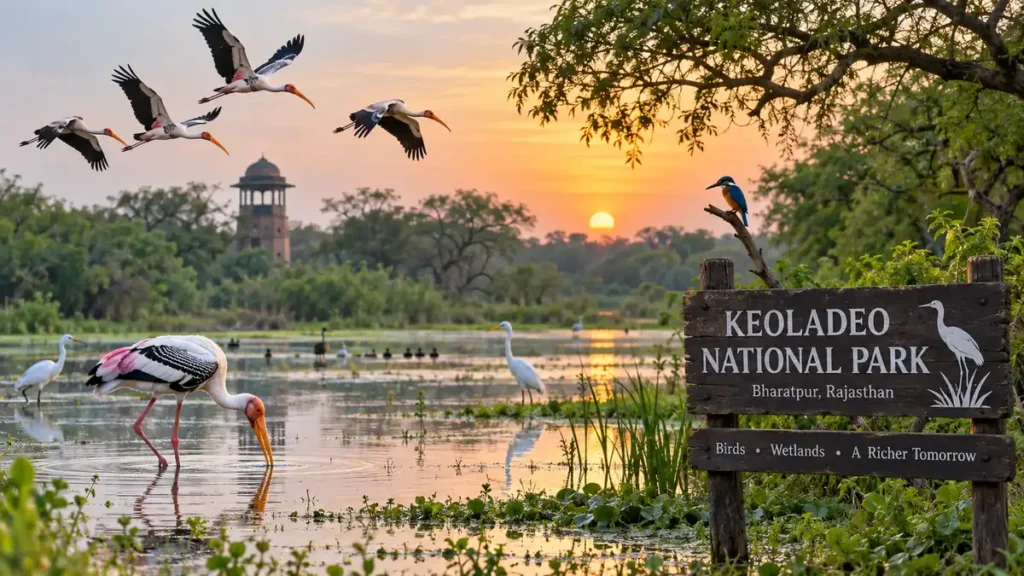
Few wildlife destinations in India let you slow down enough to actually notice nature. At keoladeo national park, you can walk or cycle beneath tree-lined paths while painted storks circle overhead, kingfishers watch the wetlands, and migratory waterfowl gather in shallow pools.
Located in Bharatpur, Rajasthan, the park—historically known as Bharatpur Bird Sanctuary—is a UNESCO World Heritage Site and internationally important wetland. Its roughly 29-square-kilometre landscape combines marshes, grasslands, woodland and scrub, supporting hundreds of bird species as well as mammals, reptiles, fish and other wildlife.
Quick answer: Keoladeo National Park is a protected wetland in Bharatpur, Rajasthan, famous for resident and migratory birds. Once managed as a royal duck-hunting reserve, it is now a UNESCO World Heritage Site. Winter offers the strongest migratory bird activity, while the monsoon and post-monsoon period can be excellent for observing breeding waterbirds.
What Is keoladeo national park?
Keoladeo National Park is one of India’s most celebrated bird habitats. It occupies 2,873 hectares, or just under 29 square kilometres, near Bharatpur in eastern Rajasthan. UNESCO describes the protected area as a mosaic of wetlands, grasslands, woodlands and woodland swamps surrounded by a heavily populated landscape.
The park has been known by several names.
Many travellers still call it Bharatpur Bird Sanctuary, while official and tourism sources also use Keoladeo Ghana National Park. “Keoladeo” is associated with a Shiva temple inside the reserve, while “Ghana” refers to dense vegetation.
What makes the landscape especially interesting is that its wetland character is not simply the result of an untouched natural lake. Water management over centuries helped transform a natural depression into a productive wetland ecosystem.
Today, the reserve is important for resident birds, breeding colonies and migratory waterfowl travelling through the wider Central Asian migratory system. India’s Ministry of Culture notes its importance for birds arriving from areas including Afghanistan, China and Siberia.
Keoladeo National Park at a Glance
| Feature | Details |
|---|---|
| Location | Bharatpur, Rajasthan, India |
| Area | 2,873 hectares, roughly 29 sq km |
| Former name | Bharatpur Bird Sanctuary |
| Other name | Keoladeo Ghana National Park |
| UNESCO status | World Heritage Site |
| UNESCO inscription | 1985 |
| UNESCO criterion | Natural criterion (x) |
| Main ecosystem | Wetlands, grassland, woodland and scrub |
| Famous for | Resident and migratory birds |
| Popular activities | Birdwatching, walking, cycling, photography |
| Peak birding period | Generally November to February |
| Nearest major tourist city | Agra |
UNESCO inscribed Keoladeo on the World Heritage List in 1985 because of its exceptional importance for birdlife and biodiversity.
History of keoladeo national park
The peaceful reserve visitors see today has a surprisingly different past.
The landscape developed from a natural depression whose hydrology was modified through water-control structures. Rajasthan Tourism notes that the construction of the Ajan Bund and subsequent flooding helped create the marshy habitat for which Bharatpur became famous.
During the princely era, the area became a royal hunting ground, particularly for waterfowl. It was used by Bharatpur’s rulers and visiting British officials for organised duck shoots.
The transformation from hunting reserve to protected wildlife habitat happened gradually.
Keoladeo was eventually designated a national park in 1982 and was inscribed as a UNESCO World Heritage Site in 1985. Conservationists and ornithologists played an important part in strengthening protection. Rajasthan Tourism specifically highlights noted Indian ornithologist Salim Ali and his efforts to secure government support for the park.
That history makes Keoladeo a striking example of changing attitudes toward wildlife: a landscape once managed partly for shooting birds is now internationally recognised for conserving them.
Why Is Keoladeo National Park Famous?
Birds are the main attraction, but the significance of Keoladeo extends beyond simply having a long species checklist.
Its shallow wetlands provide feeding and resting habitat, while trees, grasslands, scrub and drier areas create ecological niches for very different species within a compact area.
UNESCO reports roughly 375 bird species across the property, although totals vary among official and tourism sources depending on the records and classifications being used. Rajasthan Tourism commonly describes the park as having more than 370 recorded species.
The park supports combinations of:
- migratory waterfowl
- resident waterbirds
- waders
- storks
- herons and egrets
- cranes
- raptors
- kingfishers
- flycatchers
- woodland birds
- grassland species
This variety is possible because Keoladeo is not one uniform body of water.
Move through the reserve and the habitat repeatedly changes. A shallow flooded section may attract ducks and waders, while nearby trees support nesting colonies. Dry grassland and woodland edges can reveal entirely different birds and mammals.
UNESCO World Heritage Importance
Keoladeo National Park received World Heritage recognition under UNESCO’s natural criterion (x), which concerns important habitats for in-situ conservation of biological diversity.
The site is particularly notable for large congregations of resident breeding birds and for its role as a wintering area for migratory waterfowl.
It is also recognised internationally as an important wetland under the Ramsar framework. Historical UNESCO conservation documents discuss Keoladeo as a Ramsar site and highlight the close relationship between water availability, vegetation management and bird populations.
Quick Takeaway: Keoladeo’s importance comes from the entire wetland system—not from a single famous bird. Water levels, grasslands, shallow feeding areas, woodland and nesting sites work together to sustain its biodiversity.
Birds of keoladeo national park
Birdwatching is the reason many people travel specifically to Bharatpur.
Winter changes the character of the reserve as migratory birds join resident populations. Rajasthan Tourism lists ducks, geese, waders, raptors and flycatchers among the groups associated with Keoladeo’s seasonal birdlife.
Depending on season, habitat conditions and luck, visitors may encounter birds such as painted storks, spoonbills, herons, egrets, kingfishers, cormorants, Oriental darters, bar-headed geese, pelicans, cranes and numerous ducks and raptors.
The Sarus crane, one of the most impressive large birds associated with northern Indian wetlands, is another sought-after sighting.
You should not approach a visit as though every species on a historical checklist will be present. Bird populations change with migration, rainfall, wetland conditions and season.
That unpredictability is part of genuine birdwatching.
What Happened to the Siberian Cranes?
The Siberian crane is deeply connected with Keoladeo’s history, but older travel descriptions can create a misleading impression that visitors can still expect to see it.
Historically, Keoladeo was a major wintering ground for the western/central population of this critically endangered crane.
UNESCO records show a dramatic decline. Around the time of World Heritage inscription, dozens of Siberian cranes wintered at Keoladeo. Numbers subsequently collapsed, with periods when none arrived. A UNESCO-IUCN mission later reported that no wild Siberian cranes had been recorded at the park since 2002.
Threats along the cranes’ migration route, including hunting, were among the factors associated with the decline. Habitat and water-management issues at Keoladeo also became conservation concerns.
So, although the Siberian crane remains an important part of Keoladeo’s conservation story, travellers should not treat it as a normal present-day sighting.
That distinction matters because many generic descriptions of Bharatpur continue to mention the bird without explaining the historical context.
Wildlife Beyond Birds
A pair of binoculars may spend most of the day pointed toward birds, but Keoladeo is not exclusively an avian reserve.
The mixture of marsh, grassland, woodland and scrub also supports mammals, reptiles, amphibians, fish and invertebrates.
Rajasthan Tourism lists wildlife including nilgai, sambar, blackbuck, wild boar, golden jackal, jungle cat, fishing cat and striped hyena in the broader Keoladeo ecosystem.
Pythons are another notable resident. During suitable weather, reptiles may be encountered basking in warmer areas.
The experience is therefore quite different from a conventional big-cat safari.
There is no need to race from one sighting to another. Much of Keoladeo’s appeal comes from observing smaller interactions: a kingfisher dropping into water, deer crossing a distant opening, storks tending nests or a raptor causing hundreds of waterbirds to react simultaneously.
Best Time to Visit keoladeo national park
For most first-time visitors interested in migratory birds, November through February is the strongest period.
Cooler temperatures make long walks and cycling more comfortable, while winter migration increases the variety of birdlife. Local Bharatpur birding information identifies November to February as the migratory peak.
But there is no single “good” season for every type of wildlife observation.
| Season | What to Expect |
|---|---|
| November–February | Peak migratory bird activity and comfortable weather |
| March–April | Departing winter migrants, resident birds and warmer days |
| May–June | Hot conditions; early mornings are preferable |
| July–September | Monsoon landscape and breeding activity among resident waterbirds |
| October | Transition toward the winter migration period |
Winter: Best for Migratory Birds
Winter is the classic Bharatpur birding season.
Migratory waterfowl increase in number, mornings are relatively cool, and visitors can comfortably spend several hours exploring the trails.
December and January can also bring cold or misty mornings, so photographers should remember that perfect sunrise light is not guaranteed.
Monsoon: Best for Breeding Activity
The monsoon and post-monsoon landscape tells another story.
Water replenishes wetlands and breeding colonies of resident waterbirds can become active. For someone interested in nesting behaviour rather than simply building a large winter species list, this period can be fascinating.
Conditions, however, depend heavily on rainfall and water management.
Summer: Quiet but Hot
Summer is considerably hotter and generally less attractive for casual visitors.
Resident wildlife remains, but spending hours outside becomes harder as temperatures rise. If summer is your only option, enter as early as possible and concentrate your effort in the cooler morning period.
Best Time of Day for Birdwatching
Early morning is usually the most productive time to explore Keoladeo.
Bird activity is often high, temperatures are cooler and the light is more favourable for photography. A morning visit also gives you enough time to move slowly instead of trying to cover the reserve at speed.
Late afternoon can also be rewarding as temperatures drop.
Midday is less comfortable, particularly outside winter, though shaded sections can still produce interesting sightings.
For serious birdwatchers, two morning sessions are often more useful than one rushed full-day circuit.
How to Explore Keoladeo National Park
One of Keoladeo’s greatest advantages is its accessibility.
Unlike wildlife reserves where visitors spend most of their time inside a safari vehicle, Keoladeo can be explored at a human pace.
Rajasthan Tourism specifically identifies walking, bicycles and cycle-rickshaws as ways to travel through the reserve. It also notes that rickshaw pullers have received birdwatching training and can provide useful local knowledge.
Walking
Walking provides the slowest and most immersive experience.
It works especially well if you enjoy bird photography or want to examine smaller areas carefully. You can stop whenever something moves in the reeds instead of following a fixed vehicle schedule.
The drawback is distance. Trying to see every part of the park on foot can become tiring.
Bicycle
A bicycle gives you more range while preserving much of the quiet experience.
It is a useful compromise for independent travellers who want to cover significant ground but still stop frequently.
The mistake to avoid is cycling too quickly. Keoladeo rewards observation rather than distance covered.
Cycle-Rickshaw
A cycle-rickshaw is one of the park’s most distinctive ways to explore.
For first-time visitors, a knowledgeable rickshaw driver can help locate birds that are easy to miss. It is also convenient for travellers who cannot comfortably walk or cycle for several hours.
Naturalist Guide
Dedicated birders and photographers can benefit substantially from a knowledgeable naturalist.
Identifying similar-looking waterbirds and locating camouflaged owls, raptors or woodland species requires experience. Local guides also understand which areas are productive under current water and seasonal conditions.
How Much Time Do You Need?
Allow at least three to four hours for a meaningful first visit.
A half-day gives you enough time to explore without constantly checking the clock. A full day works better for photography and slower observation.
Dedicated birdwatchers may prefer two days or longer because morning conditions and bird activity can differ significantly from one day to another. Local birding resources recommend anything from a half-day to multiple days depending on the visitor’s level of interest.
If you have only two hours, avoid trying to “complete” the park. Choose a productive wetland area and watch it properly.
How to Reach keoladeo national park
Keoladeo National Park lies beside Bharatpur in Rajasthan, making it unusually accessible for a major wildlife destination.
By Train
Bharatpur Junction is the most convenient railway station.
Rajasthan Tourism states that Bharatpur is connected by regular rail services with major cities including Delhi, Mumbai, Jaipur and Agra, while the railway station is roughly 5 km from the bird sanctuary.
This makes a train journey practical for travellers combining Bharatpur with destinations in Rajasthan or the Delhi–Agra region.
By Air
Agra is the closest major airport mentioned by Rajasthan Tourism, approximately 56 km from Bharatpur.
Airport options and flight schedules can change, so check current connections before planning your journey.
By Road
Bharatpur is connected by road with Agra, Jaipur, Delhi and other northern Indian cities.
Its position makes the park particularly convenient for travellers already visiting Agra.
Rajasthan Tourism places Delhi approximately 184 km from Bharatpur, while Jaipur is about 185 km away.
Actual journey time depends on traffic, route and road conditions.
What to Carry for a Visit
You do not need specialist equipment to enjoy Keoladeo, but a few items can transform the experience.
Bring:
- binoculars
- drinking water
- comfortable walking shoes
- sun protection
- hat or cap
- light layers during winter
- insect repellent when appropriate
- camera with a telephoto lens if photographing birds
- small notebook or bird checklist
- power bank for long visits
Binoculars are more useful than a camera for many first-time visitors.
A long telephoto lens can produce beautiful images, but watching behaviour through binoculars often gives a better understanding of what is happening around you.
Avoid carrying unnecessary weight. Several hours of walking or cycling makes heavy equipment feel heavier than expected.
Practical Birdwatching and Photography Tips
The biggest mistake visitors make is moving too quickly.
When you reach an active wetland, stop.
Watch the reeds, exposed branches, shallow edges and open water separately. Many birds become visible only after you have remained still for a few minutes.
For a better experience:
- Arrive early. Cooler temperatures and morning activity generally favour birdwatching.
- Listen before moving. Calls can reveal birds hidden by vegetation.
- Scan different heights. Do not stare only at the water; check treetops and sky for raptors.
- Use binoculars first. Identify the subject before reaching for the camera.
- Keep your distance. Never move closer simply to force a bird into flight.
- Avoid loud conversation. Quiet visitors notice more.
- Ask local guides about current conditions. Productive zones change with water levels and season.
- Do not judge the visit by species count alone. Behaviour, breeding colonies and habitat interactions can be more memorable than checking names from a list.
For photography, early and late light is generally more flattering than harsh midday sun.
But wildlife photography also requires patience. Waiting beside one productive wetland can generate better opportunities than travelling constantly.
The Wetland Ecosystem and Water Management
Understanding the water explains much of what visitors see at Keoladeo.
The reserve is a managed wetland. Its ecological character depends on seasonal water availability and active habitat management.
UNESCO describes the property as a natural depression wetland historically managed as a duck-shooting reserve, while Rajasthan Tourism links its development to water impoundment associated with the Ajan Bund.
Water depth matters because different birds feed differently.
Shallow areas can support waders. Open water attracts other waterbirds. Exposed mud may become valuable feeding habitat, while trees surrounded by water can provide safer nesting sites.
Too little water can reduce wetland habitat.
But simply flooding everything deeply would not recreate the ecological balance either. The landscape depends on a mosaic of conditions.
Vegetation Management
Vegetation also needs management.
Historical UNESCO conservation reports identified invasive or excessive grass growth, including Paspalum, as a concern. Changes in grazing, vegetation structure and water availability can alter feeding and breeding habitat.
This demonstrates why wetland conservation is more complicated than placing a fence around an area and leaving it untouched.
Keoladeo is a dynamic ecological system requiring continued monitoring and management.
Conservation Challenges at Keoladeo
The park’s World Heritage designation does not make it immune to environmental pressure.
Water supply has been one of its long-standing conservation issues. UNESCO monitoring documents have repeatedly examined the relationship between insufficient water, invasive vegetation and changes in waterbird populations.
The disappearance of the park’s wintering Siberian crane population also shows that protecting a destination alone cannot protect every migratory species.
Migratory birds cross international borders. They may depend on breeding grounds, stopover wetlands and wintering habitats separated by thousands of kilometres.
Damage at any stage of that journey can affect populations elsewhere.
Conservation of Keoladeo therefore connects with a much larger network involving the Central Asian Flyway, international migratory-bird agreements and wetland protection across multiple countries.
Keoladeo National Park for Families and Casual Visitors
You do not need to be an ornithologist to enjoy the park.
Its flat landscape and slower exploration style make it approachable for families, first-time wildlife visitors and travellers who may find traditional vehicle safaris exhausting.
Children can look for easily recognisable birds such as storks, kingfishers, peafowl and large waterbirds rather than trying to identify every species.
A cycle-rickshaw can also make longer exploration easier for visitors who do not want to walk for several hours.
The key is setting the right expectation.
Keoladeo is not a zoo and sightings are never scheduled. Its attraction comes from entering a functioning ecosystem and observing whatever is active that day.
Places to Visit Around Bharatpur
A visit to Keoladeo can be combined with several historical and natural attractions around Bharatpur.
Lohagarh Fort is one of the city’s principal historical landmarks. Rajasthan Tourism describes the fort as notable for its rugged defensive character and identifies structures including Kothi Khas, Mahal Khas, Moti Mahal, Kishori Mahal, Jawahar Burj and Fateh Burj.
The Bharatpur Palace and Museum adds another layer of local history, with collections that include sculptures, art, crafts and manuscripts.
Nature-focused travellers can also investigate Band Baretha, another wildlife area in Bharatpur district.
Agra is close enough that many itineraries combine Bharatpur’s wetlands with the Taj Mahal and other Mughal-era monuments.
Responsible Tourism Inside the Park
A wildlife destination this accessible can receive substantial visitor pressure, particularly during the popular winter period.
Responsible behaviour is simple but important.
Stay on permitted routes, keep noise low, take all rubbish out with you and never feed wildlife. Do not chase birds for photographs or pressure a guide to approach nests.
Playback of recorded bird calls should also be avoided unless specifically permitted for legitimate research. Repeatedly playing calls can disturb territorial or breeding birds.
Photography should document natural behaviour rather than create it.
The same principle applies to nesting colonies. A spectacular image is not worth forcing a bird away from eggs or chicks.
Is Keoladeo National Park Worth Visiting?
For anyone interested in birds, wetlands, photography or quieter wildlife experiences, Keoladeo offers something unusual: biodiversity without the constant barrier of a safari vehicle.
You can walk.
You can stop.
You can listen.
That freedom changes the way wildlife is observed.
The reserve is also compact enough for a half-day visit yet ecologically complex enough to reward experienced birdwatchers over several days. Its combination of UNESCO World Heritage status, Ramsar wetland significance, migratory bird history and easy access from Bharatpur makes it one of northern India’s most distinctive nature destinations.
The best approach is not to arrive with a checklist of guaranteed sightings.
Visit keoladeo national park early in the day, give yourself several hours, bring binoculars and move slowly through the wetlands. Winter is the natural choice for travellers hoping to see the broadest range of migratory birds, while monsoon and post-monsoon visits reveal another side of the park through breeding colonies and renewed wetland habitat.
Keoladeo’s real appeal becomes clear once you stop trying to cover ground and simply watch the landscape come alive.