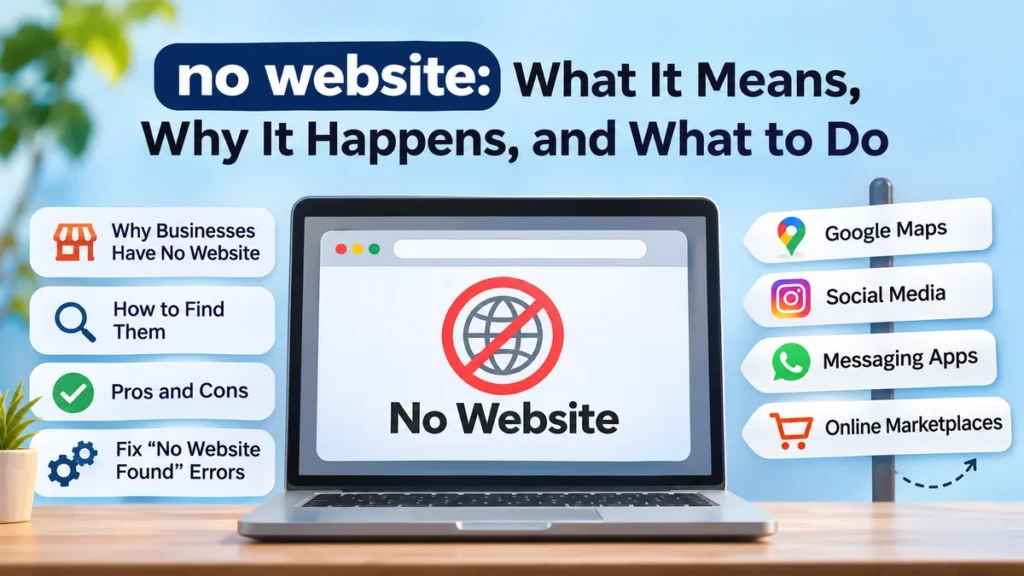
Not every business has a website, and not every missing website indicates a problem. Some businesses operate successfully through social media, Google Maps, messaging apps, and personal referrals. Others have websites that are temporarily unavailable, incorrectly configured, or simply difficult to find.
The term no website generally describes a business, organization, or individual without a dedicated website of their own. It can also refer to a missing website link, a website that no longer works, or an online service that cannot detect a particular domain. Understanding the difference helps customers find reliable information and business owners decide what kind of online presence they actually need.
What Does no website Mean?
The phrase “no website” usually means that a business or individual does not maintain a dedicated, publicly accessible website.
For example, a neighborhood bakery might have a Google Business Profile, an Instagram account, and a WhatsApp number but no independent domain such as examplebakery.com.
That business still has an online presence. It simply does not have a standalone website.
There are several situations in which the phrase may appear.
| Situation | What it means | Example |
|---|---|---|
| No dedicated website | A business has no independent website | A salon operates through Instagram |
| No website listed | A directory has no website URL for the business | A Google Maps listing without a Website button |
| Website unavailable | A website exists but cannot currently be accessed | A server outage |
| Website not found | A search engine or tool cannot locate a website | An unrecognized domain |
| Social-media-only presence | A business relies on third-party platforms | A Facebook business page |
| Website under construction | A domain exists, but the full site is not ready | A temporary coming-soon page |
These distinctions matter because a missing website is not necessarily evidence that a business is inactive, unprofessional, or unreliable.
Does no website Mean a Business Is Not Online?
No. A business can be active online without owning a traditional website.
Common alternatives include:
- Google Business Profile for business information and directions.
- Facebook Pages for announcements and customer communication.
- Instagram for photographs, products, and promotions.
- WhatsApp Business for messaging and customer inquiries.
- Online marketplaces for product listings.
- Third-party booking platforms for appointments.
Each platform provides a different set of capabilities.
A restaurant, for example, may use Google Maps for directions, Instagram for menu photographs, and a delivery platform for online orders.
The absence of a dedicated website does not prevent customers from finding or contacting that restaurant.
Why Do Some Businesses Have no website?
Businesses operate without websites for several reasons. Some make that choice deliberately, while others face practical or technical limitations.
1. They Rely on Local Customers
Many small businesses depend primarily on customers who live or work nearby.
Examples include barbershops, convenience stores, repair shops, and neighborhood restaurants.
These businesses may attract customers through their physical location, recommendations, and repeat visits.
A dedicated website can still help, but the business may not consider it essential to daily operations.
2. Social Media Meets Their Immediate Needs
Some business owners find social platforms easier to maintain than a website.
An Instagram account allows them to upload photographs, answer messages, and announce promotions without managing hosting or website software.
However, relying entirely on social media also creates limitations.
Platform rules, account restrictions, algorithm changes, and reduced visibility can affect how easily customers reach the business.
3. Website Costs and Maintenance
Creating a website may involve several expenses:
| Component | Typical purpose |
|---|---|
| Domain name | Establishes the website’s address |
| Web hosting | Stores and delivers website files |
| Website design | Determines appearance and usability |
| Content creation | Explains services and business information |
| Maintenance | Keeps software and functionality updated |
| Security | Protects the site and its visitors |
Actual costs vary considerably depending on whether the business uses a website builder, a content management system, or a custom-built solution.
A simple informational website generally requires fewer resources than a complex online store.
4. Limited Technical Knowledge
Business owners may understand the value of a website but lack the time or technical experience to create one.
Terms such as DNS, SSL certificates, hosting, and content management systems can seem unfamiliar.
Modern website builders have reduced many technical barriers, although basic maintenance and account management remain necessary.
5. The Business Is New
A recently opened business may prioritize its physical premises, inventory, employees, and customer service before developing a website.
It might initially create social profiles and a Google Business Profile.
As customer demand grows, the owner may establish a dedicated website.
6. The Website Exists but Is Not Listed
Sometimes a business does have a website, but its online directory listing does not include the address.
This may happen because the listing is incomplete, outdated, or maintained by someone who does not have access to the website details.
Consequently, a missing website field should never be treated as definitive proof that no website exists.
How Common Is no website Among Businesses?
Businesses without dedicated websites are not unusual, although their prevalence varies by country, industry, and business size.
Recent research illustrates why different estimates should be interpreted carefully.
A September 2026 study published by ULeads examined 248 Google Maps business listings across 13 searches. It found that 29 listings, approximately 11%, had no website listed. ULeads
A separate analysis published by Leadity in November 2026 reported that 35.9% of approximately 2.78 million businesses in its third-quarter 2026 Google Maps dataset showed no website. Leadity
These figures are not directly comparable because the samples, geographic coverage, and classification methods differ.
They also do not establish the percentage of all businesses worldwide that lack websites.
A Google Maps listing without a website link may belong to a business that maintains a domain elsewhere.
The useful lesson is that website availability varies substantially across markets, and reliable conclusions require checking the underlying data.
How to Find a Business With no website
Customers, researchers, and business owners sometimes need to determine whether a company has an official website.
The most reliable approach combines several checks rather than relying on a single search result.
Step 1: Search the Business Name
Enter the business name and location into Google or another search engine.
For example:
Example Bakery Chicago official website
Look for a domain that clearly belongs to the business.
Be cautious when businesses have similar names or operate in different cities.
Step 2: Check Google Maps
Open Google Maps and search for the business.
Review its business profile for a website link.
If the Website button is absent, the business may not have added its domain.
However, the missing button does not prove that the business has no website.
Step 3: Review Social Media Profiles
Look at the business’s official Facebook, Instagram, or LinkedIn profile.
Many businesses place their website address in the biography or contact information section.
A link may also point to a booking service, marketplace, or social landing page rather than a dedicated website.
Step 4: Search Local Business Directories
Local directories and industry associations may contain additional business information.
Compare the business name, location, phone number, and other identifying details before trusting a website link.
Directory records can become outdated, so verification is essential.
Step 5: Confirm Through an Official Contact Channel
If you still cannot find a website, contact the business through a verified phone number or official social account.
Ask whether it maintains an independent website.
This is particularly useful when making payments, arranging appointments, or sharing sensitive information.
How to Find Businesses With no website on Google Maps
Google Maps is also used to research local businesses that do not list a website.
A practical method involves searching by business category and geographic area.
For example, someone researching local salons might search for hair salons in a particular city and examine their business profiles.
The process generally follows these steps:
- Choose a business category, such as restaurants, salons, or automotive repair.
- Search for that category in a specific city or neighborhood.
- Open relevant Google Maps listings.
- Check whether each listing includes a website URL.
- Search the business name independently to verify whether a website exists.
- Record the findings and the date they were checked.
Researchers should distinguish between businesses with no website link and businesses that genuinely lack a dedicated website.
A November 2026 guide from FindLeadly specifically recommends verifying business names beyond Google Maps because some companies maintain websites that are not linked to their profiles. FindLeadly
Tools Used to Identify Missing Websites
Some specialized tools help identify businesses with incomplete online profiles.
Examples include:
- Hygo — searches Google Maps listings for businesses without website links.
- FindLeadly — provides filters for businesses with no listed website.
- NoSiteFinder — organizes business listings by industry and location.
These tools can reduce manual research, but their results still require verification. A missing field, broken URL, or social-only listing may be classified differently by each provider. Hygo+2
Is Having no website Bad for a Business?
Not necessarily.
The effect depends on how customers discover the business, what information they need, and whether the business can provide a reliable customer experience through other channels.
A small neighborhood shop with established local customers may function effectively without a website.
A business serving multiple cities or providing complicated services may benefit more from a dedicated online resource.
Advantages of Operating Without a Website
A business without a website may experience several practical benefits.
Lower initial costs: There may be no need to purchase hosting, commission a design, or maintain website software.
Simpler administration: Owners can concentrate on a smaller number of communication channels.
Faster setup: Creating a basic social media presence can be quicker than developing a complete website.
Direct communication: Messaging applications can make customer conversations convenient.
These advantages are particularly relevant to businesses with limited resources.
Disadvantages of Having no website
The limitations become more apparent as a business grows.
Reduced control: Third-party platforms control their own interfaces, policies, and account access.
Limited information organization: Social media posts are not always an efficient way to present detailed service information.
Branding restrictions: A dedicated website generally allows greater control over layout, navigation, and presentation.
Search visibility challenges: A business without a website cannot create its own dedicated webpages targeting specific search queries.
Platform dependence: Account suspension or technical problems can interrupt communication.
Limited functionality: Some advanced booking, customer account, and e-commerce features may require additional tools.
The decision should reflect actual business requirements rather than the assumption that every business must have a complex website.
no website vs Social Media: What Is the Difference?
A website and a social media profile can both help customers find information, but they operate differently.
| Feature | Dedicated website | Social media profile |
|---|---|---|
| Custom domain | Usually available | Generally uses platform URL |
| Design control | High | Limited |
| Content organization | Flexible | Platform-dependent |
| Search engine indexing | Individual pages can be indexed | Varies by platform |
| Customer messaging | Requires integration or setup | Often built in |
| Online booking | Can be integrated | Depends on platform |
| Platform dependence | Depends on hosting and services | Strong dependence on social platform |
| Maintenance | Owner or provider manages it | Platform manages core infrastructure |
A website and social media do not need to compete.
Many businesses use both, with the website serving as a central information source and social platforms supporting communication and audience engagement.
Can a Facebook Page Replace a Website?
A Facebook Page can provide business information, customer reviews, photographs, updates, and messaging.
For some businesses, these features may be sufficient.
However, a Facebook Page is not equivalent to owning an independent website.
The business cannot fully control the platform’s interface, account policies, or distribution of content.
A dedicated website provides greater flexibility for publishing structured information and creating custom functionality.
Why Does a Website Say “No Website Found”?
The phrase “No Website Found” can also appear as a technical error.
This situation differs from a business that has never created a website.
A domain may exist, but a search engine, browser, or website analysis tool might be unable to detect or access it.
Several technical issues can cause this behavior.
Incorrect Domain or URL
A mistyped domain name can prevent a browser or software tool from finding the intended website.
Check spelling, domain extension, and whether the address uses the correct hostname.
For example, www.example.com and example.com may require appropriate DNS and server configuration.
DNS Configuration Problems
The Domain Name System, or DNS, connects domain names to the information needed to reach their services.
Incorrect DNS records can prevent a domain from resolving to the intended server.
Common issues include missing A or AAAA records, incorrect CNAME records, and incomplete DNS changes.
Hosting or Server Problems
A website may become unavailable when its hosting server experiences an outage, misconfiguration, or resource problem.
Depending on the issue, visitors might encounter an error page or connection failure.
SSL and HTTPS Issues
An SSL/TLS certificate helps establish a secure HTTPS connection.
An expired, invalid, or incorrectly configured certificate may trigger a browser security warning.
This does not necessarily mean the website is missing.
Search Engine Indexing Issues
A functioning website may not appear in search results if its pages have not been indexed.
Possible explanations include:
- A new website that has not yet been discovered.
- A
noindexdirective. - Access restrictions that prevent crawling.
- Canonicalization pointing to another URL.
- Technical errors during crawling.
A website being absent from Google Search is different from the website being inaccessible.
Security and Firewall Restrictions
Security systems such as Cloudflare may restrict automated tools or certain visitors.
A tool that cannot access a website may incorrectly report that it does not exist.
Search Atlas, for example, identifies URL formatting, DNS problems, indexing restrictions, and firewall blocks among possible reasons its website discovery process may fail. chat.labs.searchatlas.com
How to Fix a no website Error
If you own a website that suddenly appears unavailable, diagnose the problem systematically.
Check Whether the Domain Works
Enter the domain directly into a browser.
Try the HTTPS address and check whether the correct hostname redirects as expected.
If the website works in a browser but not in a particular tool, the problem may involve that tool’s detection process.
Verify DNS Records
Review DNS settings through the domain registrar or DNS provider.
Confirm that the records point to the intended hosting service.
DNS changes can take time to become visible across different networks because of caching.
Check Hosting Status
Sign in to your hosting account and confirm that the service is active.
Review server logs or hosting error messages when available.
Inspect HTTPS Configuration
Confirm that the website has a valid certificate covering the requested hostname.
Also check whether HTTP-to-HTTPS redirects are configured correctly.
Review Search Console
For websites missing from Google Search, use Google Search Console to inspect indexing status.
The URL Inspection tool can help determine whether Google has indexed a particular page and whether crawling or indexing problems have been reported.
Test Security Rules
If a firewall or security service is enabled, inspect its logs for blocked requests.
Avoid disabling all security protections merely to test website availability.
Instead, identify the specific rule or configuration responsible for the problem.
Can You Run an Online Business With no website?
Yes. Some businesses operate through online marketplaces, social platforms, and messaging services without maintaining a dedicated domain.
For example, an independent seller might display products on Instagram, communicate through WhatsApp Business, and accept payments using an available payment service.
Other businesses use third-party marketplaces that provide product pages, checkout systems, and order management.
This arrangement can work, but the seller remains dependent on the services and rules of those platforms.
When a Website Becomes More Useful
A dedicated website may become valuable when a business needs to:
- Publish detailed information about many services.
- Organize a large product catalog.
- Provide customer support documentation.
- Offer customized booking or account features.
- Publish educational resources.
- Establish a consistent brand identity across channels.
- Build a long-term content and search visibility strategy.
The main question is not whether every business needs a website, but whether a website would solve a meaningful business or customer problem.
How to Create an Online Presence Without a Website
A business that is not ready to build a dedicated website can still establish a useful online presence.
Establish Accurate Business Information
Start by preparing consistent contact details, operating hours, business descriptions, and service information.
Ensure that customers can identify the correct business and distinguish it from similarly named organizations.
Create a Google Business Profile
Eligible businesses can use Google Business Profile to manage how their business appears in Google Search and Maps.
Depending on eligibility and available features, the profile may display contact information, business hours, photographs, and other details.
A business does not necessarily need a dedicated website to maintain a profile.
Choose Relevant Social Platforms
Select platforms based on where customers actually look for the business.
A visually oriented business may find Instagram useful, while another may prefer Facebook or a professional networking platform.
Maintaining accurate information on one or two relevant platforms can be more manageable than creating numerous inactive accounts.
Provide a Reliable Contact Method
Customers should know how to reach the business.
A published phone number, messaging channel, or appropriate booking service can reduce confusion.
Contact information should be checked regularly.
Keep Business Details Consistent
Use the same business name, location details, and primary contact information wherever possible.
Correct outdated directory listings and remove misleading information when you have the authority to do so.
Consistency helps customers recognize the business across different services.
How to Tell Whether a Business With no website Is Legitimate
A business without a website is not automatically suspicious.
However, customers should evaluate its credibility before making significant payments or sharing personal information.
Useful verification methods include checking its physical location, business registration where applicable, contact information, and independently published customer feedback.
A Google Maps listing or social media profile alone does not guarantee legitimacy.
Be particularly cautious if a business requests unusual advance payments, refuses to provide basic identifying information, or pressures customers to act immediately.
Does a Website Guarantee Trustworthiness?
No.
A professional-looking website can be created by either a legitimate business or a fraudulent operator.
Website appearance, HTTPS encryption, and search engine visibility should not be treated as proof of reliability.
Trust requires evaluating the business itself, its conduct, and the available independent evidence.
Should Every Business Eventually Have a Website?
There is no universal requirement that every business maintain a dedicated website.
A small business with a limited service area and dependable customer relationships may find that its existing channels meet its needs.
Another business may benefit substantially from a website because customers need detailed information before making decisions.
The following questions can help clarify the choice:
- Do customers frequently ask for information that could be published online?
- Are existing platforms sufficient for inquiries and bookings?
- Would dedicated webpages make services easier to understand?
- Does the business need functionality that social platforms cannot provide?
- Is there enough time or budget to maintain a website properly?
A simple, accurate website is often more useful than a complicated website that is outdated or difficult to navigate.
Equally, an accurate and well-maintained business profile may be more useful than an abandoned website.
Final Thoughts on no website
The phrase no website can describe several different situations, from a business that operates entirely through social media to a domain that is temporarily unavailable or missing from search results.
For customers, the priority is finding accurate information and verifying that a business is legitimate.
For business owners, the priority is making it easy for customers to discover services, communicate, and obtain trustworthy information.
A dedicated website can provide greater control, flexibility, and opportunities for publishing useful content. However, it is not the only way to establish an online presence.
The most practical next step is to evaluate the existing online channels, identify what customers cannot currently accomplish, and determine whether a website would address those needs.