A great beard is not simply about growing more facial hair. The way it frames your jaw, balances your features, and connects with your hairstyle can completely change your appearance. That is why the italian beard has become a recognizable reference in modern men’s grooming.
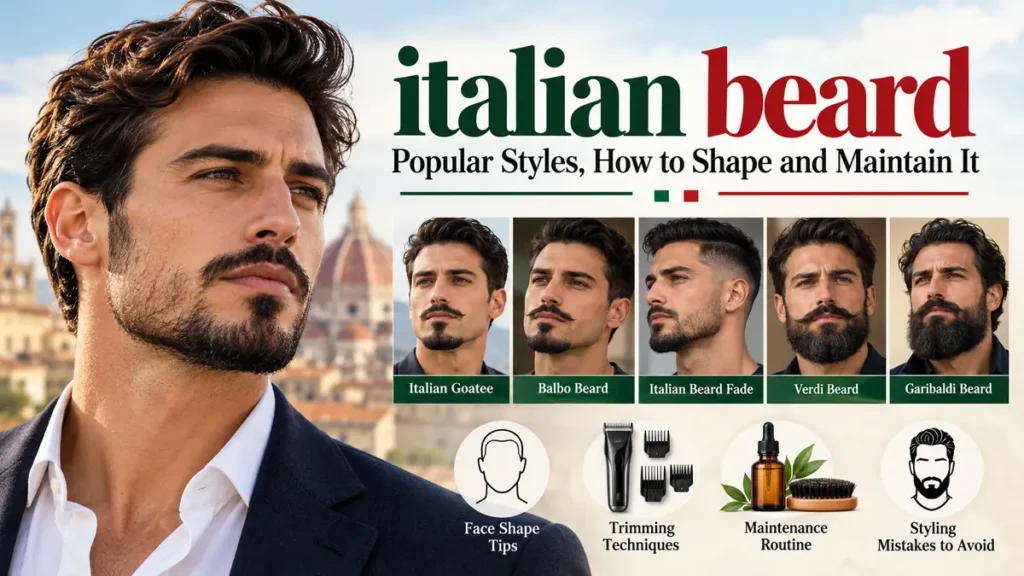
The italian beard is a carefully shaped facial-hair look characterized by clean cheek lines, a defined neckline, controlled sideburns, and balanced length around the chin and jaw. It can take several forms, including a sculpted short beard, Italian goatee, Balbo, or modern beard fade, depending on facial structure and growth patterns.
The style is particularly associated with precise barbering, deliberate proportions, and a polished Mediterranean-inspired appearance. Rather than following one rigid design, it allows different beard shapes to achieve a similar sense of refinement.
Understanding the variations is the first step toward choosing a version that works with your natural beard growth.
What Is an italian beard?
An italian beard is best understood as a family of grooming styles rather than one officially standardized beard shape.
Some interpretations feature a connected moustache and chin beard with shaved cheeks. Others maintain a fuller beard with tapered sideburns, sharper jawline contours, and gradually increasing length toward the chin.
A June 2026 feature in GQ Italia describes the contemporary Italian beard trend through shorter sideburns, graduated beard lengths, and carefully maintained cheek and neck contours. GQ Italia
Key Characteristics of the Italian Beard
Although individual variations differ, several elements frequently appear:
- Defined cheek lines: Natural growth is shaped to create a neat boundary.
- Clean neckline: Excess neck hair is removed without cutting unnecessarily high beneath the jaw.
- Controlled sideburns: Shorter sideburns may transition smoothly into fuller facial hair.
- Balanced chin volume: Hair around the chin and lower jaw provides visual structure.
- Well-groomed moustache: The moustache is trimmed and shaped to complement the beard.
- Intentional symmetry: Both sides are checked for balance without forcing naturally uneven growth into identical patterns.
The defining quality is controlled shaping rather than a particular beard length.
What Is the Italian Beard Called?
There is no single alternative name for every Italian-inspired beard.
The Italian word pizzetto commonly refers to a goatee-style beard concentrated around the chin. Another historically associated design is the Balbo, named after Italian aviator Italo Balbo.
Other styles frequently discussed alongside Italian grooming include the circle beard, short boxed beard, Verdi, Garibaldi, and Van Dyke.
These names describe different facial-hair arrangements. They should not be treated as interchangeable.
Popular italian beard Styles and Variations
The most suitable style depends on where your facial hair grows, how much definition you prefer, and how frequently you are prepared to trim.
| Beard style | Main feature | Maintenance |
|---|---|---|
| Classic Italian goatee | Chin and moustache emphasis | Medium |
| Balbo beard | Separate moustache and lower beard | High |
| Italian beard fade | Graduated sideburn transition | High |
| Short boxed beard | Compact, defined full beard | Medium |
| Designer stubble | Short growth with clean edges | Low–medium |
| Verdi-inspired beard | Fuller beard with styled moustache | High |
| Garibaldi beard | Full, rounded lower beard | Medium |
| Van Dyke | Separate moustache and pointed chin beard | High |
1. Classic Italian Goatee or Pizzetto
The pizzetto focuses facial hair around the mouth and chin while leaving the cheeks largely clean-shaven.
Some versions include a connected moustache, creating a rounded circle-beard outline. Others retain a separate moustache or only a small chin tuft.
This style can be particularly practical for men whose facial hair grows strongly around the mouth but remains sparse on the cheeks.
The main challenge is maintaining clean boundaries. Because the cheeks are exposed, uneven lines around the mouth and chin become more noticeable.
2. Balbo Beard
The Balbo combines a shaped moustache with a separate beard covering the chin and portions of the lower jaw.
Its defining characteristic is the visible separation between the moustache and the beard. Sideburn connections are generally absent.
The design can create a structured lower-face appearance without requiring dense cheek growth.
However, the separated sections need careful trimming. Allowing the moustache and beard to connect unintentionally changes the appearance of the style.
3. Modern Italian Beard Fade
The Italian beard fade is among the more recognizable contemporary interpretations.
It combines very short sideburns with progressively longer facial hair toward the cheeks, jaw, and chin.
The transition should appear gradual rather than showing obvious steps between different lengths.
This style often pairs well with a low fade, mid fade, or tapered haircut because the hair and beard can share a continuous transition.
A poorly blended fade, however, can make the beard appear disconnected from the hairstyle.
4. Short Boxed Italian Beard
A short boxed beard maintains facial-hair coverage across the cheeks, jaw, and chin while keeping the overall length relatively compact.
Its clean edges and controlled shape make it suitable for people who prefer a conventional full-beard appearance.
An illustrative starting length is approximately 5–12 mm, although the ideal measurement depends on density and facial proportions.
Unlike the pizzetto, this variation requires reasonably consistent growth along the cheeks and jaw.
5. Italian Designer Stubble
Designer stubble creates a deliberately maintained short-beard appearance.
Instead of allowing facial hair to grow unevenly, the beard is trimmed to a consistent length, often around 1–5 mm, and finished with controlled cheek and neckline boundaries.
It offers a relatively subtle option for people who do not want a prominent full beard.
Short facial hair can still require frequent attention because new growth quickly changes the outline.
6. Verdi-Inspired Beard
The Verdi beard takes its name from Italian composer Giuseppe Verdi.
It traditionally features a fuller, rounded beard paired with a distinct, styled moustache.
Unlike closely trimmed modern variations, the Verdi relies on substantial facial-hair volume and careful moustache grooming.
It suits people who enjoy a more traditional appearance and are comfortable using a beard comb, scissors, and occasional moustache wax.
7. Garibaldi Beard
Named after Italian historical figure Giuseppe Garibaldi, the Garibaldi is a fuller beard with a broad, rounded lower silhouette.
Its appearance is generally more natural and less sharply sculpted than a modern beard fade.
The beard requires sufficient growth along the cheeks and chin to establish its rounded shape.
Regular trimming is still necessary to prevent uneven bulk, particularly beneath the jaw.
8. Van Dyke and Anchor-Inspired Styles
The Van Dyke features a moustache separated from a chin beard, which is often shaped into a point.
An anchor beard uses a different outline, extending along portions of the jaw to create an anchor-like silhouette.
Neither is exclusively Italian, but both appear in collections of Italian-inspired facial-hair designs because they emphasize deliberate shaping and strong visual definition.
These styles work best when the moustache, chin, and surrounding shaved areas can be maintained distinctly.
Choosing an italian beard for Your Face Shape
A beard can change the apparent proportions of a face, but it cannot alter the underlying bone structure.
The goal is to balance facial width, length, and jaw definition.
Round Face
A round face may benefit from shorter cheek hair and slightly more length around the chin.
A tapered beard, Balbo, or carefully shaped goatee can create a more elongated appearance.
Avoid adding excessive width around the lower cheeks if your aim is to make the face look narrower.
Square Face
Square faces already have prominent jaw angles.
A short boxed beard or rounded chin shape can soften those angles while preserving definition.
Keeping every corner extremely sharp may exaggerate the squareness, which is not always the desired effect.
Oval Face
Oval faces generally accommodate a wide range of beard proportions.
A short sculpted beard, Italian fade, or pizzetto can all work well, depending on facial-hair density.
The most useful consideration is maintaining proportion rather than adding unnecessary length or width.
Long or Rectangular Face
For longer faces, excessive chin length may further emphasize vertical proportions.
A fuller beard along the jaw and lower cheeks can provide visual width.
A compact boxed beard may therefore be more balanced than a long, pointed goatee.
Diamond and Heart-Shaped Faces
Faces with wider cheekbones or foreheads and narrower chins may benefit from additional volume around the lower jaw.
A rounded chin beard, Balbo, or moderately full beard can help balance the lower face.
The ideal result depends on the individual jawline, not simply the face-shape label.
Face Shape Comparison
| Face shape | Suggested style | Main shaping goal |
|---|---|---|
| Round | Tapered beard, Balbo | Add visual length |
| Square | Short boxed, rounded beard | Balance angular features |
| Oval | Fade, goatee, short beard | Maintain proportion |
| Rectangular | Compact full beard | Avoid excessive chin length |
| Diamond | Rounded chin beard | Add lower-face fullness |
| Heart | Balbo, fuller lower jaw | Balance a narrower chin |
These are visual guidelines, not strict rules. Natural beard growth and personal preference matter more than matching a face-shape chart exactly.
How to Grow an italian beard
Growing an Italian-inspired beard begins with understanding your natural facial-hair distribution.
Some men have dense growth along the jaw but thinner cheeks. Others have strong moustache growth but limited coverage around the chin.
Choosing a shape that complements your existing growth is usually more effective than trying to force an unsuitable design.
Allow Your Facial Hair to Grow
If you are starting from a clean-shaven face, allow approximately three to four weeks of growth before attempting a more substantial shape.
This is a practical observation period, not a guarantee that every beard will become full within a month.
During this stage, examine the density of your cheeks, moustache, chin, and jawline.
You may discover that a goatee suits your growth better than a full beard, or that a short fade can accommodate thinner areas.
Understand Beard Growth Patterns
Beard growth depends on several factors, including genetics, age, hormonal influences, and individual follicle characteristics.
The speed and density of facial-hair growth vary between individuals.
Trimming or shaving does not make facial hair grow back thicker. It changes the appearance of the hair’s cut ends, not the number of follicles producing hair.
Likewise, ordinary beard oils can soften existing hair and improve manageability, but they should not be mistaken for proven treatments that create new follicles.
Shape Gradually
Once sufficient hair has grown, begin with a conservative trim.
Keep more length than you think you need, particularly around the chin. You can always shorten an area later, but an accidentally overtrimmed section requires time to regrow.
For a faded version, establish the longer beard length before creating the shorter transitions.
For a goatee, identify the desired chin and moustache boundaries before shaving the surrounding cheeks.
How to Trim and Shape an italian beard at Home
A precise beard shape requires a clear plan, suitable tools, and careful attention to symmetry.
The most common home-trimming mistake is removing too much hair while trying to correct a small difference between the two sides.
Essential Beard Grooming Tools
A basic grooming setup may include:
- Adjustable beard trimmer with multiple guard lengths
- Precision trimmer for edges and moustache details
- Beard comb or brush
- Small grooming scissors
- Razor or foil shaver for clean-shaven areas
- White grooming pencil for marking guidelines
- Shaving gel and suitable moisturizer
A white pencil is particularly useful for beginners because it allows you to preview cheek and neckline boundaries before cutting.
Step 1: Wash, Dry, and Comb Your Beard
Begin by washing your beard with a gentle cleanser.
Dry the facial hair before using a trimmer for precise length control, unless the device and technique specifically call for wet trimming.
Comb the hair in its natural direction so uneven areas become visible.
Trimming an uncombed beard can produce inconsistent results because curled or displaced hairs may lie differently after grooming.
Step 2: Establish the Overall Length
Choose a guard that leaves slightly more length than your intended result.
For example, someone planning a short boxed beard might initially use a 10 mm guard and adjust gradually.
Work with light, controlled passes.
Avoid repeatedly trimming one section while leaving the opposite side untouched. Instead, alternate between both sides to maintain balance.
Step 3: Define the Cheek Line
The cheek line determines the upper boundary of the beard.
For a natural appearance, follow the existing growth pattern and remove only the stray hairs above it.
For a more sculpted design, create a slightly clearer boundary without cutting unnecessarily deep into the cheek.
Check both sides from the front and at an angle.
A cheek line that looks balanced from one side may appear uneven when viewed directly.
Step 4: Shape the Neckline
The neckline supports the overall silhouette of the beard.
For many short-beard styles, a useful starting reference is approximately one or two finger widths above the Adam’s apple, adjusted for individual anatomy and beard length.
From that central point, create a gentle curve toward the area beneath each ear.
Avoid shaving directly along the underside of the jawbone. Setting the neckline too high can make the beard appear narrow or disconnected when viewed from the side.
Longer beards may require a lower, less exposed neckline.
Step 5: Create the Beard Fade
For a modern Italian beard fade, use progressively shorter trimmer guards as you move upward toward the sideburns.
An illustrative progression might be:
| Area | Example length |
|---|---|
| Upper sideburn | 1–2 mm |
| Lower sideburn | 3–4 mm |
| Upper cheek | 5–6 mm |
| Lower cheek and jaw | 7–10 mm |
| Chin | 10–15 mm |
These measurements are starting examples rather than fixed specifications.
Blend the transitions using small movements and inspect the result under even lighting.
The aim is a gradual change in length, not a visible line separating two sections.
Step 6: Trim the Moustache
Comb the moustache downward and remove hairs that extend beyond your preferred lip line.
Use small scissors or a precision trimmer for better control.
For a connected circle beard, preserve the hair linking the moustache to the chin.
For a Balbo or Van Dyke, maintain the intended separation.
The connection pattern is an important part of the design, so do not remove it without deciding which style you want.
Step 7: Finish and Check Symmetry
After shaping, examine the beard from the front, both sides, and slightly below the chin.
Look for uneven bulk, isolated long hairs, and abrupt fade transitions.
Make small corrections rather than repeatedly reducing the entire beard.
Finish by rinsing away loose hair and applying a suitable moisturizer or beard-conditioning product.
italian beard Maintenance and Daily Grooming
A carefully shaped beard can lose its definition as new growth appears around the cheeks, neck, and sideburns.
Maintenance frequency depends on the style, hair-growth rate, and desired sharpness.
Daily Beard Care
Wash the beard and the skin beneath it with a gentle cleanser, then apply a suitable moisturizer or conditioning product.
The American Academy of Dermatology recommends regular cleansing, moisturizing, and grooming to help manage beard-related dryness, itchiness, and irritation. American Academy of Dermatology
Beard oil may be helpful for normal or dry skin, while people with sensitive skin may prefer a fragrance-free moisturizer.
Comb longer facial hair to remove tangles and distribute conditioning products evenly.
Weekly Trimming Routine
A practical maintenance schedule might look like this:
| Task | Suggested frequency |
|---|---|
| Gentle cleansing | Daily |
| Moisturizing | Daily |
| Moustache touch-up | Every 3–7 days |
| Cheek and neckline cleanup | Every 2–5 days |
| Short beard length trim | Every 5–10 days |
| Beard fade maintenance | About every 1–2 weeks |
| Longer beard reshaping | Every 3–6 weeks |
These intervals are flexible. Someone who prefers natural edges may trim less frequently than someone maintaining a sharply sculpted fade.
Preventing Razor Bumps and Ingrown Hairs
Sharp beard outlines often require shaving exposed areas, especially the neck.
Incorrect shaving technique can cause razor burn, irritation, and ingrown hairs.
To reduce these problems:
- Soften facial hair with warm water before shaving.
- Apply a moisturizing shaving cream or gel.
- Shave in the direction of hair growth.
- Use light pressure and avoid repeatedly passing over the same area.
- Rinse the blade regularly.
- Replace dull blades and keep shaving equipment clean.
- Apply a gentle moisturizer afterward.
These steps reflect dermatology guidance for reducing shaving-related irritation. American Academy of Dermatology+1
People who regularly experience painful razor bumps may find that an electric trimmer leaving a little stubble is more comfortable than a very close shave.
Persistent inflammation, painful bumps, or scarring should be assessed by a dermatologist.
italian beard vs. Other Popular Beard Styles
The term Italian beard is sometimes confused with several more precisely defined facial-hair designs.
Understanding their differences makes it easier to communicate with a barber.
| Feature | Italian-inspired beard | Goatee | Balbo | Full beard |
|---|---|---|---|---|
| Cheek coverage | Optional | Usually shaved | Usually minimal | Full |
| Moustache | Connected or separate | Optional | Separate | Usually connected |
| Chin emphasis | Common | Strong | Strong | Variable |
| Sideburn connection | Optional | Usually absent | Absent | Present |
| Fade | Often used | Uncommon | Optional | Optional |
| Overall appearance | Tailored and defined | Chin-focused | Disconnected and sculpted | Broad facial coverage |
Is an Italian Beard the Same as a Goatee?
Not necessarily.
A goatee is a specific facial-hair arrangement concentrated around the chin, sometimes combined with a moustache.
An Italian-inspired beard can include a goatee, but it may also retain facial hair across the cheeks and jaw.
The difference lies in whether the term describes a particular hair pattern or a broader grooming aesthetic.
Is an Italian Beard Suitable for Patchy Growth?
Yes, provided the chosen variation works with the areas where hair grows most consistently.
For example, someone with sparse cheeks but strong moustache and chin growth may find a pizzetto or Balbo more practical than a full boxed beard.
A person with uneven sideburn density might prefer a shorter, naturally tapered transition instead of a dramatic skin fade.
Keeping a patchy beard very long does not always conceal gaps. In some cases, a shorter and more uniform trim makes the overall appearance more balanced.
Common italian beard Styling Mistakes
Even a well-chosen beard shape can look uneven when its proportions or boundaries are poorly maintained.
Cutting the Neckline Too High
A high neckline removes the hair that visually supports the jaw.
This can make the beard appear smaller and less connected to the face.
Check the outline from the side before removing additional neck hair.
Creating an Abrupt Fade
A fade should transition gradually between lengths.
Using only two dramatically different guards can create an obvious step.
Introduce intermediate lengths and work slowly through the transition.
Making the Cheek Lines Too Artificial
Extremely low or sharply drawn cheek lines may look striking in photographs but can appear unnatural in everyday settings.
A clean outline does not need to ignore the natural direction of facial-hair growth.
Ignoring the Moustache
An untidy moustache can disrupt an otherwise carefully shaped beard.
Keep the lip line controlled and ensure the moustache proportions match the chin and jaw.
Using Too Much Beard Oil
Excessive oil can leave facial hair greasy and may be uncomfortable for some skin types.
Begin with a small amount, distribute it evenly, and adjust according to beard length and dryness.
Copying a Beard Without Considering Growth Density
A photograph may show a beard supported by naturally dense facial hair.
Trying to reproduce the same shape with significantly different growth can create unnecessary gaps or uneven proportions.
Adapt the style to your own growth pattern rather than treating a reference image as an exact template.
How to Explain the italian beard Style to Your Barber
Because the term covers multiple designs, simply asking for an Italian beard may not produce the result you expect.
A photograph is useful, but a clear description of the shape is equally important.
Discuss the following details before trimming begins:
- Beard length: Short stubble, medium beard, or longer chin-focused shape.
- Cheek coverage: Full, tapered, or clean-shaven.
- Moustache connection: Connected to the chin or deliberately separated.
- Sideburn treatment: Natural transition, low fade, or stronger fade.
- Neckline: Natural and conservative or more sharply defined.
- Chin shape: Rounded, squared, tapered, or pointed.
For example, you could request a short boxed beard with a gradual sideburn fade, slightly more length around the chin, a natural cheek line, and a clean neckline.
That description gives the barber specific shaping instructions rather than relying on an ambiguous style name.
It is also useful to explain which areas you want to preserve. A small misunderstanding about chin length or moustache connections can substantially change the finished appearance.
Can You Maintain an italian beard Without Visiting a Barber?
Yes. Many short and medium-length versions can be maintained at home with a quality adjustable trimmer, a comb, scissors, and a mirror.
Simple styles such as designer stubble and short boxed beards are generally easier to manage independently.
More complicated designs, particularly high-contrast fades, Balbo variations, and sharply separated moustache arrangements, demand greater precision.
A professional initial trim can provide a useful template for subsequent home maintenance.
Once the shape is established, regular small adjustments are often easier than allowing the beard to become overgrown and attempting to recreate the entire outline.
Final Thoughts on the italian beard
The italian beard is not defined by a single moustache connection, beard length, or shaving pattern. Its appeal comes from thoughtful shaping, controlled proportions, clean boundaries, and attention to the relationship between facial hair and face shape.
From the classic pizzetto and Balbo to the modern faded beard and fuller Verdi-inspired design, each variation offers a different way to emphasize the chin, jaw, and moustache.
The most effective approach is to choose a style that suits your natural growth, begin trimming conservatively, and maintain both the facial hair and the skin beneath it.
A well-maintained Italian-inspired beard does not need to be perfectly geometric or exceptionally dense. It needs to look balanced, comfortable, and intentionally groomed.