A haircut can look sharp without dramatically changing your appearance. That’s exactly why the low taper fade has become a popular choice for men who want clean edges, natural volume, and a style that works in both professional and casual settings.
Unlike a high fade that removes considerable hair from the sides, a low taper focuses on subtle transitions near the temples, sideburns, and neckline. The result is a polished haircut that preserves most of your hair’s natural shape.
A low taper fade is a men’s haircut that gradually shortens the hair around the sideburns and neckline while keeping more length on the sides and top. It creates a smooth transition from longer hair to shorter hair near the edges, offering a neat appearance without the dramatic contrast of a full skin fade.
What Is a Low Taper Fade?
A low taper fade combines two barbering techniques: tapering and fading.
A taper gradually reduces hair length toward the edges of the head. A fade creates a closely blended transition between different lengths, sometimes ending with extremely short hair or exposed skin.
In a low taper fade, the barber concentrates the shortest areas around the bottom of the sideburns and the nape of the neck. The transition usually stays below the upper temple area, although its exact placement depends on the haircut and head shape.
Most of the sides remain relatively full, making this haircut less dramatic than a conventional low fade.
Key Characteristics
- Low transition: The shortest hair stays close to the ears, sideburns, and neckline.
- Natural sides: More hair remains around the temples and upper sides.
- Smooth blending: Clippers and guards create gradual changes in length.
- Flexible top: The haircut works with short crops, curls, waves, quiffs, and longer hairstyles.
- Customizable finish: The edges can be soft and natural or sharply defined.
The defining feature is the location of the taper, not a particular length on top.
A person with short, straight hair and someone with long, curly hair can both wear a low taper fade while achieving completely different overall looks.
Low Taper Fade vs. Low Fade, Mid Taper, and High Taper
These haircut names sound similar, but they describe different blending patterns and transition heights.
Understanding the differences helps prevent confusion when explaining your preferred style to a barber.
| Haircut | Transition Area | Overall Appearance | Hair Retained on Sides |
|---|---|---|---|
| Low taper fade | Sideburns and lower neckline | Subtle and natural | Most |
| Low fade | Lower sides, usually around the head | More noticeable contrast | Moderate |
| Mid taper fade | Higher around temples and neckline | Balanced and defined | Moderate to high |
| High taper fade | Higher tapering around temple and side areas | Sharper and more prominent | Varies |
| Skin fade | Can start low, mid, or high | Very close or bald finish | Depends on fade height |
Low Taper Fade vs. Low Fade
The main difference is how much of the head receives the fading treatment.
A low taper fade usually affects smaller areas around the sideburns and neckline. The rest of the sides retain their natural density.
A low fade generally creates a continuous fading band around the lower sides and back of the head.
Choose a low taper when you prefer a softer, more conservative appearance. A low fade makes more sense when you want visible contrast around the entire lower head.
Low Taper vs. Mid Taper Fade
A mid taper fade moves the transition higher, creating more definition around the temples.
The low taper remains closer to the hairline and maintains a fuller silhouette.
Both styles can look clean, but the mid taper is generally more noticeable from the side.
Low Taper vs. High Taper Fade
A high taper creates a more prominent transition by starting the shortening process higher around the sideburn and temple regions.
A low taper preserves more length near the upper sideburns.
Barbers sometimes use these terms differently, so showing a photograph is more reliable than relying on the haircut name alone.
Is a Low Taper the Same as a Drop Fade?
No. A drop fade describes a fading line that curves downward behind the ear toward the back of the head.
A low taper focuses on the sideburns and neckline.
A haircut can combine elements of both techniques, but they are not interchangeable.
Popular Low Taper Fade Hairstyles
One of the biggest advantages of this haircut is its versatility. The taper can be paired with numerous top styles without changing its basic structure.
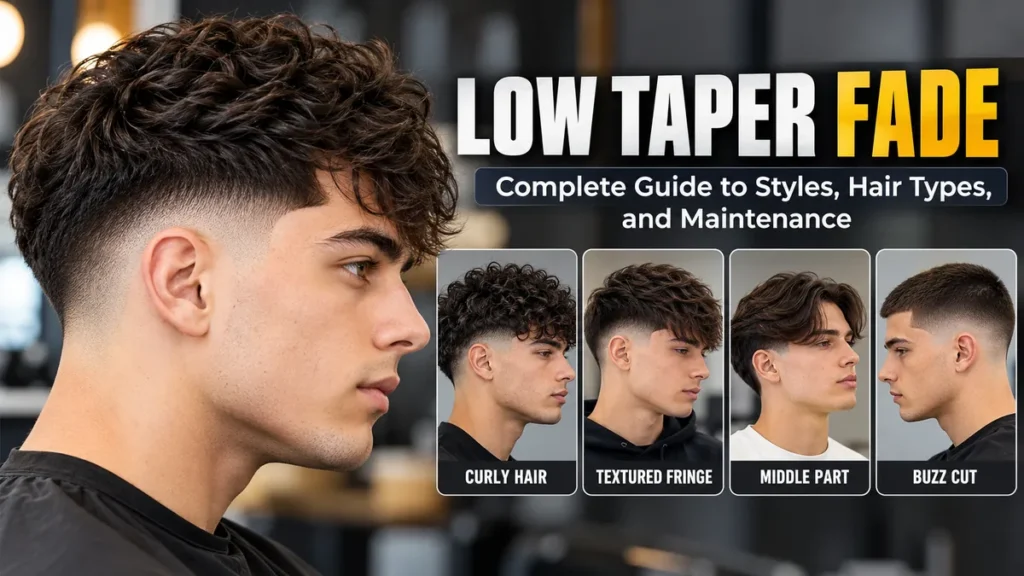
1. Low Taper Fade With Textured Fringe
A textured fringe keeps movement and volume toward the forehead while the taper cleans up the sides.
The top is usually cut with scissors or texturizing techniques to create separation between strands.
This combination works particularly well with straight or slightly wavy hair.
A light styling cream or matte clay can add definition without making the fringe appear stiff.
2. Low Taper Fade With Curly Hair
Curly hair naturally creates volume, and a low taper helps control the edges without removing the curls that define the hairstyle.
The barber can leave the curls longer on top while blending the sideburns and neckline.
For a balanced appearance, the transition should follow the natural curl pattern rather than creating an abrupt change in density.
A leave-in conditioner or curl cream can help reduce frizz and maintain definition.
3. Low Taper Fade With Straight Hair
Straight hair can make clipper lines and uneven blending more visible.
A carefully executed low taper creates a gradual transition while preserving the clean outline of the hairstyle.
Popular combinations include a side part, textured crop, short quiff, and classic comb-over.
A small amount of matte paste can provide texture without an overly glossy finish.
4. Low Taper Fade With Wavy Hair
Wavy hair provides natural movement that pairs well with a subtle taper.
The haircut removes bulk near the edges while allowing the waves to remain visible.
A medium-length top often provides enough weight for the waves to form naturally.
Sea salt spray may add texture, although frequent use can leave some hair types feeling dry.
5. Low Taper Fade With Fluffy Hair
Fluffy hairstyles rely on soft volume and a loose, airy texture.
A low taper creates a neat foundation while allowing the top to appear fuller.
This contrast is particularly effective when the hair has medium density and enough length to lift away from the scalp.
For styling, use a lightweight mousse or a small amount of volumizing product, then blow-dry with moderate heat.
6. Low Taper Fade With a Middle Part
A middle-part hairstyle, sometimes called a curtain haircut, features longer hair separated near the center of the forehead.
The low taper keeps the sideburns and neckline tidy without interfering with the longer front sections.
This pairing suits people who want a contemporary hairstyle while maintaining some traditional barbering details.
The top needs enough length to fall naturally to either side.
7. Low Taper Fade With a Buzz Cut
A buzz cut keeps the hair short and relatively uniform across the top.
Adding a low taper creates subtle definition around the sideburns and neckline.
The result is practical, easy to style, and suitable for people who prefer minimal daily grooming.
Because the hair is short, regrowth around the edges can become noticeable relatively quickly.
8. Low Taper Fade With a Crew Cut
The crew cut is a short hairstyle with slightly more length toward the front.
A low taper complements its structured appearance without introducing excessive contrast.
This combination works well for people who prefer traditional, low-maintenance hairstyles.
9. Low Taper Fade With a Quiff
A quiff features hair styled upward and backward near the forehead.
The longer front creates height while the taper keeps the lower edges controlled.
For a natural appearance, the upper sides should blend smoothly into the top rather than forming a disconnected shape.
A blow-dryer and light styling product can help maintain volume.
10. Low Taper Fade With a Pompadour
A pompadour uses more volume at the front, typically styled backward.
The low taper gives the hairstyle a cleaner outline while maintaining fullness along the sides.
Unlike a high skin fade, this combination preserves a softer transition between the voluminous top and lower edges.
11. Low Taper Fade With a Mullet
A modern mullet combines shorter or more controlled sides with longer hair at the back.
Adding a low taper around the temples and sideburns creates definition while preserving the length at the nape.
The neckline taper may be modified or minimized to avoid removing the longer back section.
This is an example of why a barber should adapt the technique to the complete haircut rather than follow a fixed pattern.
12. Low Taper Fade With Twists or Braids
Twists, braids, and protective hairstyles can also incorporate a low taper.
The taper typically cleans up the sideburns and neckline while preserving the main braided or twisted sections.
For these styles, the barber should avoid cutting into the established parting pattern or removing hair needed for future maintenance.
A soft, natural hairline is often preferable to repeated aggressive edging.
Does a Low Taper Fade Suit Every Face Shape?
A low taper fade can be adapted to most face shapes. However, the length, volume, and styling direction of the hair on top often influence the final appearance more than the taper itself.
Round Face
Round faces generally have softer angles and similar facial width and length.
A low taper paired with a quiff, textured top, or moderate height can create a more elongated appearance.
Avoid excessive width around the upper sides if your goal is a slimmer silhouette.
Oval Face
Oval faces typically accommodate a wide variety of hairstyles.
A low taper with a textured crop, side part, middle part, or curly top can work well.
The main consideration is maintaining a balanced relationship between the fringe, crown, and sides.
Square Face
Square faces feature a more defined jawline and angular proportions.
A crew cut, short quiff, or classic side part with a low taper can complement these features.
Keeping some natural fullness around the temples can create a softer overall appearance.
Long or Rectangular Face
For longer face shapes, excessive height on top can exaggerate facial length.
A textured fringe, medium-length crop, or relaxed side part may create a more balanced silhouette.
Keeping the taper low also helps preserve some width along the sides.
Heart-Shaped and Diamond Faces
Heart-shaped faces tend to have a broader forehead and narrower chin, while diamond faces often feature prominent cheekbones.
A low taper with a medium-length, textured top can help balance these proportions.
Avoid removing too much volume around the temples if you want to maintain a softer facial outline.
These are styling guidelines rather than strict rules. Personal preference, hair density, and natural growth patterns matter just as much as face shape.
How to Ask Your Barber for a Low Taper Fade
The most common haircut misunderstanding happens when someone asks for a low taper but receives a full low fade.
The solution is to explain exactly where the taper should begin and how short it should become.
A clear request would be:
“I want a low taper fade around the sideburns and neckline. Keep the blend low, leave the upper sides full, and don’t fade around the entire head. Keep the top textured and natural.”
This gives the barber a better starting point than simply naming the haircut.
Understand Clipper Guard Numbers
Clipper guards control how much hair remains after cutting. Approximate lengths for common guards are shown below.
| Guard | Approximate Hair Length | Typical Use |
|---|---|---|
| No guard, closed | Very close, varies by clipper | Shortest fade areas |
| #0.5 | 1.5 mm | Close taper transitions |
| #1 | 3 mm | Short, defined edges |
| #1.5 | 4.5 mm | Intermediate blending |
| #2 | 6 mm | Softer lower sides |
| #3 | 10 mm | Fuller blending areas |
| #4 | 13 mm | Longer side sections |
Actual cutting lengths vary with clipper models, blade settings, and guard systems.
For a softer low taper, you might request a #1 or #2 at the shortest point. For a more dramatic finish, ask whether a zero or skin taper would suit your preferences.
A skin taper is not mandatory. The style can retain visible stubble or short hair at the edges. barber.style+1
Bring the Right Reference Photos
A front-facing photograph alone may not clearly show the taper.
Bring images showing the sideburns, sides, and back of the head. Ideally, choose a reference featuring hair texture and density similar to yours.
Explain whether you want a natural neckline, a sharp line-up, or a skin-level finish.
Specify the Length on Top
The taper and top are separate parts of the haircut.
Tell your barber whether you want to maintain the current top length, remove a specific amount, or create a particular hairstyle.
For curly hair, explain how much volume you want to preserve. For straight hair, describe whether you prefer a textured, flat, or lifted finish.
How Barbers Create a Low Taper Fade
A professional low taper requires controlled clipper work and careful blending.
Although techniques vary, most barbers follow a similar process.
Step 1: Assess the Hair and Head Shape
The barber examines hair density, growth direction, crown patterns, sideburn length, and neckline shape.
These details determine how high the transition should extend.
Hair that grows in several directions around the nape may require a different blending approach from hair that lies flat.
Step 2: Establish the Shortest Area
Using adjustable clippers or a trimmer, the barber creates the shortest section near the sideburns and lower neckline.
This initial area should remain compact.
Taking the shortest section too high can turn a subtle taper into a more noticeable fade.
Step 3: Blend With Different Guard Lengths
The barber gradually increases the cutting length using clipper guards and lever adjustments.
A light outward flicking motion helps prevent harsh horizontal lines.
Clipper-over-comb techniques may also be used to connect shorter sections to longer hair.
Step 4: Refine the Transition
The barber checks the blend from different angles and removes visible dark spots or uneven patches.
This stage is especially important for straight, dense hair because abrupt changes in length are more visible.
For coily or curly hair, the barber also considers how the hair’s natural volume affects the transition.
Step 5: Shape the Neckline and Sideburns
A detail trimmer can refine the edges without significantly changing the taper.
Some people prefer a natural neckline that follows their growth pattern. Others choose a defined line-up.
Very sharp outlines can look striking immediately after cutting but may show regrowth more quickly.
Step 6: Finish the Top and Check Symmetry
The barber adjusts the top hairstyle, checks the overall silhouette, and makes final blending corrections.
Both sides should look balanced, although natural differences in hair growth can prevent perfectly identical results.
How to Style a Low Taper Fade at Home
The faded sections generally require little daily styling. Most grooming effort goes into the hair on top.
The right routine depends on your hair texture and preferred finish.
Styling Straight or Textured Hair
- Start with clean, slightly damp hair.
- Apply a small amount of matte clay, paste, or styling cream.
- Distribute the product evenly through the top.
- Use your fingers or a comb to establish the desired direction.
- Allow the hair to air-dry or use a blow-dryer on low to medium heat.
For a textured fringe, move the hair forward and separate small sections with your fingers.
For a quiff, direct the front upward and slightly backward.
Styling Curly or Coily Hair
Curly and coily hair often benefits from moisture-focused styling rather than heavy waxes.
Apply a leave-in conditioner or curl cream while the hair is damp.
Gently scrunch curls to encourage definition, then allow them to dry naturally or use a diffuser with low heat.
Avoid excessive brushing after the curls have dried, as this can disrupt their shape and increase frizz.
For tightly coiled hair, finger styling or a suitable curl sponge may help create the preferred texture.
Styling Wavy Hair
Wavy hair usually needs less product than very straight hair to maintain movement.
A lightweight styling cream or mousse can enhance the natural wave pattern.
If using sea salt spray, apply it sparingly and monitor dryness.
Choosing Styling Products
| Product | Best Suited For | Typical Finish |
|---|---|---|
| Matte clay | Short, textured hairstyles | Natural, low shine |
| Styling paste | Straight or wavy hair | Flexible texture |
| Pomade | Side parts and slicked styles | Smooth, often shiny |
| Curl cream | Curly and coily hair | Defined, softer curls |
| Leave-in conditioner | Dry or textured hair | Moisturized, natural |
| Mousse | Fine or fluffy hairstyles | Lightweight volume |
| Hair gel | Structured hairstyles | Defined, firmer hold |
Start with a small amount of product. Adding more is easier than removing excess without washing your hair.
How Long Does a Low Taper Fade Last?
A low taper fade typically stays noticeably defined for around two to four weeks, depending on hair growth, the shortest guard used, and how sharp you want the edges to appear.
Skin-level tapers often need earlier touch-ups because even a small amount of regrowth changes their appearance.
Softer tapers with slightly longer hair at the edges can remain presentable for longer. barber.style+2
Maintenance Timeline
| Time After Haircut | What to Expect | Suggested Action |
|---|---|---|
| Week 1 | Crisp edges and clear blending | Normal styling |
| Week 2 | Minor regrowth near sideburns and neckline | Optional edge clean-up |
| Week 3 | Taper becomes softer and less defined | Consider a touch-up |
| Week 4 | More noticeable regrowth | Refresh the taper if desired |
| Weeks 5–6 | Shape may appear fuller or overgrown | Consider a full haircut |
These are approximate intervals rather than fixed rules.
Can You Maintain a Low Taper Fade at Home?
Basic neckline grooming is possible, but recreating the entire fade requires more skill.
A mirror, detail trimmer, and suitable guards can help with minor maintenance.
Avoid moving the taper line higher while trying to remove regrowth. This is a common reason a low taper gradually turns into an unintended mid fade.
If you are inexperienced with clippers, leave the blended areas untouched until your next appointment.
Preventing Razor Bumps and Skin Irritation
Very close cutting can irritate sensitive skin, particularly around the neckline.
If you frequently develop razor bumps, ask your barber to leave a little more length instead of shaving directly to the skin.
A guarded taper may be more comfortable than repeated close passes with a foil shaver or razor. barber.style+1
Clean barbering tools, gentle cleansing, and avoiding unnecessary friction can also help reduce irritation.
Persistent, painful, or infected bumps should be assessed by a healthcare professional.
Common Low Taper Fade Mistakes to Avoid
Even a technically clean haircut can look disappointing if its proportions do not match the intended style.
Taking the Taper Too High
This is one of the most frequent mistakes.
If the barber removes too much hair above the sideburns, the result may resemble a mid taper or conventional fade.
Ask for a compact transition and emphasize that you want to preserve fullness above the ears.
Removing Too Much Weight From Curly Hair
Curly and coily hair relies on its shape and distribution of volume.
Removing too much hair near the temples can make the top appear disconnected from the sides.
Keeping enough weight above the taper usually creates a more balanced result.
Choosing a Skin Fade Without Considering Maintenance
A skin-level taper creates sharper contrast but makes regrowth more visible.
If you prefer fewer appointments, a softer taper ending at a #1 or #2 may be more practical.
Ignoring Natural Hair Growth Patterns
Cowlicks, uneven sideburn growth, and irregular necklines can affect the final appearance.
A skilled barber adapts the blend to these features rather than forcing the same outline onto every head.
Overusing Styling Products
Too much clay, wax, or pomade can make the top look greasy or heavy.
This is particularly noticeable on fine hair, where excess product can reduce volume.
Attempting Complex Blending Without Experience
Creating a smooth taper requires control over clipper angles, lever settings, and cutting lengths.
An incorrect guard or excessive pressure can leave visible patches.
For beginners, basic neckline maintenance is safer than attempting to rebuild the full taper.
Is a Low Taper Fade Good for Thin Hair or a Receding Hairline?
Yes, a low taper fade can work with thin hair or a receding hairline, but the top hairstyle should be selected carefully.
Because the taper preserves more hair on the upper sides, it can avoid the strong contrast that sometimes emphasizes sparse areas.
For fine hair, a short textured crop or modest quiff may create the appearance of more volume.
For a receding hairline, a forward-styled fringe or natural side part can provide a balanced appearance without requiring an aggressively sharp front line.
A low taper does not restore hair density or stop hair loss. Its benefit is visual: it allows the barber to adjust proportions while retaining natural coverage.
If the hairline is uneven, forcing a perfectly straight line-up can remove additional hair and make recession more noticeable.
A softer, natural outline may be preferable.
Is a Low Taper Fade Suitable for School, Work, and Formal Occasions?
The haircut’s understated structure makes it adaptable to different environments.
For professional settings, a low taper with a classic side part, crew cut, or neatly styled short top can create a restrained appearance.
For students, a textured fringe or curly top provides a more relaxed style while keeping the edges tidy.
For formal occasions, a low taper can complement a comb-over, quiff, or pompadour.
The overall presentation depends on how the top is styled and how much contrast exists at the sides.
A soft taper ending at a longer guard generally appears more conservative than a sharply lined skin taper.
Where schools or workplaces have grooming policies, the specific rules should guide the final haircut.
Should You Choose a Low Taper Fade?
A low taper fade is particularly suitable if you want a haircut that preserves natural fullness while creating cleaner edges.
It offers several practical advantages: flexibility with different top hairstyles, relatively gentle regrowth, and compatibility with straight, wavy, curly, and coily textures.
However, it may not be the ideal choice if you want dramatic contrast across the entire sides and back. In that case, a low skin fade, mid fade, or high fade may better match your preference.
It also requires periodic maintenance if you want the shortest sections to remain clearly defined.
For someone trying a fade-style haircut for the first time, beginning with a conservative low taper can be sensible. A barber can always remove more hair during the appointment, but restoring length takes time.
Final Thoughts on the Low Taper Fade
The low taper fade offers a practical balance between a traditional haircut and modern fading techniques. By concentrating the shortest hair around the sideburns and neckline, it creates a clean finish without sacrificing the natural shape of the sides.
Its versatility is the main attraction. It works with textured fringes, buzz cuts, curly tops, waves, middle parts, and longer hairstyles.
The most important decision is not simply choosing the haircut name. It is determining how low the taper should remain, how short the edges should become, and how much volume you want to preserve.
Before your next haircut, save a clear side-and-back reference photo and explain those three details to your barber. That simple preparation can make the difference between a subtle, well-balanced low taper fade and a haircut that removes more hair than you intended.