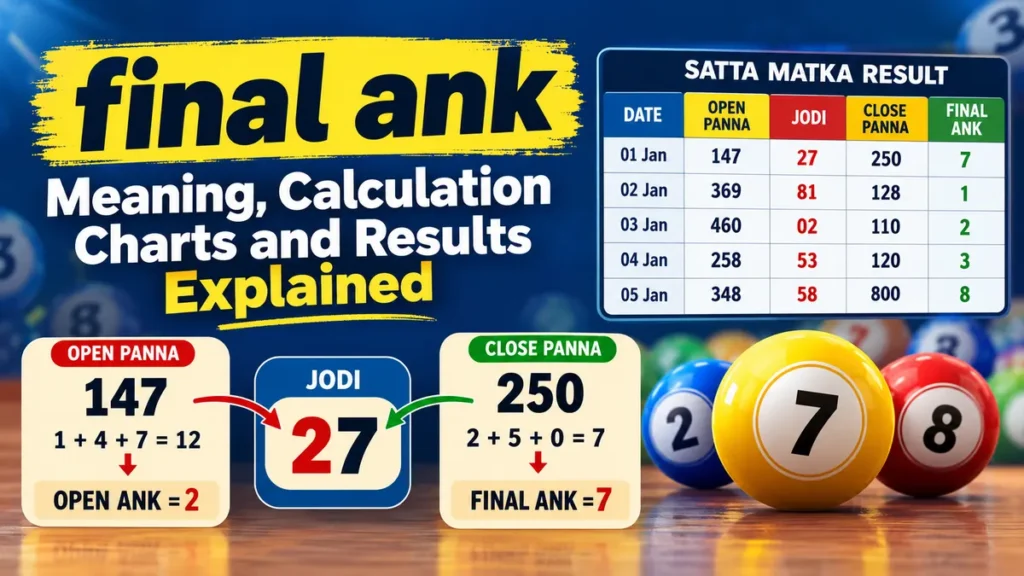
The term final ank frequently appears on Satta Matka websites, particularly alongside Kalyan, Milan Day, Main Bazar, and Rajdhani results. For someone unfamiliar with these charts, the combinations of three-digit panels, two-digit pairs, and single numbers can be difficult to understand.
final ank is a single digit between 0 and 9 associated with a Satta Matka result, commonly the closing digit. An ank is calculated by adding the three digits of a panna (panel) and keeping the last digit of the total. The opening and closing anks together form a two-digit jodi.
Understanding this system helps readers interpret historical results without confusing recorded numbers with predictions.
What Is final ank in Satta Matka?
In Satta Matka terminology, ank means a single digit. The word final generally refers to the closing or completed portion of a result.
Matka result formats commonly contain two three-digit combinations, known as the open panna and close panna. Each produces a single-digit ank. These digits are then combined to create a jodi.
For example, a complete result might appear as:
147
Open Panna
27
Jodi
250
Close Panna
The open panna 147 produces an ank of 2 because 1 + 4 + 7 = 12. The close panna 250 produces an ank of 7 because 2 + 5 + 0 = 7. Together, they form the jodi 27.
Some websites use final ank specifically for the close ank, while others use it as a broader label for a single-digit result or a published number. Checking the site’s chart headings is therefore essential.
How Is final ank Calculated?
The basic calculation uses the last digit of the sum of a three-digit panel. It is a straightforward arithmetic operation, not a formula for predicting future results.
Step-by-step calculation
- Identify the three-digit panna or panel.
- Add its three digits together.
- Take the final digit of the sum.
- Record that digit as the ank.
Consider the panel 358:
Example calculation
3 + 5 + 8 = 16
Keep the last digit
Ank = 6
The mathematical expression is:
\[ \text{Ank}=(a+b+c)\bmod 10 \]
Here, a, b, and c represent the three digits of the panel. The modulo operation returns the remainder after division by 10.
final ank calculation examples
| Panna | Digit sum | Ank |
|---|---|---|
| 123 | 1 + 2 + 3 = 6 | 6 |
| 147 | 1 + 4 + 7 = 12 | 2 |
| 258 | 2 + 5 + 8 = 15 | 5 |
| 369 | 3 + 6 + 9 = 18 | 8 |
| 460 | 4 + 6 + 0 = 10 | 0 |
| 589 | 5 + 8 + 9 = 22 | 2 |
| 777 | 7 + 7 + 7 = 21 | 1 |
| 999 | 9 + 9 + 9 = 27 | 7 |
A common mistake is repeatedly adding the digits of the total. For example, the sum of 589 is 22. The ank is 2, not 4. Only the last digit of the original total is retained.
Try a final ank calculation
Enter a three-digit panna
Digit sum
16
Calculated ank
6
3 + 5 + 8 = 16; last digit = 6. This calculates a value from an entered panel, not a future result.
Understanding Open Ank, Close Ank, Panna and Jodi
Several related terms appear throughout Matka result charts. Although they are connected, each describes a different component of the result.
| Term | Meaning | Example |
|---|---|---|
| Ank | Single digit from 0 to 9 | 5 |
| Open Ank | Digit derived from the opening panel | 3 |
| Close Ank | Digit derived from the closing panel | 8 |
| Final Ank | Often the closing or final digit | 8 |
| Panna / Patti | Three-digit combination | 348 |
| Jodi | Pair of open and close digits | 38 |
| Matka Final | Completed result, sometimes shown as a full sequence | 120-38-260 |
Open panna and open ank
The open panna represents the first three-digit component of a completed Matka result.
Suppose the opening panel is 348.
3 + 4 + 8 = 15
The open ank is 5.
Close panna and close ank
The close panna represents the second three-digit component.
Suppose the closing panel is 800.
8 + 0 + 0 = 8
The close ank is 8, and this may be called the final ank.
How the jodi is formed
The open ank and close ank are written next to each other, preserving their order.
348
Open panna
5
58
Jodi
800
Close panna
8
This creates the full illustrative result 348-58-800.
A leading zero must be preserved. If the open ank is 0 and the close ank is 5, the jodi is 05, not simply 5.
How to Read a final ank Chart
A final ank chart is a table of numbers organized by date, market, and result type. Some charts display only single digits, while others include complete open and close panels.
Historical charts can help explain how numbers were recorded, but they do not establish which number will appear in a future result.
Example of a result chart
The following table uses fictional dates and calculated examples for illustration.
| Date | Open Panna | Jodi | Close Panna | Final Ank |
|---|---|---|---|---|
| Day 1 | 147 | 27 | 250 | 7 |
| Day 2 | 369 | 81 | 128 | 1 |
| Day 3 | 460 | 02 | 110 | 2 |
| Day 4 | 258 | 53 | 120 | 3 |
| Day 5 | 348 | 58 | 800 | 8 |
To interpret a chart correctly, first identify the market name and date. Then examine the open panna, calculate its ank, and repeat the process for the close panna.
The two calculated digits should match the displayed jodi. If they do not, the chart may contain a transcription error, use a different notation, or be incomplete.
Why do final ank charts differ between websites?
Different websites may publish different information because of delayed updates, incomplete results, formatting conventions, or copied records.
For example, one website may show the open result before the close result becomes available. Another may publish the full result only after both components have been declared.
Other differences include:
- Missing market or date labels.
- Confusion between a predicted number and a recorded result.
- Incorrectly copied pannas or jodis.
- Archived information presented without a clear date.
- Different definitions of the phrase final ank.
A dash or blank entry should not be interpreted as zero. Zero is a valid calculated ank, whereas a missing entry means the information has not been provided.
Kalyan final ank and Other Matka Markets
Kalyan is one of the most commonly mentioned market names associated with final ank searches. However, the terminology also appears alongside several other Matka market labels.
Kalyan final ank
Kalyan result pages commonly present open and close information, jodi records, and historical charts. The same digit-sum calculation is used to interpret a three-digit panel.
The phrase Kalyan final ank may refer to a published closing digit, a historical result, or a site’s predicted number, depending on how the page is labeled.
Milan Day and Milan Night
Milan Day and Milan Night are separate market labels found in Matka information directories. Their result pages may contain date-wise charts, open and close digits, and panna combinations.
The distinction between the two labels does not change the basic ank calculation.
Main Bazar and Rajdhani
Main Bazar, Rajdhani Day, and Rajdhani Night are other names commonly displayed in result tables.
These labels identify different result series rather than different arithmetic systems.
Madhur, Sridevi and Time Bazar
Madhur Day, Madhur Night, Sridevi, and Time Bazar also appear in Matka chart collections.
When comparing records from these markets, the most important details are the market name, date, open or close status, and whether the displayed value is historical or speculative.
Market names and result terminology are documented across current Matka reference pages.
Types of Panna and Related Number Formats
Panna, also called panel or patti, is usually a three-digit combination. Matka reference material commonly categorizes these combinations according to repeated digits.
Single panna
A single panna contains three different digits.
Examples include 123, 147, and 358.
For 358, the ank is 6 because the digits add up to 16.
Double panna
A double panna contains two identical digits.
Examples include 112, 344, and 688.
For 344, the digit sum is 11, producing an ank of 1.
Triple panna
A triple panna contains three identical digits.
Examples include 111, 555, and 777.
For 777, the digit sum is 21, producing an ank of 1.
These categories describe the structure of the panel. They do not establish that one category is more likely to produce a future winning result.
Half Sangam and Full Sangam
Half Sangam and Full Sangam are additional terms used in Matka result classifications.
Half Sangam generally combines a single ank from one part of the result with a three-digit panna from the other part.
Full Sangam refers to the combination of the open and close pannas.
These terms describe different combinations of result components, rather than separate methods for calculating the final digit.
final ank Predictions vs. Historical Results
A major source of confusion is the difference between an announced result and a number suggested before a draw.
Websites may use expressions such as Golden Ank, fix ank, expert guessing, final number, or lucky number. These labels can make speculative information look similar to a recorded outcome.
| Term | General interpretation |
|---|---|
| Final Ank | Single digit associated with a result; usage varies |
| Historical Ank | Digit recorded for a previous result |
| Golden Ank | Suggested or predicted digit |
| Fix Ank | Claim of a predetermined or certain digit |
| Guessing Number | Speculative selection |
| Jodi Chart | Record of paired open and close digits |
The distinction is especially relevant because some current websites publish prediction sections alongside historical charts.
Can historical final ank numbers predict future results?
Historical numbers can be analyzed to identify frequencies, repetitions, and sequences. However, a visible pattern does not automatically provide reliable predictive information.
Consider a hypothetical sequence:
2, 7, 2, 4, 2, 9, 2
The digit 2 appears frequently, but that observation alone does not prove it will appear again.
Similarly, if the digit 6 has not appeared for several recorded sessions, it does not necessarily become more likely to appear next.
When results are independent and uniformly random, every digit from 0 through 9 has the same probability of appearing in the next single-digit outcome: 10%.
This probability applies only under those assumptions. It does not establish that any particular Matka operation uses a fair or independently random process.
What is the gambler’s fallacy?
The gambler’s fallacy is the mistaken belief that previous independent random outcomes change what must happen next.
For example, seeing the same digit several times may create an expectation that a different digit is now due.
That expectation is not supported by the mathematics of independent events.
Historical charts can describe what happened, but they cannot independently prove what will happen next.
How to Evaluate final ank Information Online
Matka-related websites vary considerably in the way they present data. Some focus on historical records, while others emphasize predictions and claims of certainty.
A useful way to evaluate a chart is to check its transparency and internal consistency.
Check the date and market
A number without a clearly identified date and market is difficult to interpret.
A historical result should specify which session it belongs to, rather than displaying an isolated digit with no context.
Verify the arithmetic
When the full panna is available, its corresponding ank can be checked mathematically.
For example, if a chart lists panna 256 with ank 3, the calculation does not agree:
2 + 5 + 6 = 13
The correct calculated ank is 3, so the entry is internally consistent.
By contrast, a displayed ank of 4 would not match that panna.
Arithmetic consistency helps identify errors, although it cannot prove that a reported result actually occurred.
Distinguish records from predictions
An announced historical result should not be confused with a forecast.
Labels such as sure shot, guaranteed, fixed, or 100% accurate should be treated skeptically unless independently verifiable evidence exists.
Look for original sources
Multiple websites may copy information from the same source. Seeing the same number on several pages is therefore not necessarily independent confirmation.
Where possible, examine the source’s update history, date labels, and correction policy.
Is Satta Matka Legal and What Are the Risks?
Satta Matka is a form of gambling associated with wagering on numerical outcomes. Its legal status depends on the applicable jurisdiction and the activity involved.
In India, gambling laws include central and state-level provisions, and restrictions can vary by state and by whether an activity takes place online or offline. Access to a website does not establish that its services are legal.
Anyone researching Matka should distinguish between reading historical numerical records and participating in real-money gambling.
Financial risks also deserve attention. Gambling can result in monetary losses, and claims of guaranteed outcomes may encourage people to rely on unsupported predictions.
The arithmetic behind an ank is simple, but that simplicity should not be mistaken for evidence that the next result can be calculated in advance.
Common Mistakes When Understanding final ank
Several misunderstandings can make result charts unnecessarily confusing.
Confusing ank with panna: An ank is a single digit, whereas a panna is a three-digit combination.
Treating jodi as a single number: A jodi contains two ordered digits representing the open and close anks.
Using repeated digit addition: The standard panna calculation keeps the last digit of the sum rather than repeatedly reducing the sum to a single digit.
Ignoring leading zeros: Values such as 05 and 007 have specific formatting significance and should not be shortened when reproducing a chart.
Mistaking Golden Ank for a confirmed result: Prediction labels do not establish that a number has been announced.
Assuming past frequency guarantees future outcomes: Historical repetitions alone cannot reliably predict independent random events.
Comparing different market records: Results from Kalyan, Milan, Rajdhani, or Main Bazar should not be combined without clearly identifying the series and dates.
Avoiding these mistakes makes it easier to understand what a chart actually represents.
final ank: Key Takeaways
final ank is a single-digit value associated with Satta Matka results, commonly referring to the closing ank. It is calculated by adding the three digits of a panna and retaining the final digit of the sum.
The open and close anks form a two-digit jodi, while a complete result may be displayed as an open panna, jodi, and close panna.
Understanding these relationships makes historical Matka charts easier to read, including those associated with Kalyan, Milan Day, Main Bazar, Rajdhani, Madhur, Sridevi, and Time Bazar.
The most useful approach is to verify the chart’s date, market, terminology, and arithmetic before interpreting its numbers. Historical results provide information about past records, but they do not guarantee future outcomes.