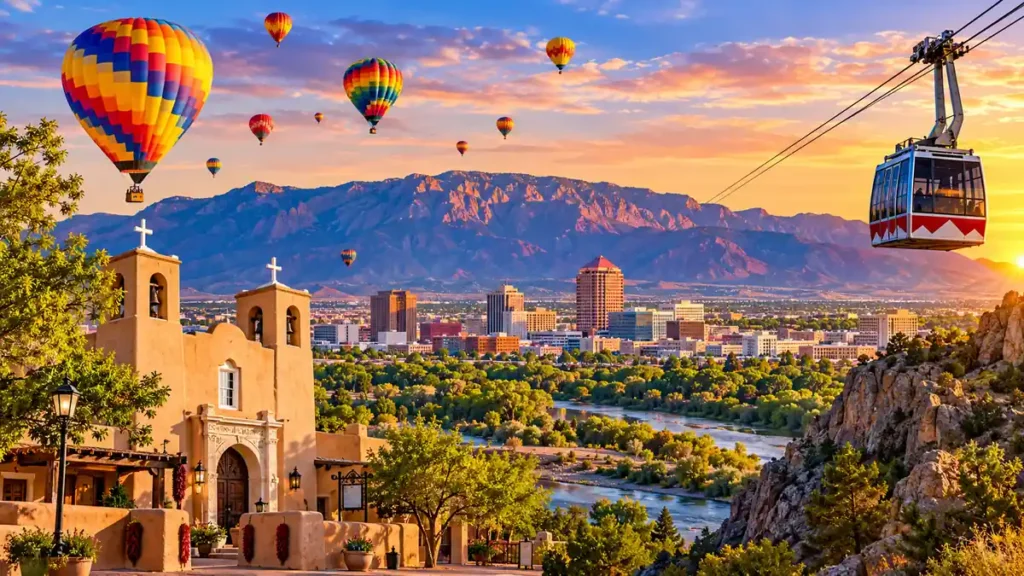
Albuquerque is one of those cities that makes more sense once you get outside and explore it. The Sandia Mountains rise dramatically on the eastern edge, the Rio Grande cuts through a cottonwood forest, historic Route 66 runs through town, and centuries of Native American and Hispanic heritage remain part of everyday life.
If you’re searching for things to do in albuquerque, start with Historic Old Town, ride the Sandia Peak Aerial Tramway, explore Pueblo culture, see ancient petroglyphs, spend time along the Rio Grande, and experience the city’s famous hot-air-balloon culture. Families can also easily spend a day at the ABQ BioPark. Visit Albuquerque
Albuquerque rewards travelers who mix its headline attractions with slower experiences: walking adobe-lined streets, eating New Mexican food, cycling beneath cottonwoods, watching the mountains change color at sunset, and exploring the neon signs of old Route 66.
1. Explore Historic Old Town Albuquerque
Historic Old Town is the natural starting point for a first visit.
Albuquerque was founded as a Spanish colonial settlement in 1706, and the historic district still revolves around its central plaza. Adobe-style buildings, courtyards, galleries, restaurants, shops, and historic architecture make the neighborhood easy to explore on foot.
The area is more than a preserved historic district. It remains an active part of Albuquerque, with local shopping, food, entertainment, and cultural events throughout the year. City of Albuquerque
Allow at least a couple of hours to wander without a rigid route. You’ll find everything from Southwestern artwork and jewelry to chile products and handmade crafts.
Visit San Felipe de Neri Church
While exploring Old Town, look for San Felipe de Neri Church beside the plaza.
The church is one of the area’s most recognizable historic landmarks and helps put Old Town’s Spanish colonial history into context.
Old Town works particularly well in the late afternoon. You can explore before the strongest midday heat, have dinner nearby, and stay as the evening atmosphere develops.
Quick takeaway: If you have only one day in Albuquerque, combine Old Town with the Albuquerque Museum and a sunset experience in the Sandia Mountains.
2. Ride the Sandia Peak Aerial Tramway
Few Albuquerque attractions provide a better sense of the city’s geography than the Sandia Peak Aerial Tramway.
The tram climbs from the northeastern edge of Albuquerque toward Sandia Peak, with expansive views over the Rio Grande Valley and surrounding landscape. Visit Albuquerque identifies the summit elevation as 10,378 feet. Visit Albuquerque
The landscape changes considerably as you climb. Albuquerque’s high-desert environment gradually gives way to a much cooler mountain setting.
Sunset can be particularly memorable, when the light spreads across the city and western horizon.
Mountain weather, however, can differ sharply from conditions below. Temperatures may be significantly cooler, and wind or other conditions can affect tram operations. Check current operating information before making the drive.
If you’re sensitive to elevation, take your time once you reach the top rather than immediately rushing into strenuous activity.
3. Experience Albuquerque’s Hot Air Balloon Culture
Hot-air balloons are not simply a tourist attraction here. They are closely associated with Albuquerque’s identity.
The area’s weather and geography have helped make Albuquerque one of the world’s best-known ballooning destinations. Visitors may spot balloons throughout the year, particularly during favorable early-morning conditions.
Several operators offer passenger flights, generally beginning around sunrise when conditions are suitable.
The experience is surprisingly peaceful once you’re airborne. Instead of feeling like a conventional aircraft flight, you’re drifting with the wind while the Rio Grande, neighborhoods, desert, and mountains spread out below.
Flights are weather dependent, so avoid scheduling your balloon ride immediately before an inflexible departure.
4. Attend the Albuquerque International Balloon Fiesta
Visiting in October changes the Albuquerque experience completely.
The 2026 Albuquerque International Balloon Fiesta is scheduled for October 3–11, 2026, with more than 500 balloons expected during the nine-day event. Balloon Fiesta
Mass ascensions fill the morning sky with balloons, while evening sessions can include balloon glows and fireworks. Balloon Fiesta Park itself becomes a major gathering place with food, merchandise, artisans, and entertainment.
One fascinating local phenomenon is the Albuquerque Box, a combination of wind patterns and geography that can sometimes allow balloon pilots to change direction at different altitudes. Balloon Fiesta
Arrive much earlier than you would for an ordinary event. Morning activities begin around dawn, and traffic becomes heavy.
Even if you don’t attend the Fiesta itself, the city’s year-round balloon culture is worth exploring.
5. Visit the Anderson-Abruzzo Albuquerque International Balloon Museum
If you’re interested in ballooning but aren’t comfortable taking a flight, make the balloon museum part of your itinerary.
Located near Balloon Fiesta Park, it explores ballooning history, science, exploration, technology, and Albuquerque’s connection with lighter-than-air aviation.
It also makes a useful companion visit to the Balloon Fiesta because it explains why Albuquerque became such an important ballooning destination.
Families with curious children can particularly appreciate the scientific side of flight rather than simply viewing balloons as colorful objects in the sky.
6. Discover Pueblo History at the Indian Pueblo Cultural Center
Understanding Albuquerque requires understanding that Native American history here isn’t simply something from the distant past.
The Indian Pueblo Cultural Center is owned by New Mexico’s 19 Pueblos and places Pueblo voices at the center of the story. It opened in 1976 and celebrates its 50th anniversary in 2026. Indian Pueblo Cultural Center
Its permanent exhibition, We Are of This Place: The Pueblo Story, examines Pueblo history, resilience, culture, and contemporary life. Other galleries feature pottery, murals, Native American student artwork, and rotating exhibitions. Indian Pueblo Cultural Center
This is an important distinction: you’re learning about Pueblo communities through an institution governed by the communities themselves.
Give yourself enough time to read rather than racing through the galleries.
7. See Ancient Images at Petroglyph National Monument
Just west of central Albuquerque lies one of the city’s most remarkable landscapes.
Petroglyph National Monument preserves volcanic terrain containing thousands of petroglyphs created by Native peoples and later Spanish settlers. The National Park Service describes roughly 24,000 carvings across the landscape. National Park Service
Three commonly explored areas are Boca Negra Canyon, Rinconada Canyon, and Piedras Marcadas Canyon.
Which petroglyph trail should you choose?
Boca Negra Canyon is useful when time is limited and you want relatively easy access to petroglyphs.
Rinconada Canyon provides more of a desert hiking experience.
Piedras Marcadas Canyon offers another opportunity to combine walking with petroglyph viewing.
Whichever you choose, remember that these aren’t decorative rocks. Many images retain cultural and spiritual significance. Look, photograph respectfully, stay on appropriate routes, and never touch or mark the petroglyphs.
Carry water and sun protection because shade can be limited.
8. Spend a Day at the ABQ BioPark
For families wondering what to do in Albuquerque with kids, the ABQ BioPark deserves serious consideration.
Rather than being a single attraction, the BioPark consists of four major areas:
- ABQ BioPark Zoo
- ABQ BioPark Aquarium
- ABQ BioPark Botanic Garden
- Tingley Beach
The 64-acre zoo dates to 1927 and houses more than 900 animals, while the Botanic Garden covers 32 acres. The Aquarium includes a 285,000-gallon ocean tank. City of Albuquerque
Trying to see everything quickly can become exhausting, particularly with younger children.
If you have a full day, a combination ticket can make sense. If you have only a few hours, choose the facility that best matches your interests.
Current posted hours for the Zoo, Aquarium, and Botanic Garden are generally 9 a.m.–5 p.m., although seasonal closures and special-event hours can apply. Timed tickets can be purchased online in advance. City of Albuquerque
9. Walk or Bike Along the Rio Grande
One of Albuquerque’s greatest assets is easy to overlook from a car.
The Rio Grande passes directly through the metropolitan area, bordered by the bosque, a ribbon of cottonwood forest that provides a surprisingly green contrast to the surrounding high desert.
The Paseo del Bosque Trail runs approximately 16 miles along the river corridor without roadway interruptions. Walkers, runners, cyclists, families, and other recreational users share the route. City of Albuquerque
Along the way, you can access or pass near wetlands, the BioPark, public art, Tingley Beach, and other recreation areas.
You don’t need to complete the entire trail. Choose a section and spend an hour walking beneath the cottonwoods.
Early morning and late afternoon generally offer more comfortable temperatures and better light.
10. Relax at Tingley Beach
Despite its name, Tingley Beach isn’t a conventional swimming beach.
It’s a collection of ponds and recreational areas near the Rio Grande and forms part of the ABQ BioPark.
Visitors come here to walk, fish, watch birds, picnic, sail model boats, or connect with nearby trails. A roughly mile-long walking trail loops around the ponds. City of Albuquerque
It’s particularly useful when you want something easy and outdoors without committing to a serious mountain hike.
Combine Tingley Beach with the Paseo del Bosque Trail, Aquarium, or Botanic Garden for a relaxed half-day around the river.
11. Hike at Elena Gallegos Open Space
For accessible mountain scenery without leaving Albuquerque far behind, head toward Elena Gallegos Open Space.
The 640-acre area sits at approximately 6,500 feet against the Sandia Mountains. Trails accommodate hikers, mountain bikers, and equestrians, while picnic areas provide wide views across the city and surrounding mountains. City of Albuquerque
You don’t need to be an experienced hiker.
The half-mile paved Cottonwood Springs Trail leads toward a wildlife viewing area and provides a more accessible option. Longer trails connect toward more demanding terrain.
Elena Gallegos is also excellent for a picnic, especially when you want mountain scenery without spending an entire day hiking.
Summer heat still matters, despite the higher elevation. Start early, bring water, and pay attention to changing weather.
12. Explore Albuquerque Museum
The Albuquerque Museum sits conveniently close to Old Town, making the two easy to combine.
Its collections examine Albuquerque and New Mexico through history, art, photography, artifacts, and rotating exhibitions.
The permanent Only in Albuquerque exhibition explores the city’s development and identity, while Art of New Mexico connects artistic expression with the state’s people and landscapes.
This is particularly useful early in your trip.
After understanding how Indigenous, Spanish, Mexican, Anglo, and other influences shaped Albuquerque, you’ll notice more context in the architecture, neighborhoods, food, and public art you encounter later.
13. Visit the National Hispanic Cultural Center
Another important place for understanding Albuquerque’s cultural identity is the National Hispanic Cultural Center.
Located south of downtown, the center hosts visual arts, performances, educational programs, cultural events, and other programming connected with Hispanic culture. National Hispanic Cultural Center
Check the current event calendar before visiting. Depending on the date, your experience might involve an exhibition, performance, film, lecture, or special cultural program.
Together, the National Hispanic Cultural Center and Indian Pueblo Cultural Center provide a much deeper understanding of Albuquerque than sightseeing alone.
14. Explore the National Museum of Nuclear Science & History
New Mexico played an important role in the development of nuclear science, and that complicated history is explored at the National Museum of Nuclear Science & History.
Exhibits examine scientific development, atomic history, nuclear energy, medicine, national defense, and the broader consequences of nuclear technology.
It’s one of the more distinctive museums in Albuquerque and provides valuable context for understanding New Mexico’s connection with 20th-century scientific research.
The museum works particularly well for science enthusiasts, history travelers, teenagers, and anyone interested in the intersection between technological progress and social consequences.
Give yourself more time than you initially expect; there’s substantial information to absorb.
15. Cruise Historic Route 66 and Explore Nob Hill
Central Avenue carries Albuquerque’s Route 66 heritage directly through the city.
The famous highway was established in 1926, making 2026 its centennial year. Albuquerque retains an especially visible connection to the Mother Road through historic buildings, signs, motels, diners, and neon. Visit Albuquerque
Nob Hill is one of the easiest areas for experiencing that legacy on foot.
Located east of the University of New Mexico, the neighborhood combines historic Route 66 architecture with locally owned restaurants, shops, galleries, nightlife, and distinctive neon signs. Visit Albuquerque
Visit around sunset and stay into the evening when the neon becomes part of the experience.
Rather than simply driving Central Avenue end to end, stop periodically. Route 66 is much more interesting when you pay attention to the surviving architecture and businesses.
16. Try Authentic New Mexican Food
Sightseeing alone doesn’t explain Albuquerque. Food does a considerable amount of that work.
New Mexican cuisine has its own identity, shaped by regional ingredients and generations of Native American, Hispanic, Mexican, and other influences.
The ingredient you’ll encounter constantly is New Mexico chile.
You’ll commonly be asked whether you want red or green chile. Asking for “Christmas” gets you both.
Look beyond chile, too. Depending on the restaurant, you may encounter:
- Breakfast burritos
- Carne adovada
- Enchiladas
- Sopaipillas
- Posole
- Tamales
- Green chile stew
- Blue-corn dishes
Don’t assume every chile dish will have the same heat level. It varies considerably.
Breakfast is an underrated opportunity to experience local food. A breakfast burrito with chile can be as characteristically Albuquerque as a more elaborate dinner.
17. See Albuquerque Through Its Breaking Bad History
Television fans know Albuquerque as the filming location for Breaking Bad and Better Call Saul.
Many recognizable exterior locations are scattered around town, and specialized tours connect them for visitors.
There’s an important etiquette point, however: some famous filming locations are private homes or ordinary businesses.
Don’t trespass, block driveways, bother residents, or treat someone’s property as a movie set.
An organized tour can be a better approach because it adds filming stories and context rather than simply driving from one address to another.
Even non-fans may find the experience interesting because the shows made Albuquerque’s high-desert landscape and architecture such an important part of their visual identity.
18. Watch an Albuquerque Sunset
You don’t need a ticket to enjoy one of the city’s most memorable experiences.
Albuquerque has more than 300 days of sunshine in a typical year, broad horizons, high elevation, dry air, and dramatic mountain scenery. Visit Albuquerque
All of those elements contribute to spectacular sunsets.
Good viewpoints include the Sandia foothills, western parts of the city, open-space areas, and elevated locations overlooking the Rio Grande Valley.
The Sandia Mountains themselves often take on warm pink and reddish tones as the setting sun hits their western face.
Leave some unplanned time around sunset rather than filling every minute with attractions.
Free Things to Do in Albuquerque
Albuquerque can be surprisingly manageable for travelers trying to control their sightseeing budget.
Petroglyph National Monument offers substantial outdoor exploration, although parking or specific access-area fees may apply. Walking sections of the Paseo del Bosque Trail is another easy low-cost activity.
You can also explore Old Town’s public spaces, walk around Nob Hill, photograph Route 66 neon, watch balloons from public viewpoints when they’re flying, or enjoy the bosque.
For inexpensive mountain scenery, Elena Gallegos Open Space currently charges just $1 per vehicle Monday through Friday and $2 on weekends, according to the City of Albuquerque. City of Albuquerque
Free attractions are especially useful for filling shorter gaps between museums or scheduled activities.
Best Things to Do in Albuquerque With Kids
Families don’t need an entirely different Albuquerque itinerary.
The BioPark is the obvious centerpiece because children can choose among animals, aquatic life, plants, and outdoor recreation.
The Balloon Museum can turn the city’s balloon culture into a science lesson, while Petroglyph National Monument introduces children to archaeology, geology, and cultural history.
Tingley Beach works well when younger travelers need unstructured outdoor time.
The Sandia Peak Tramway can also be memorable for older children comfortable with heights.
A sensible family day might combine one major attraction in the morning with something outdoors later rather than attempting three museums back to back.
Outdoor Things to Do in Albuquerque
Albuquerque’s location is one of its strongest advantages.
Within the same trip, you can experience high-desert landscapes, cottonwood forest, volcanic terrain, mountain environments, and the Rio Grande.
For hiking, start with Elena Gallegos or Petroglyph National Monument.
For cycling, the paved Paseo del Bosque Trail provides 16 miles of roadway-free multi-use trail through the Rio Grande corridor. City of Albuquerque
For something distinctly Albuquerque, book a balloon flight.
For mountain scenery without a long hike, ride the Sandia Peak Tramway.
And for a gentle outdoor afternoon, walk around Tingley Beach or find a quiet stretch of the bosque.
The main consideration is climate. High-desert sunshine can feel intense even when air temperatures seem comfortable. Carry water, use sun protection, and avoid underestimating elevation.
What Is Albuquerque Famous For?
Albuquerque is particularly famous for hot-air ballooning, New Mexican cuisine, Route 66, Pueblo and Hispanic cultural heritage, and the Sandia Mountains.
Its best-known annual event is the Albuquerque International Balloon Fiesta, held each October.
The city is also strongly associated with red and green chile, the Rio Grande, Breaking Bad, Southwestern art, adobe architecture, and historic Old Town.
What makes Albuquerque unusual isn’t any single attraction. It’s how closely urban neighborhoods sit beside open desert, mountains, river forest, and landscapes with thousands of years of human history.
How Many Days Do You Need in Albuquerque?
Two to three days is enough for most first-time visitors, although four days gives you more freedom for hiking, museums, and slower exploration.
With one day, focus on Old Town, one cultural attraction, New Mexican food, and Sandia Peak.
With two days, add Petroglyph National Monument, the BioPark, or the Indian Pueblo Cultural Center.
With three days, add the Rio Grande bosque, Route 66 and Nob Hill, museums, and a balloon experience.
During Balloon Fiesta, additional time is worthwhile because early starts, event traffic, and large crowds make tightly packed sightseeing schedules impractical.
When Is the Best Time to Visit Albuquerque?
Spring and fall generally provide comfortable conditions for outdoor sightseeing. Visit Albuquerque notes that these seasons typically bring milder weather, while summers offer numerous events and winters are often sunny and relatively mild. Visit Albuquerque
October is particularly popular because of the Balloon Fiesta.
Summer can still be rewarding, but structure outdoor activities around mornings and evenings when possible.
Winter has its own advantages: smaller crowds at some attractions, crisp mountain views, and the possibility of snow in higher elevations.
Remember that Albuquerque sits roughly a mile above sea level. Visitors arriving from lower elevations sometimes notice the altitude during their first day.
Hydrate, moderate strenuous exercise initially, and don’t underestimate the dry climate.
A Simple Albuquerque Itinerary
If you have three days, organize your trip geographically instead of driving back and forth across the city.
Day 1: Begin in Historic Old Town, visit Albuquerque Museum, have a New Mexican lunch, explore the Indian Pueblo Cultural Center, and finish around the Sandia Mountains at sunset.
Day 2: Start early at Petroglyph National Monument, then explore the BioPark area and walk or cycle part of the Paseo del Bosque Trail. Spend the evening around Nob Hill and historic Route 66.
Day 3: Take a sunrise balloon flight if conditions permit, visit the Balloon Museum or National Hispanic Cultural Center, explore another museum, and leave the late afternoon flexible for Elena Gallegos Open Space.
During Balloon Fiesta, build your itinerary around the event rather than treating it as an extra stop. Its early morning sessions require very early starts.
Practical Tips for Visiting Albuquerque
Albuquerque is spread out, so having a car makes it easier to combine attractions in different neighborhoods.
Don’t schedule every day too tightly. Distances may appear short on a map, but mountain trips, hiking, museum visits, event traffic, and meals can quickly consume more time than expected.
Carry water throughout the year. The city’s high elevation and dry climate can cause dehydration faster than some visitors anticipate.
Use sunscreen even when temperatures are cool.
If you’re hiking, start earlier during warmer months.
For major attractions, verify operating hours shortly before visiting. Weather can affect mountain and balloon activities, while museums and city facilities sometimes change hours seasonally.
And when exploring Indigenous cultural sites, remember that you’re encountering living cultures rather than simply historic attractions. Follow photography rules and site-specific guidance.
Final Thoughts on things to do in albuquerque
The best things to do in albuquerque reveal different sides of the same city: ride above the landscape at Sandia Peak, walk among ancient petroglyphs, learn from Pueblo voices, explore Old Town, cycle beneath Rio Grande cottonwoods, experience Route 66 neon, and taste New Mexico chile.
But don’t turn Albuquerque into a checklist.
Leave room for a slow walk through the bosque, an unexpected gallery in Old Town, a breakfast burrito covered in green chile, or an evening watching the Sandias change color.
Those unscheduled moments often explain Albuquerque better than any single attraction.