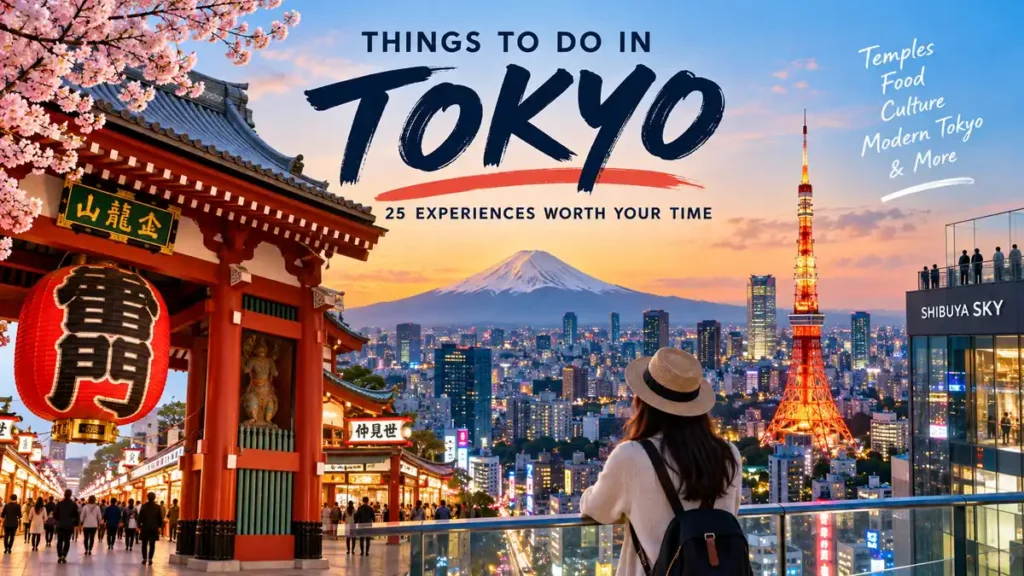
Tokyo can feel impossible to plan. One moment you’re standing beneath a centuries-old temple gate; an hour later you’re surrounded by giant screens, neon signs, anime shops, and some of the busiest pedestrian crossings on Earth.
The best things to do in tokyo combine both sides of the city: explore Sensō-ji and Meiji Jingu, cross Shibuya Scramble, see the skyline from Shibuya Sky or Tokyo Skytree, experience digital art at teamLab, eat through local markets, wander Japanese gardens, and explore distinctive neighborhoods such as Asakusa, Shinjuku, Harajuku, Ginza, and Akihabara.
Tokyo rewards travelers who stop thinking of it as one enormous attraction and start treating it as a collection of neighborhoods. Each district has its own rhythm, food, architecture, nightlife, and culture.
Here are the experiences that deserve space in a first Tokyo itinerary—and several quieter alternatives that make a second visit just as rewarding.
1. Start at Sensō-ji in Asakusa


6
Sensō-ji is one of the strongest introductions to traditional Tokyo.
Enter through the enormous Kaminarimon gate and continue toward Nakamise-dori, the historic shopping street leading toward the temple complex. Small stores along the route sell sweets, souvenirs, crackers, crafts, and other Japanese specialties.
The temple is dedicated to Kannon, the Buddhist bodhisattva associated with compassion, and remains one of Tokyo’s most recognizable religious landmarks. It consistently appears among the city’s top attractions in both official tourism guidance and traveler rankings.
Don’t simply photograph the main hall and leave. Walk into the surrounding Asakusa streets, where the atmosphere changes dramatically within a few blocks.
Quick takeaway: Visit earlier in the morning if you want to experience the architecture before Nakamise and the temple grounds become heavily crowded.
2. Experience Shibuya Scramble Crossing


7
Few intersections have become as closely associated with a city as Shibuya Scramble Crossing.
When the traffic stops, pedestrians stream across from multiple directions simultaneously beneath enormous digital displays. Watching from street level is fun, but seeing the crossing from above makes its scale much clearer.
Shibuya itself deserves several hours.
Beyond the crossing you’ll find department stores, restaurants, record shops, fashion boutiques, nightlife, and the famous Hachikō statue near Shibuya Station.
The district is especially impressive after sunset, when its screens and signs transform the streets.
3. See Tokyo From Shibuya Sky
Tokyo makes more sense when you see it from above.
Shibuya Sky sits above Shibuya and provides sweeping views across the capital.
On a clear day, the panorama extends far beyond the dense urban core. Around sunset, buildings gradually turn into thousands of lights while the city changes from daytime Tokyo to its famous nighttime skyline.
Other excellent viewpoints include Tokyo Skytree, Tokyo Tower, and the Tokyo Metropolitan Government Building. Official Tokyo tourism guidance highlights observation points as some of the city’s defining landmarks.
For a first visit, you don’t need to visit every observation deck. Pick one or two and spend the remaining time exploring at street level.
4. Walk Through Meiji Jingu
A few train stops from Shibuya’s enormous screens, Tokyo suddenly becomes remarkably quiet.
Meiji Jingu is a Shinto shrine dedicated to Emperor Meiji and Empress Shōken.
Visitors approach through a broad forested path framed by massive torii gates. The trees soften the surrounding city noise so effectively that the experience can feel disconnected from central Tokyo.
At the shrine, observe how visitors purify themselves and offer prayers rather than treating the complex merely as another photography stop.
Meiji Jingu is also conveniently positioned beside Harajuku and close to Yoyogi Park, making these areas easy to combine. It remains one of Tokyo’s most popular landmarks.
5. Explore Harajuku Beyond Takeshita Street
Harajuku became internationally famous for youth fashion, cosplay, colorful desserts, and unconventional street style.
Takeshita Street is its busiest introduction.
Expect fashion boutiques, character merchandise, crepes, accessories, and crowds. But Harajuku becomes more interesting when you continue beyond this famous strip.
Walk toward Cat Street and Omotesandō for a different side of the neighborhood. You’ll find independent shops, international fashion labels, striking contemporary architecture, galleries, cafés, and quieter side streets.
This contrast—playful Takeshita Street versus polished Omotesandō—is exactly what makes Harajuku worth exploring rather than merely photographing.
6. Enter Tokyo’s Anime World in Akihabara


6
Anime, manga, gaming, electronics, collectibles, and Japanese pop culture converge in Akihabara.
Multi-floor stores sell everything from current character merchandise to vintage video games. Arcades, capsule-toy machines, hobby shops, trading cards, figurines, and specialty cafés fill the streets.
Even travelers who aren’t dedicated anime fans can appreciate the district’s visual intensity.
For serious collectors, don’t stop at the largest stores facing the main roads. Smaller shops upstairs or along side streets often contain the more unusual finds.
Lonely Planet includes Akihabara’s arcades and anime culture among Tokyo’s essential experiences.
Try Nakano Broadway too
If Akihabara feels overwhelmingly commercial, continue your pop-culture exploration at Nakano.
Nakano Broadway is particularly interesting for older manga, rare collectibles, vintage toys, watches, and niche Japanese subcultures. The surrounding neighborhood is more relaxed than central Akihabara.
7. Step Into Digital Art at teamLab
Tokyo’s futuristic reputation isn’t limited to skyscrapers.
teamLab’s immersive installations use projection, light, sound, mirrors, flowers, water, and responsive digital technology to turn visitors into participants rather than passive museum observers.
teamLab Planets TOKYO DMM in Toyosu is particularly unusual because visitors physically move through large-scale environments, including water-based spaces. Tripadvisor currently lists teamLab Planets among Tokyo’s highest-profile attractions.
Tokyo also has teamLab Borderless at Azabudai Hills, giving digital-art fans another major immersive experience.
Allow enough time to move slowly through the installations instead of treating them as photo backgrounds.
8. Discover Shinjuku by Day and Night


7
Shinjuku almost feels like several neighborhoods compressed into one.
By day, explore skyscrapers, department stores and one of Tokyo’s most important transportation hubs. After dark, enormous signs illuminate the entertainment streets around Kabukichō.
Nearby Omoide Yokocho offers a completely different visual experience: narrow alleys packed with tiny restaurants and yakitori counters.
Golden Gai is another maze of compact bars occupying a network of narrow lanes.
The area can become extremely busy at night, so don’t schedule every minute. Wandering is part of the experience.
9. Slow Down in Shinjuku Gyoen
After Shinjuku’s crowds, Shinjuku Gyoen National Garden feels almost therapeutic.
The large garden incorporates different landscape traditions and broad lawns that encourage visitors to slow down.
It becomes especially popular during cherry blossom season, but it’s worthwhile outside spring too.
Traveler rankings place Shinjuku Gyoen among Tokyo’s leading attractions.
Tokyo is greener than first-time visitors often expect. Meiji Jingu, Yoyogi Park, Ueno Park and traditional gardens provide valuable breaks between dense sightseeing districts. Time Out notes how extensively these green spaces are woven into the urban landscape.
10. Eat Your Way Through Tsukiji Outer Market
Food should be treated as an attraction in Tokyo, not merely something you fit between attractions.
Tsukiji’s wholesale market operations moved to Toyosu, but the Tsukiji Outer Market remains packed with food stalls, restaurants, vendors, and specialty shops.
Visitors come for sushi, seafood, tamagoyaki, grilled dishes, Japanese sweets, tea, and other snacks.
Morning is generally the natural time to explore.
Instead of trying every viral stall, follow your appetite. One carefully prepared bowl of seafood or sushi is usually more memorable than racing through ten social-media recommendations.
What food should you try in Tokyo?
Build your trip around variety rather than prestige.
Try:
- Sushi or sashimi
- Ramen
- Soba or udon
- Yakitori
- Tonkatsu
- Tempura
- Okonomiyaki
- Curry rice
- Onigiri
- Wagashi
- Convenience-store snacks
- A traditional kissaten coffee shop
Tokyo’s culinary reputation extends from inexpensive noodle counters to high-end dining, and exploring both ends of that spectrum reveals more about the city than concentrating only on famous restaurants.
11. Visit Toyosu Market
Travelers particularly interested in Tokyo’s seafood industry should also consider Toyosu Market.
Toyosu took over the major wholesale functions formerly associated with Tsukiji. Its viewing areas allow visitors to observe parts of the enormous seafood operation, including the famous tuna auction under applicable visitor arrangements.
Pairing Toyosu with nearby attractions works better than crossing Tokyo solely for a brief market visit.
This is particularly convenient if you’re already visiting teamLab Planets.
12. Explore Ueno Park and Tokyo’s Museums
Ueno is one of the best neighborhoods for travelers who want several attractions within walking distance.
Ueno Park combines open space, museums, cultural institutions, temples, and seasonal cherry blossoms.
The surrounding museum district can occupy most of a rainy day.
History and science enthusiasts can prioritize the Tokyo National Museum or National Museum of Nature and Science, while art lovers have several collections to explore nearby.
Just south of the park, Ameyoko provides a complete change of atmosphere with busy market streets, restaurants, small stores, and snack vendors.
13. See Tokyo Skytree and the Sumida River
Tokyo Skytree rises dramatically above eastern Tokyo.
The observation areas provide expansive city views, and the tower is easy to combine with Asakusa.
Instead of simply taking the train between them, consider walking around the Sumida River. You’ll see bridges, riverside promenades, Tokyo Skytree rising above lower neighborhoods, and a less frantic version of the city.
This pairing works particularly well when exploring Tokyo for the first time: Sensō-ji provides the historical side, while Skytree represents contemporary Tokyo.
14. Compare Tokyo Skytree With Tokyo Tower
Tokyo Tower remains one of the city’s classic visual symbols.
Skytree is taller and provides a distinctly modern experience. Tokyo Tower, meanwhile, has the nostalgic appeal of an older Tokyo landmark and looks especially attractive when illuminated after dark.
Which is better?
| Viewpoint | Best for |
|---|---|
| Shibuya Sky | Open-air atmosphere and central-city views |
| Tokyo Skytree | Height and vast panorama |
| Tokyo Tower | Classic Tokyo atmosphere |
| Tokyo Metropolitan Government Building | Budget-conscious sightseeing |
If your itinerary is short, choose whichever fits naturally into the neighborhood you’re already exploring.
15. Shop and Wander Through Ginza
Ginza represents Tokyo at its most polished.
Major Japanese department stores, luxury brands, restaurants, galleries, cafés, stationery shops, and architecturally distinctive buildings line its streets.
But you don’t need a luxury-shopping budget to enjoy it.
Walk the main avenues, then investigate the upper floors and basements of department stores. Japanese depachika food halls are attractions in themselves, displaying beautifully presented sweets, bento, seafood, fruit, prepared dishes, and gifts.
Ginza is also home to Kabukiza Theatre.
16. Watch Kabuki at Kabukiza
Kabukiza Theatre introduces visitors to one of Japan’s best-known traditional performing arts.
The elaborate costumes, stylized acting, makeup, music, and stagecraft make kabuki visually compelling even for travelers unfamiliar with the stories.
Lonely Planet highlights kabuki in Ginza alongside sumo as a strong way to experience traditional Japanese culture in contemporary Tokyo.
Check the current performance schedule rather than assuming performances occur continuously.
17. Experience Sumo Culture in Ryōgoku
Ryōgoku is strongly associated with professional sumo.
Ryōgoku Kokugikan hosts major tournaments at scheduled times during the year.
Seeing a tournament is unforgettable when dates align with your trip. Outside tournament periods, the neighborhood still offers ways to understand sumo history and culture.
Try chanko nabe, the hearty hot-pot dish strongly associated with sumo wrestlers.
Because tournaments follow specific schedules, verify official dates before building your itinerary around one.
18. Visit the Ghibli Museum
Fans of Studio Ghibli can make the trip west to Mitaka for the Ghibli Museum.
The museum celebrates animation through exhibits, architectural details, original concepts, and spaces designed to evoke the imaginative worlds associated with Studio Ghibli.
It’s not a conventional museum where you rush systematically from display to display.
That playfulness is part of the point.
Lonely Planet includes the Ghibli Museum among its essential Tokyo experiences.
Tickets can be limited and admission arrangements can change, so this is one attraction worth researching before arrival.
19. Discover Old Tokyo in Yanaka and Nezu
One of the most useful answers to “What are some non-touristy things to do in Tokyo?” is simply: leave the biggest stations behind.
Yanaka and neighboring areas preserve a smaller-scale urban atmosphere that contrasts sharply with Shibuya and Shinjuku.
Walk through Yanaka Ginza, browse neighborhood shops, explore side streets, and continue toward Nezu.
You aren’t coming here for one blockbuster attraction.
You’re coming because ordinary Tokyo becomes the attraction.
This is particularly rewarding after several days of major landmarks.
20. Browse Books in Jimbochō
Jimbochō is one of Tokyo’s great specialist neighborhoods.
Its streets are famous for bookstores, including shops specializing in secondhand books, maps, academic texts, photography, art, and older publications.
Even if you don’t read Japanese, browsing these stores can be fascinating.
Combine the area with a traditional café or Japanese curry lunch.
It represents a side of Tokyo that generic “top 10 attractions” itineraries often miss.
21. Spend an Evening in Nakameguro or Daikanyama
For a calmer evening, move away from the giant entertainment centers.
Nakameguro is known for cafés, boutiques, restaurants, and the Meguro River, whose banks become particularly popular during cherry blossom season.
Nearby Daikanyama has a polished residential atmosphere with design-oriented stores, cafés, and contemporary architecture.
Time Out’s neighborhood coverage emphasizes Nakameguro’s combination of riverside scenery, restaurants, cafés, and independent shops.
These neighborhoods are ideal when you want Tokyo to feel livable rather than monumental.
22. Experience Tokyo’s Nightlife


Tokyo doesn’t shut down when museums close.
It changes personality.
Shinjuku provides everything from tiny Golden Gai bars to large entertainment venues. Shibuya has clubs and late-night restaurants, while areas such as Ebisu offer a somewhat calmer drinking and dining scene.
Try an izakaya for one of the most approachable introductions to Japanese evening culture.
Ordering several small dishes over drinks creates a completely different experience from a formal restaurant meal.
Remember that trains don’t generally operate all night. Check the last service toward your accommodation before settling into a distant neighborhood.
23. Try an Onsen or Sento
Public bathing is an important part of Japanese culture, and you don’t necessarily need to travel to a mountain resort to experience it.
Tokyo has sento neighborhood bathhouses as well as larger bathing complexes.
Learn the etiquette before entering: wash thoroughly before getting into the communal bath, keep towels out of the water, and follow each facility’s rules.
Travelers with tattoos should research facilities individually because policies vary. Time Out maintains current recommendations specifically for tattoo-friendly onsen and sento in Tokyo.
24. Enjoy Tokyo’s Seasonal Side
The best things to do in tokyo change significantly with the calendar.
Spring
Cherry blossoms transform parks, riversides, temple grounds, and neighborhood streets.
Popular locations include Ueno Park, Shinjuku Gyoen, and the Meguro River. Expect crowds around peak bloom.
Summer
Summer brings festivals, fireworks, long evenings, and intense heat and humidity.
Schedule outdoor sightseeing earlier or later in the day and use museums, shopping complexes, and indoor attractions during the hottest hours.
Autumn
Autumn foliage adds color to gardens, parks, temple grounds, and tree-lined avenues.
It is an excellent season for combining city walks with nearby nature.
Winter
Clearer skies can improve long-distance views, while illuminations transform commercial districts after dark.
Winter is also excellent for ramen, hot pot, sento visits, museums, and indoor cultural experiences.
Seasonal events change annually, so check current schedules close to your trip. Tokyo’s official tourism site categorizes activities across festivals, events, nature, culture, shopping, nightlife, and seasonal experiences.
25. Take a Day Trip From Tokyo
One overlooked advantage of Tokyo is how easily it can function as a base.
Several very different destinations are reachable without changing hotels.
Kamakura
Choose Kamakura for temples, shrines, traditional streets, coastal scenery, and the Great Buddha.
Hakone
Hakone combines hot springs, mountain landscapes, museums, Lake Ashi, and potential views of Mount Fuji when conditions cooperate.
Nikkō
Nikkō offers ornate shrines, forested scenery, and historical architecture.
Kawaguchiko and Mount Fuji
For travelers prioritizing Mount Fuji views, the Fuji Five Lakes region can be rewarding when visibility is good.
Yokohama
Japan’s second-largest city by population is close enough for an easy urban day trip, with waterfront areas, museums, shopping, and Chinatown.
Time Out and other major Tokyo guides regularly recommend destinations including Kamakura, Hakone and Nikkō as escapes from central Tokyo.
How Many Days Do You Need in Tokyo?
Four to five full days is a useful starting point for first-time visitors, although a week lets you explore at a much better pace.
Tokyo is enormous. Trying to “complete” it is the wrong goal.
A sensible five-day structure could look like this:
| Day | Areas to combine |
|---|---|
| 1 | Asakusa, Sensō-ji, Sumida River, Tokyo Skytree |
| 2 | Meiji Jingu, Harajuku, Omotesandō, Shibuya |
| 3 | Tsukiji/Toyosu, Ginza, teamLab, Tokyo Tower |
| 4 | Shinjuku Gyoen, Shinjuku, Golden Gai |
| 5 | Ueno, Akihabara, Yanaka or a personal-interest neighborhood |
With six or seven days, add Nakano, Jimbochō, Nakameguro, museums, a sumo or kabuki experience, or a day trip.
The biggest planning mistake is crossing the entire city repeatedly. Group attractions geographically.
How to Get Around Tokyo Efficiently
Tokyo’s rail system looks intimidating but quickly becomes manageable.
JR lines, Tokyo Metro, Toei Subway, private railways, buses, and walking collectively cover the city extremely well.
An IC card makes routine transportation much easier where accepted. Instead of repeatedly calculating individual fares, you can tap through compatible gates and use the same stored-value system for many everyday purchases.
Google Maps and other transit-navigation apps are extremely helpful, but pay attention to the specific station exit.
That detail matters.
Some Tokyo stations are enormous, and choosing the wrong exit can add considerable walking time.
Don’t underestimate travel distances
Two places both described as “Tokyo” may be far apart.
Rather than selecting attractions purely by popularity, organize each day around adjoining neighborhoods. This gives you more time to walk, eat, browse shops, and notice the city rather than spending the entire trip transferring between trains.
Free things to do in tokyo
Tokyo doesn’t have to be an expensive sightseeing destination.
Some of its most memorable experiences cost nothing.
You can walk Shibuya Crossing, explore Meiji Jingu’s main grounds, wander Asakusa, browse Akihabara, explore Harajuku’s streets, walk along the Sumida River, visit parks, window-shop in Ginza, photograph Tokyo Tower from surrounding streets, and discover neighborhoods such as Yanaka.
Tokyo also has free museums and observation opportunities, although opening conditions can change. Time Out specifically highlights free museums as part of the city’s cultural offering.
A strong Tokyo itinerary mixes paid attractions with these open-ended experiences.
things to do in tokyo for Families
Tokyo works surprisingly well for family trips.
Interactive museums and digital-art spaces provide alternatives when children become tired of temples. Parks create room to slow down, while trains themselves can be exciting for younger travelers.
Theme parks are another major draw.
Tokyo Disneyland and Tokyo DisneySea are actually located just outside Tokyo in neighboring Chiba Prefecture, but they are commonly included in Tokyo itineraries.
Klook’s 2026 visitor data identifies theme parks and museums among the city’s strongest family-oriented experience categories.
Families should resist overscheduling. Tokyo involves substantial walking even when you’re using trains.
Unique things to do in tokyo Beyond the Famous Attractions
Once you’ve covered the headline landmarks, Tokyo becomes even more interesting.
Wake early and explore a residential neighborhood before commuter traffic builds. Spend an hour inside an old kissaten. Browse stationery stores. Visit a sento. Hunt for vintage cameras. Explore basement food halls. Ride a local train without making the destination the main event.
Visit Kichijoji and walk around Inokashira Park. Browse retro shops in Koenji. Explore Shimokitazawa for secondhand fashion and live-music culture.
Tokyo’s official tourism guidance makes the same broader point: the metropolis extends far beyond its headline skyscrapers, including western areas such as Okutama and even islands administered as part of Tokyo.
These experiences don’t always produce the most recognizable photographs.
They often produce the strongest memories.
Practical Tips for Your First Tokyo Trip
A few decisions can make sightseeing considerably easier.
- Group neighborhoods together. Asakusa and Skytree work naturally; so do Meiji Jingu, Harajuku and Shibuya.
- Wear comfortable shoes. You’ll probably walk much farther than expected.
- Start popular outdoor attractions early. Tokyo’s headline landmarks can become extremely crowded.
- Reserve limited-capacity attractions ahead. teamLab experiences, observation decks, museums, performances, and other timed attractions may sell out.
- Keep some unscheduled time. Tokyo rewards spontaneous exploration.
- Carry a small amount of cash. Digital payment is widespread, but cash can still be useful.
- Respect shrine and temple etiquette. These are active religious sites rather than decorative attractions.
- Check opening days. Museums, gardens, markets, and attractions can have different closing days.
- Use convenience stores intelligently. They’re useful for drinks, breakfast, snacks, ATMs, and basic travel necessities.
- Don’t chase every viral attraction. Pick experiences that match your interests.
Booking patterns also suggest that some major Tokyo experiences benefit from advance planning. Klook’s 2026 data shows travelers typically reserve its Tokyo activities roughly 11–12 days ahead, with longer lead times useful during busier periods.
What Should You Not Miss in Tokyo?
If you have only a few days, prioritize contrast rather than trying to collect the largest possible number of attractions.
See Sensō-ji in Asakusa, then experience futuristic Tokyo from a skyline observation deck. Walk through Meiji Jingu before entering Harajuku and Shibuya. Explore a major food area, visit a garden, spend an evening in Shinjuku, and dedicate several hours to whatever personal interest brought you to Japan—anime, fashion, architecture, museums, food, photography, or traditional culture.
That’s the secret to choosing the best things to do in tokyo.
Tokyo isn’t memorable because of one tower, crossing, temple, or bowl of ramen. It’s memorable because all of them can exist within the same day. Build your itinerary around neighborhoods, leave room to wander, and let the quieter moments between the famous attractions become part of the trip.