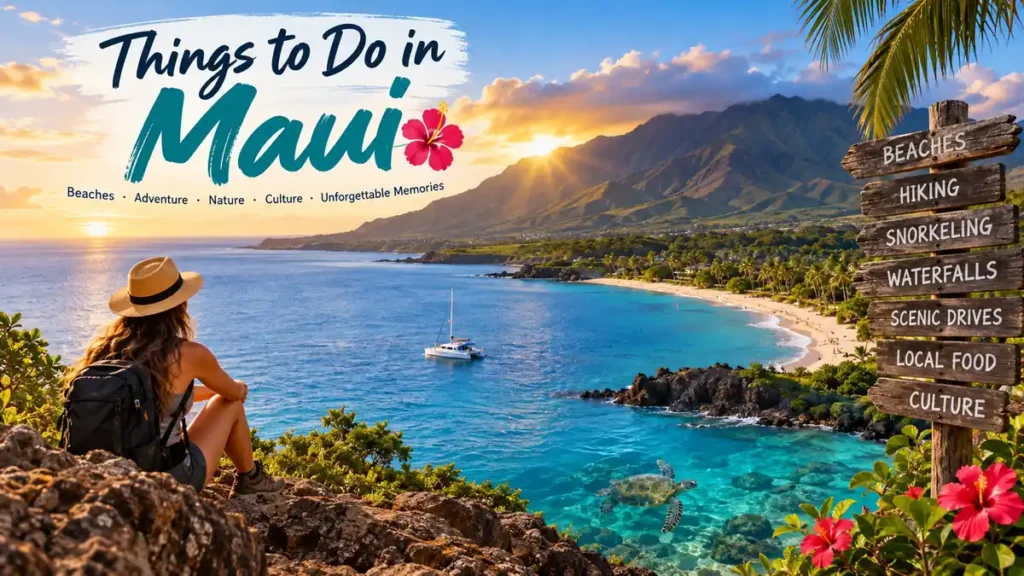
Maui can feel like several Hawaiian islands packed into one. Drive a few hours and you can move from sunny beaches and turquoise coves to misty rainforest, bamboo forests, volcanic desert, farms, waterfalls, and a summit more than 10,000 feet above the Pacific.
For first-time visitors, the best things to do in maui include exploring Haleakalā National Park, driving the Road to Hāna, snorkeling in clear Pacific waters, relaxing at Kāʻanapali and Wailea beaches, visiting Waiʻānapanapa State Park, hiking the Pipiwai Trail, discovering Upcountry Maui, experiencing Hawaiian culture, and watching humpback whales in season.
The challenge isn’t finding something to do. It’s deciding which experiences deserve your limited vacation time.
This guide covers Maui’s essential sights along with practical planning details that can make the difference between an incredible day and one spent rushing from place to place.
Best things to do in maui at a glance
If you only have a few days, prioritize experiences that show you different sides of the island rather than trying to check off every attraction.
| Experience | Best For | Area | Time Needed |
|---|---|---|---|
| Haleakalā National Park | Volcano views, hiking | Upcountry | Half/full day |
| Road to Hāna | Scenic driving, rainforest | East Maui | Full day |
| Waiʻānapanapa State Park | Black-sand coastline | Hāna | 1–2 hours |
| Pipiwai Trail | Bamboo forest, hiking | Kīpahulu | 2–3 hours |
| Kāʻanapali Beach | Swimming, sunset | West Maui | Half day |
| Wailea beaches | Relaxation, families | South Maui | Half day |
| Molokini snorkeling | Marine life | Offshore South Maui | Half day |
| Whale watching | Wildlife | Offshore | 2–3 hours |
| ʻĪao Valley | Scenery, short walks | Central Maui | 1–2 hours |
| Upcountry Maui | Farms, small towns | Upcountry | Half day |
| Hawaiian cultural experience | History and traditions | Various | Evening |
| Pāʻia | Food, shops, local atmosphere | North Shore | 2–3 hours |
1. Explore Haleakalā National Park
No Maui landscape prepares you for Haleakalā.
The enormous shield volcano dominates much of the island, but its summit feels almost detached from tropical Hawaiʻi. At higher elevations, beaches and palms give way to volcanic rock, cinder cones, native plants and expansive views above the clouds.
The Summit District reaches 10,023 feet. Temperatures can be dramatically colder than at sea level, particularly before dawn, so bring layers even when your hotel area feels hot.
Watch sunrise from Haleakalā
Haleakalā sunrise is one of Maui’s most famous experiences. The first light can illuminate layers of clouds and volcanic terrain while much of the island remains in darkness.
It requires more preparation than simply driving to the summit.
The National Park Service currently requires advance reservations for vehicles entering the Summit District from 3 a.m. to 7 a.m. Reservations can be released up to 60 days ahead, with another portion released two days ahead. A reservation is separate from the park entrance fee.
Reservations are specifically for sunrise access. Visitors do not currently need the same sunrise reservation for a normal daytime or sunset visit.
If waking up around 2 or 3 a.m. doesn’t sound appealing, don’t assume you’re missing Haleakalā. Visiting later in the morning or around sunset still provides extraordinary volcanic scenery.
Hike into the volcanic landscape
The summit isn’t only a viewpoint.
Trails descend into an environment of colorful cinder cones and old lava flows that looks remarkably different from Maui’s coastline.
Long hikes here demand preparation because of the elevation, sun exposure and substantial climbs involved in returning from the crater. Even a short walk from an overlook, however, reveals far more detail than you’ll see from a parking area.
Haleakalā also protects rare native species, including the striking ʻāhinahina, or Haleakalā silversword.
Quick Takeaway: Give Haleakalā several hours instead of treating the summit as a quick photo stop. The landscape becomes far more interesting once you explore beyond the main viewpoint.
2. Drive the legendary Road to Hāna
The Road to Hāna is less about reaching Hāna and more about everything along the way.
The route crosses Maui’s wetter northeastern side through tropical vegetation, waterfalls, coastal viewpoints and narrow bridges. Stops around Keʻanae, Hāna and Waiʻānapanapa turn the drive into a full-day adventure.
Although mileage alone can make the journey look short, don’t plan it like an ordinary highway drive. Winding sections and frequent stops consume most of the day.
A sensible Road to Hāna day looks like this:
- Start early.
- Fill your fuel tank before the remote sections.
- Select several priority stops rather than trying to see everything.
- Carry water, snacks and rain protection.
- Use designated parking areas.
- Allow local traffic to pass when safe.
- Avoid trespassing for waterfalls or viewpoints.
- Keep enough daylight for your return.
The official Hawaiʻi tourism site emphasizes that the journey itself is a major part of visiting Hāna, with beaches, cultural sites and natural attractions continuing beyond the town.
Should you drive to Hāna yourself?
You can, provided you’re comfortable with narrow, winding roads.
A guided trip can make sense for travelers who would rather watch the scenery than concentrate on driving. Independent travelers gain more flexibility but also have to manage parking, timing and road conditions themselves.
The common mistake is creating a list of 15 or 20 stops.
Pick a handful you genuinely want to experience. Maui is much more enjoyable when you’re standing beside a waterfall than racing to the next one.
3. See the black sand at Waiʻānapanapa State Park
Near Hāna, Waiʻānapanapa State Park protects one of East Maui’s most distinctive stretches of volcanic coastline.
The contrast is memorable: dark volcanic sand, deep-blue water, green tropical vegetation, lava formations and rugged cliffs.
But this is no longer a place where nonresident travelers should simply arrive unplanned.
Advance entry and parking reservations are required for nonresidents, and same-day admission should not be expected. Hawaiʻi’s state park system lists the park’s regular hours as 7 a.m. to 6 p.m.
Beyond the famous black-sand beach, look for sea stacks, native hala forest, coastal trails, blowholes and archaeological features.
The landscape is why you come; the beach is only one part of it.
4. Hike through bamboo on the Pipiwai Trail
Continue beyond Hāna toward the Kīpahulu District of Haleakalā National Park and you’ll discover an entirely different version of the park.
Instead of the dry volcanic summit, Kīpahulu is green, humid and lush.
The Pipiwai Trail is the signature hike.
The approximately four-mile round trip passes tropical vegetation and an impressive bamboo forest before reaching views of Waimoku Falls, which drops roughly 400 feet.
When wind moves through the bamboo, the stalks knock together above the trail, creating one of Maui’s most distinctive hiking experiences.
Wear footwear with decent traction because rain can make sections muddy and slippery.
Nearby are the Pools of ʻOheʻo. They remain an attractive landscape to view, but swimming in the pools is currently prohibited. The National Park Service specifically lists them as inaccessible for swimming.
Respect closures even if old travel articles or social-media posts show people in the water.
5. Spend a beach day at Kāʻanapali
Maui has so many beaches that choosing one can become its own project.
Kāʻanapali Beach is an easy starting point for first-time visitors. The long West Maui shoreline combines sand, swimming, resort facilities and beautiful sunset views.
It’s also convenient when you want a low-effort day between bigger adventures.
Conditions change daily, so assess the ocean before entering rather than assuming a normally calm-looking beach will always be calm.
Early mornings are often particularly pleasant. The sand is quieter, temperatures are comfortable and you still have most of the day ahead.
6. Explore the beaches of South Maui
South Maui gives you several beaches within a relatively compact area.
Kamaʻole beach parks around Kīhei are convenient for swimming and sunset, while Wailea offers attractive sandy beaches bordered by a more developed resort area. Mākena provides another striking section of South Maui coastline.
The Hawaiʻi Tourism Authority highlights Kāʻanapali, Mākena, Kamaʻole and Wailea among Maui’s notable beach areas.
If you’re traveling with children or inexperienced swimmers, choose the beach based on current conditions rather than reputation alone.
A beautiful beach with rough surf isn’t necessarily the right beach that day.
7. Snorkel Maui’s clear coastal waters
Snorkeling is one of the easiest ways to discover that some of Maui’s best scenery is underwater.
Depending on location and conditions, you may encounter coral, tropical reef fish and Hawaiian green sea turtles, known as honu.
Morning outings are often preferred because winds can increase later in the day.
Several parts of South and West Maui offer shore snorkeling, while boat trips reach offshore sites.
The essential rule is simple: observe marine animals without chasing, touching or crowding them.
Is Molokini Crater worth visiting?
Molokini is a crescent-shaped volcanic islet offshore from South Maui and one of the island’s best-known snorkeling destinations.
Its protected shape and offshore location can provide clear underwater visibility, although conditions vary from day to day.
A boat trip is most worthwhile if snorkeling is a major priority. If you simply want to spend an hour casually looking at reef fish, good shore snorkeling may be enough and saves a significant portion of your day.
That distinction matters when planning a short Maui itinerary.
8. Go whale watching in winter
Visit during whale season and the ocean becomes an attraction in its own right.
North Pacific humpback whales migrate to Hawaiian waters to breed, give birth and nurse calves. NOAA says humpbacks generally appear around Hawaiʻi from November through May, with abundance usually peaking from January through March.
Maui is particularly well positioned for whale watching because whales use the relatively shallow waters surrounding the Hawaiian Islands.
You can sometimes spot blows and breaches from shore, but a responsible boat trip offers a different perspective.
Federal rules prohibit approaching a humpback whale within 100 yards in Hawaiian waters.
If your trip falls outside whale season, don’t build your itinerary around seeing humpbacks. Choose snorkeling, paddling or another ocean activity instead.
9. Walk through ʻĪao Valley
ʻĪao Valley offers a quick transition from Maui’s developed central region into a steep, intensely green mountain landscape.
The valley is best known for Kūkaʻemoku, commonly called the ʻĪao Needle, a prominent vegetation-covered rock formation rising above the valley.
This is a good choice when you want dramatic scenery without committing to a long hike.
Clouds and rain are part of the experience here. Maui’s windward mountains collect moisture, producing the lush landscape that makes the valley so photogenic.
Because reservation requirements and temporary access conditions can change, check Hawaiʻi State Parks before your visit rather than relying on an old itinerary.
10. Discover Upcountry Maui
Visitors often picture Maui horizontally—beaches circling the island—but elevation is equally important.
Head uphill into Upcountry and the atmosphere changes.
Around Makawao and Kula you’ll encounter ranchland, farms, cooler temperatures and broad views toward the coast. This agricultural landscape offers a useful contrast to Maui’s resort districts.
Makawao retains connections to Hawaiʻi’s paniolo, or cowboy, history. Around Kula, farms take advantage of the volcanic slopes and cooler climate.
Upcountry works especially well when combined with a Haleakalā visit.
Rather than rushing directly from the summit back to the beach, leave time to explore the communities on the mountain’s lower slopes.
11. Explore Pāʻia and Maui’s North Shore
Pāʻia makes a natural stop before or after a Road to Hāna journey, but it deserves more than a fuel stop.
The compact North Shore town has restaurants, independent shops and an atmosphere noticeably different from Maui’s large resort areas.
Nearby beaches expose you to the windier North Shore.
Depending on season and weather, the ocean here can look dramatically more powerful than the protected resort beaches. Experienced surfers and wind-sport athletes may love those conditions; casual swimmers should be much more cautious.
Pāʻia is also an excellent place to try local food before heading deeper into East Maui.
12. Taste local Maui food
You don’t need an expensive restaurant reservation to eat well on Maui.
Food trucks, markets, bakeries, roadside stands and neighborhood restaurants can be just as memorable.
Look for foods with strong connections to Hawaiʻi, including poke, poi, laulau and fresh local fish. Maui also has agricultural products ranging from tropical fruit to coffee and produce grown Upcountry.
Food is one of the easiest ways to add local context to a beach-heavy itinerary.
Instead of eating every meal inside a resort, dedicate at least one lunch or dinner to a locally owned business away from your hotel.
It changes the experience of the island.
13. Learn about Hawaiian culture
Maui shouldn’t be treated simply as a collection of photogenic landscapes.
Native Hawaiian culture is fundamental to understanding the island.
Place names, traditional navigation, fishing, agriculture, music, hula and oral histories connect the landscape to generations of people who lived here long before modern tourism.
Even Haleakalā carries profound cultural significance. Visitors should treat sacred and culturally important areas as more than scenic backgrounds.
A cultural program or thoughtfully presented lūʻau can introduce Hawaiian history, food, dance and storytelling, but quality varies. Look for experiences that explain the traditions being presented instead of treating them only as entertainment.
You can also learn through historic sites, botanical gardens and cultural organizations.
The goal isn’t to “consume” Hawaiian culture in an evening. It’s to leave with a better understanding of the place you’re visiting.
14. Visit Lahaina respectfully
Lahaina was one of Hawaiʻi’s most historically important towns long before it became a major visitor destination.
The devastating August 2023 wildfire fundamentally changed the community. Recovery and rebuilding continue, so visitors should approach Lahaina differently from the way older Maui guides describe it.
Respect closures and private property. Don’t enter restricted areas simply to see fire damage, and remember that places appearing as tourist attractions in old articles may no longer operate in the same form.
When businesses are open and welcoming visitors, spending locally can help support the wider West Maui economy.
The useful mindset is simple: you’re visiting someone’s home and community, not a disaster site.
15. Paddle an outrigger canoe
For a water experience with deeper cultural roots, consider traditional outrigger canoe paddling.
Outrigger canoes descend from the voyaging and working vessels central to Polynesian life. Their lateral float provides stability while retaining a narrow, efficient hull.
Guided paddling experiences can combine time on the ocean with information about Hawaiian navigation, history and marine ecosystems.
Lonely Planet highlights outrigger canoe paddling along South Maui as a way to connect modern recreation with Hawaiʻi’s long canoe tradition.
For travelers who have already snorkeled or taken a boat cruise, paddling gives the ocean a completely different scale. You’re much closer to the water and moving under your own power.
16. Watch a Maui sunset
Some of the best things to do in Maui cost nothing.
Sunset is one of them.
West-facing beaches around Kāʻanapali, Kapalua, Kīhei and Wailea offer easy places to watch the light change across the Pacific.
Rather than arriving at the exact sunset time, get there 30–45 minutes early. Find a safe spot, put the phone down occasionally and stay after the sun disappears.
The colors often improve after sunset.
A sunset cruise provides wider ocean views, but you don’t need to board a boat to enjoy the experience.
A towel on the beach works perfectly well.
17. Go stargazing above the clouds
Haleakalā gets most of its attention at sunrise, but nighttime reveals another side of the mountain.
Its high elevation and dark surroundings can create excellent stargazing conditions when skies are clear. Stars that are difficult to see from brightly illuminated resort districts can become much more prominent at elevation.
The difference in temperature is substantial.
Pack warm clothing even if you spent the afternoon swimming. Wind at the summit can make the air feel much colder.
If you’re driving after dark, take extra care. The National Park Service notes that the summit road has sections without streetlights, and weather can be wet, windy and very cold.
18. Take an easy coastal walk
Not every Maui activity needs to occupy an entire day.
Coastal walking paths around the resort areas provide an easy way to enjoy beaches, lava-rock shoreline, sunsets and ocean views without complicated logistics.
These walks are particularly useful on arrival day, when jet lag or a long flight makes a major excursion unrealistic.
They’re also excellent in the morning before temperatures rise.
During whale season, carry binoculars. A casual coastal walk can unexpectedly become a whale-watching session.
19. Visit gardens and farms
Maui’s climate changes dramatically with elevation and rainfall, allowing a surprising range of plants and agricultural products to grow on the island.
Botanical gardens along the Hāna Highway showcase tropical species, while Upcountry farms offer another view of Maui’s agricultural landscape.
Farm experiences can involve pineapple, coffee, cacao, tropical fruit or other crops depending on location.
This is an especially useful activity for families or travelers who want a break from beaches and demanding hikes.
It also helps explain why Maui’s food culture is so closely connected to the island’s varied microclimates.
20. Make time to do nothing
This may be the most underrated Maui activity.
A common first-trip mistake is turning the island into an endurance test:
Haleakalā Monday. Hāna Tuesday. Snorkeling Wednesday. Whale watching Thursday. Hiking Friday.
By the end, you’ve technically seen Maui but barely experienced it.
Leave open time.
Spend a morning swimming. Read under a palm tree. Walk a beach without a destination. Stop when you find a food truck that smells good. Stay for sunset instead of driving to another attraction.
Maui rewards curiosity, but it also rewards slowing down.
Free things to do in maui
Maui can be expensive, but many memorable experiences don’t require a tour.
Good low-cost or free options include:
- Spending the morning at a public beach
- Watching sunset from South or West Maui
- Exploring Pāʻia
- Walking coastal paths
- Visiting scenic viewpoints
- Browsing local markets
- Exploring Makawao
- Looking for whales from shore during winter
- Enjoying a picnic near the coast
- Watching surfers from a safe shoreline viewpoint
Some parks charge admission or parking fees, so “outdoor” doesn’t automatically mean free.
A balanced itinerary with a few paid experiences and several independent days is usually more relaxing than booking tours every day.
Best things to do in maui with kids
Maui can work extremely well for families, but age and swimming ability matter.
For younger children, prioritize manageable activities such as calm beach mornings, short nature walks, farms, easy coastal paths and scenic stops.
Older children and teenagers may enjoy snorkeling, canoeing, Haleakalā, whale watching and selected hikes.
The Road to Hāna requires more thought. Long hours on winding roads aren’t enjoyable for every child, and squeezing too many stops into the day makes it harder.
Haleakalā sunrise presents a similar issue. A spectacular view may not compensate for waking a small child in the middle of the night.
For many families, a daytime summit visit is easier.
What should you not miss on your first Maui trip?
For a first visit, five experiences provide an excellent introduction:
- Haleakalā National Park for Maui’s volcanic landscape.
- Road to Hāna for rainforest and East Maui scenery.
- A South or West Maui beach day for the classic Hawaiian coastline.
- An ocean activity such as snorkeling, paddling or seasonal whale watching.
- A cultural or Upcountry experience to see Maui beyond its resorts.
You don’t need to visit every famous attraction.
If you have five days, one major experience per day is plenty. With seven days, alternating adventure days with slower beach or exploration days creates a much better rhythm.
When is the best time to visit Maui?
There isn’t one perfect month for everyone.
The official Hawaiʻi tourism site identifies April, May, September and October as particularly favorable periods for visiting Maui.
Your priorities matter more than finding a universally “best” date.
January through March: Excellent if humpback whales are a priority.
April and May: Useful for travelers seeking pleasant conditions outside the winter peak.
Summer: Popular for family vacations, with plenty of beach and ocean time.
September and October: Another attractive shoulder-season period.
November and December: Whale season begins developing again, alongside winter travel demand.
Maui also has strong microclimates. One side of the island may be sunny while clouds and rain cover another.
Don’t judge the entire day’s weather from your hotel balcony.
How many days do you need in Maui?
Five days is enough to experience Maui’s major highlights, but seven days gives the island room to breathe.
With only three days, trying to combine Haleakalā, the Road to Hāna, snorkeling, several beaches and Upcountry Maui will feel rushed.
For a first trip, seven days could look like this:
| Day | Suggested Focus |
|---|---|
| 1 | Arrival and nearby beach |
| 2 | Haleakalā + Upcountry |
| 3 | Beach + snorkeling |
| 4 | Road to Hāna |
| 5 | Relaxed morning + Pāʻia or local food |
| 6 | Whale watching in season or another ocean activity |
| 7 | Flexible beach, culture or ʻĪao Valley day |
The flexible day matters.
Weather, ocean conditions or simple fatigue can disrupt even a carefully designed itinerary.
Do you need a rental car in Maui?
For travelers planning to explore independently, a car makes Maui significantly easier.
Major attractions are spread across different parts of the island, and destinations such as Haleakalā, Hāna and Upcountry aren’t clustered around one resort center.
But renting a car doesn’t mean driving everywhere every day.
Group nearby attractions together. Combine Haleakalā with Upcountry, for example, or South Maui beaches with a snorkeling day.
For the Road to Hāna, confirm your rental agreement and road restrictions before choosing a route, particularly if you’re considering remote sections beyond the standard visitor drive.
Avoid using private land as parking simply because other cars are stopped there.
Maui reservations you should know about
One of the biggest differences between older Maui advice and current travel planning is the importance of reservations.
Two major attractions require particular attention.
Haleakalā sunrise
Advance reservations are required to enter the summit area between 3 a.m. and 7 a.m. for sunrise. The park remains accessible at other times under its normal entrance rules.
Waiʻānapanapa State Park
Nonresident visitors need advance entry reservations, with parking reservations required when arriving by vehicle. Walk-up or same-day entry should not be assumed.
Requirements can change, so verify official park information shortly before your trip rather than relying solely on an itinerary created months earlier.
How to experience Maui responsibly
The island’s natural beauty can make it easy to forget that these landscapes are ecosystems, cultural places and people’s neighborhoods.
A few habits make a meaningful difference:
- Stay on marked trails.
- Never cross private property for a waterfall or photo.
- Don’t touch coral.
- Give turtles, monk seals and whales plenty of space.
- Respect ocean warnings and lifeguards.
- Use legal parking areas.
- Don’t block narrow roads for photographs.
- Carry out your rubbish.
- Support locally owned businesses when possible.
- Follow closures even when social media shows other visitors ignoring them.
- Learn how to pronounce and understand Hawaiian place names rather than treating them simply as labels.
Haleakalā, Hāna and many other Maui landscapes carry cultural meaning that predates modern recreation and tourism.
Treating those places respectfully makes for a better visit, not a more restrictive one.
Final thoughts on things to do in maui
The most memorable things to do in maui aren’t all versions of the same tropical vacation.
One morning you can stand above the clouds at Haleakalā. Another day you’re surrounded by bamboo on the Pipiwai Trail. You can swim from a golden beach, see black volcanic sand near Hāna, paddle an outrigger canoe, taste local food in Pāʻia, explore Upcountry farms or watch humpback whales surface offshore.
The key is not trying to fit all of Maui into one trip.
Choose a few major adventures, leave room for beaches and spontaneous stops, make reservations for places that require them, and pay attention to the culture and communities behind the scenery.
That’s when Maui stops feeling like a checklist of attractions and starts feeling like an island you’ve actually experienced.