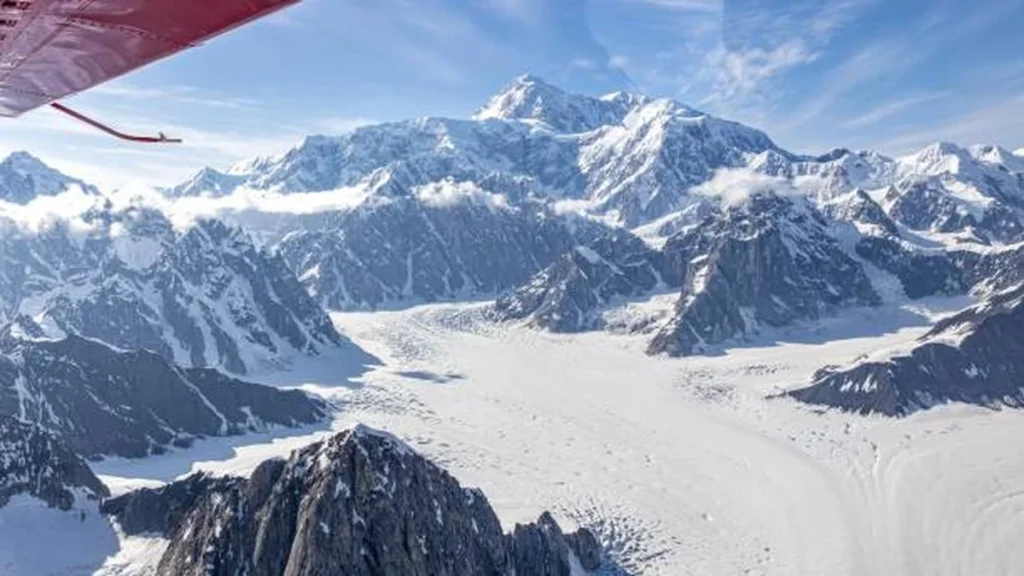
You can spend three days in Denali National Park and never see Denali. That’s not a scare tactic — it’s just physics. The mountain is so massive it builds its own weather, and only about 30% of visitors get a clear view of the mountain during their stay from the ground. Flightseeing is the workaround, and it’s the closest most travelers will ever get to a 20,310-foot summit that very few people ever stand on top of.
Denali flightseeing means boarding a small bush plane — usually from Talkeetna, sometimes from Healy or Anchorage — to fly within a few miles of Denali’s summit, over glaciers like the Ruth and Kahiltna, with an optional landing on the ice itself. Flights run 35 minutes to 3 hours, cost roughly $285–$615 per person in 2026, and remain weather-dependent even when everything else about your trip goes to plan.
What Is Denali Flightseeing, Exactly?
Ground-level views of Denali are limited by geography as much as weather. Denali Park Road is closed at mile 43 until 2027, and even the best road-accessible overlooks sit dozens of miles from the peak. A flightseeing plane closes that gap in minutes.
Small, high-wing aircraft — Cessna 206s and 185s, De Havilland Beavers, and similar bush planes — climb out of a valley airstrip and thread between granite walls that most travelers will only otherwise see in mountaineering documentaries. Every seat is effectively a window seat, and pilots narrate the route over a headset, pointing out glaciers, climbing routes, and the mountain’s various faces as conditions allow.
Quick takeaway: this isn’t a scenic charter flight in the airline sense. It’s low, slow, and close — you’re flying through the Alaska Range, not just over it.
Where to Fly From — Talkeetna vs. Healy vs. Anchorage
Three departure points serve almost all Denali flightseeing traffic, and each has a different relationship to the mountain.
Talkeetna is the traditional hub and where most operators are based. It sits roughly 60 air miles from the summit, and Talkeetna sits at just 345 feet elevation on the southern edge of the Susitna Valley, while Denali’s summit rises to 20,310 feet less than 60 air miles to the northwest. This is where the classic Ruth Glacier and Great Gorge routes originate, and it’s the closest thing Alaska has to a flightseeing capital.
Healy/Denali Park entrance flights depart from the Healy River Airport, right outside the park boundary. Fly Denali is the only scenic flight offered from the Denali National Park entrance area that lets you land on one of Denali’s pristine glaciers, which makes this the practical choice if you’re staying near the park entrance and don’t want the 2–3 hour drive to Talkeetna.
Anchorage/Lake Hood flights, offered by operators like Rust’s Flying Service, are the most convenient for travelers based in Anchorage, but they involve a longer approach across Cook Inlet and the Susitna flatlands before reaching the mountain, which means more flight time spent getting there rather than circling it.
A useful rule locals repeat: fly from wherever you are when the weather looks good. Waiting for a “better” departure point across the state often costs you a clear window that won’t come back.
Meet the Operators
| Operator | Base | Known For |
|---|---|---|
| K2 Aviation | Talkeetna | Rust family aviation heritage; wide range of route options up to 20,000 ft |
| Talkeetna Air Taxi | Talkeetna | Performs more glacier landings than any other company in the world |
| Denali Air | Denali Park area (private airstrip) | Nearly the entire flight stays inside park boundaries; roughly 50 years operating |
| Fly Denali | Healy | Only operator flying glacier landings directly from the park-entrance area |
| Rust’s Flying Service | Anchorage (Lake Hood) | Combines flightseeing with Anchorage-based logistics; also flies other Alaska routes |
All five run seasonal schedules, hold current FAA air-tour certifications, and build weather flexibility into their booking policies — but their routes and departure points differ enough that “which operator” often comes down to “which departure point fits your itinerary.”
Tour Types and Routes You’ll Actually Choose Between
Nearly every operator’s lineup boils down to three tiers:
- Entry-level south-side tour (60–75 minutes) — covers the Ruth Glacier and Great Gorge without necessarily circling the whole mountain. Good for a taste of the experience on a tighter budget or schedule.
- Mid-tier multi-angle tour (75–90 minutes) — adds views from additional sides of the mountain and typically passes the Kahiltna Glacier, the longest glacier in Denali National Park at 45 miles long and 3 miles wide, sometimes near the climbers’ base camp.
- Grand/circle tour (90 minutes–2 hours) — the most comprehensive option, often including the remote north side and the >Wickersham Wall, the greatest continual vertical relief in the world, weather permitting.
Any of these can usually be paired with a glacier landing, which adds time and cost but changes the tour from “flying past the mountain” to “standing on it.”
What Denali Flightseeing Costs in 2026
Pricing is fairly consistent across Talkeetna operators. Denali flightseeing tours from Talkeetna cost $285-615 per person in 2026 depending on flight duration and route coverage, with glacier landings adding $120-170 to the base price.
Breaking that down by tier:
| Tour Level | Duration | Price Range (flight only) |
|---|---|---|
| Entry-level (Ruth Glacier/south side) | 60–75 min | $285–$380 |
| Mid-tier (multi-angle + Kahiltna) | 75–90 min | $380–$490 |
| Grand/circle tour | 90–120 min | $475–$615 |
Add a glacier landing and expect another $120–$170, plus the park fee if you’ll be setting foot on National Park land. This costs $15 per person ages 16 years and older and is valid for 7 days. If you have an America the Beautiful Pass, you do not need to pay the park fee. A useful budgeting rule from current guidance: budget $520-640 per person total for the complete experience including a mid-tier tour with glacier landing, National Park entrance fee when landing, and ground transportation. Note that group size doesn’t typically lower the per-person rate — pricing stays flat whether you book alone or with a full planeload.
Glacier Landings — Worth the Extra Money?
A glacier landing turns the tour from a flyby into a full stop. Most landings happen near the Sheldon Mountain House, near the Great Gorge of the Ruth Glacier, the world’s deepest gorge, only about 11 miles from the top of Denali. Passengers typically get 20–30 minutes on the ice to walk around, take photos, and feel the scale of the surrounding peaks before reboarding.
It’s genuinely worth it if:
- You want tactile proof you were on the mountain, not just near it
- You’re comfortable with cold temperatures at elevation (bring layers)
- Your schedule and budget can absorb the extra time and $120–$170 cost, plus the park fee
It’s skippable if you’re tight on time, budget, or simply want the aerial views without the ground stop — the flyby routes alone already deliver the dramatic scenery most people are chasing.
Your Real Odds of Seeing the Summit
Here’s the part most tour operator sites gloss over: flightseeing dramatically improves your view, but it doesn’t guarantee the summit will be visible. Summit views occur on approximately 30% of flights, making flexible scheduling and backup days essential for 2026 planning. Pilots will still fly a spectacular route through glaciers and granite walls even when the top of the mountain is capped in cloud — but if seeing the actual summit is the goal, build in a buffer.
A few practical ways to improve your odds:
- Book your flight as early in your trip as possible. If weather cancels it, you’ll have days left to reschedule instead of one shot on your last afternoon.
- Consider a 3-day window in the area. Denali’s weather systems rarely last long, so you’ll probably get at least one day of good weather if you’re there for three.
- Don’t over-optimize for time of day. Morning departures offer slightly better statistical odds but no guarantees — Denali’s microclimate can clear or cloud over on its own schedule regardless of the hour.
What to Expect Onboard, and What to Wear
Aircraft are small — typically 3 to 9 passengers depending on the plane — and every seat has a real view, though the very front and very back often have the clearest sightlines without a wing strut or propeller in frame. One practical tip that keeps coming up in traveler reviews: pick a seat in the back of the airplane — you are less likely to get the propeller blades in your photos.
Dress in layers. It gets chilly inside the plane once you get up to 7,000 feet, and if you’re adding a glacier landing, temperatures on the ice can be noticeably colder than at your hotel that morning. Long pants and a warm layer are worth the extra bag space even on a warm Talkeetna afternoon.
There’s no universal weight limit across operators, but all of them weigh passengers and luggage before departure to balance the aircraft — expect to step on a scale at check-in, and don’t be surprised if the operator asks about your weight when booking.
Weather, Refunds, and When to Book
Because Denali’s weather can change by the hour, every reputable operator builds cancellation flexibility into their policies. Full refunds or free rescheduling for weather-related cancellations are standard, and some booking platforms add their own flexibility on top — as of recent booking terms, you can cancel your reservation up to 24 hours in advance and get a full refund through certain third-party platforms.
On timing: peak-season flights (roughly June through August) book out weeks to months in advance, especially for morning departures. If your trip dates are flexible, shoulder-season months like late May or September often combine easier availability with genuinely strong odds of clear mountain views.
READ MORE: Places to Stay in Bryson City: A Local’s Guide to Every Option
Is Denali Flightseeing Worth It?
For most travelers, yes — with realistic expectations. It’s the only way to get within a few miles of a summit that almost no one visiting the park will ever stand on top of, and the glacier scenery alone (the Great Gorge, the Ruth Amphitheater, the sheer granite of the Moose’s Tooth) is worth the price even on days the summit stays hidden.
Skip it, or treat it as optional, if you’re extremely budget-constrained, prone to motion sickness in small aircraft, or only have a single non-flexible time slot with no room to reschedule around weather.
Looking for more travel inspiration? Head over to Vucrex for more guides like this.
FAQ Section
Is Denali flightseeing worth it?
For most visitors, yes. It’s the closest most people will get to Denali’s summit and offers glacier and glacier-gorge views unavailable from the ground, though summit visibility still depends on weather.
How much does a Denali flightseeing tour cost?
Expect $285–$615 per person in 2026 depending on route and duration, with glacier landings adding roughly $120–$170 plus a $15 park fee if applicable.
What’s the best time of day to fly?
Morning departures have a slight statistical edge for clear summit views, but Denali’s microclimate can clear or cloud over at any hour, so flexibility matters more than a specific time slot.
Do I need to add a glacier landing?
No — flyby routes alone deliver dramatic scenery. Add a landing if you want to physically stand on the ice and have the extra budget and time.
What happens if weather cancels my flight?
Reputable operators offer full refunds or free rescheduling for weather cancellations, and some booking platforms allow cancellation up to 24 hours ahead for a full refund.
Can I see Denali by plane from Anchorage instead of Talkeetna?
Yes, operators like Rust’s Flying Service depart from Anchorage’s Lake Hood, though the approach involves more flight time crossing Cook Inlet before reaching the mountain compared to Talkeetna’s shorter route in.
Is there a weight limit for flightseeing tours?
There’s no fixed universal limit, but operators weigh passengers and bags before departure to balance the aircraft, so be prepared to step on a scale at check-in.
What should I wear on a Denali flightseeing tour?
Dress in layers with long pants — cabin temperatures drop noticeably above 7,000 feet, and glacier landings can be significantly colder than ground temperatures.